
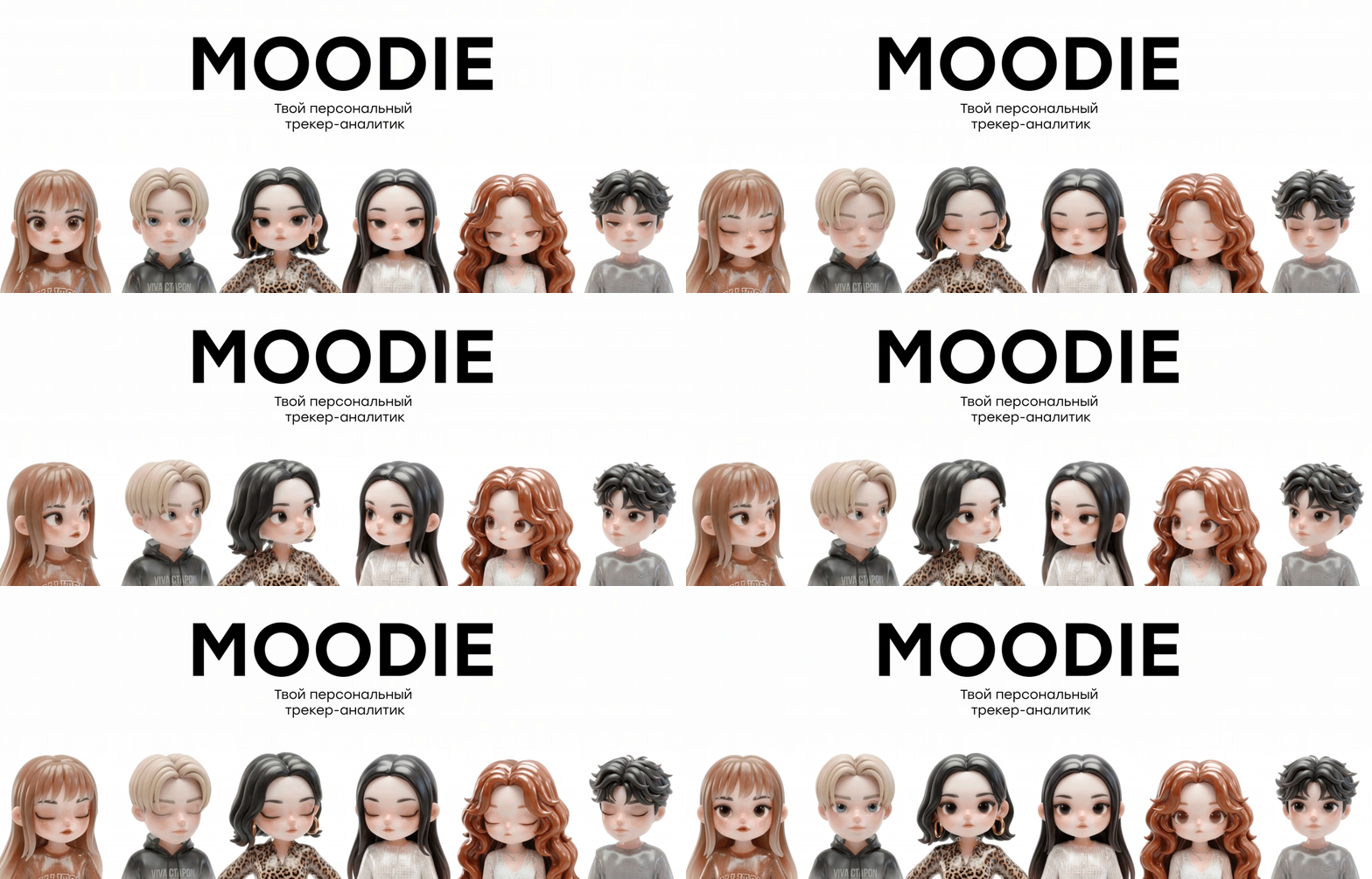
MOODIE is a digital diary of health and emotions that supports you every day. It helps you notice: fatigue, anxiety, good mood, increased energy, or hidden tension. The AI assistant is the basis of the application, and the visual character changes along with the user’s condition.

AI-generated image
the problem
In the modern world, we often forget to listen to ourselves, lose concentration and lose our goals.
decision
An application that combines an emotion diary, a planning system, and health recommendations. You capture moods, events, and thoughts in text, voice, or fast format. Moodie analyzes the data and carefully suggests what can help, for example, a breathing pause, a walk, meditation or adjusting the daily rhythm.
Our life is a narrative. According to Walter Fischer’s Narrative Paradigm, we perceive life not as a set of data, but as a story. Our «Diary» section helps you create narrative coherence in your life. By writing down thoughts and tracking trends, you turn the chaos of events into a clear story where you are the main character.
There is also a companion character who lives inside the interface. He understands you without words and reflects your emotional background, changing color and shape in response to the condition.
How communication theory works in design
In modern design, as well as in product development, we are moving away from intuitive creativity and moving towards science-based design. It functions as a full-fledged communication system that uses symbols, codes, contexts, and meanings as a language. This is consistent with the definition of communication proposed by Roger Griffin and Wendy Wood. In their understanding, communication is a connected and systemic process that creates meanings that are realized through the transmission of verbal and non-verbal signs embedded in the context. This is exactly what makes design not a decorative, but a meaningful practice.
AI-generated image
The designer works as the sender of the message. It encodes meaning in visual forms, interface, and interaction structure.
And the viewer or user becomes the recipient who performs the decoding. And there is always a risk of divergence of interpretations, which is indicated by the theory of decoding and encoding. Therefore, the design task is to minimize the «noise» of the system and create the most accurate transmission of meaning.
If an objective approach to communication seeks to predict reactions and structure variables, then design uses it in those aspects related to user scenarios, UX patterns, and interface ergonomics.
The logic of predictable behavior, testability of hypotheses, and quantitative verification
is applied here.
AI-generated image
The interpretive paradigm, on the contrary, allows you to work with meanings, emotional reactions, and cultural codes when an artist or designer allows multiple readings of their work. This corresponds to the phenomenological, semiotic, and critical traditions of Craig Calhoun: they help to understand the meaning of symbols, the role of the audience, and power relations within the media environment.
A modern health application, especially if it has an integrated emotional interface (like a companion character), inevitably combines both logics. It relies on data about the user’s behavior, condition, and habits, but at the same time creates a field of trust, empathy, and psychological support. By creating an interface, we don’t just draw pictures, we create a symbolic and secure environment that, according to Marshall McLuhan, is defined by technology as an extension of human senses and capabilities. This medium shapes how users perceive and interact with their own emotional world, turning raw data into a narrative of self-discovery and balance.
AI-generated image
Presentation of a brand for General Audience
In today’s world, we often forget to listen to ourselves. Moodie helps you build a more honest, attentive, and sustainable relationship with your own condition. This is a space where emotions become clearer, tasks become more realistic, and self-awareness becomes calmer.
AI-generated image
target audience
The target audience in the B2C segment is people for whom self-knowledge, productivity through rest («rest = part of success»), and the narrative of life as a story are important. They face problems of burnout, chaos, distracted attention, and notification anxiety. They are looking for a soft instrument without pressure. They need emotional support, as well as schedule optimization and planning. They are characterized by activity on social networks and daily habit fixation.
Examples:
Sasha (21 years old)A student who combines study and work. He is fond of fashion. Faces a lot of stress based on workload.
AI-generated image
Moodie communicates with B2C users through an empathic, narrative, and personalized approach, turning the app into a «companion friend» for everyday life. Communication focuses on emotional support and gentle engagement, trying to be unobtrusive.
The user sees himself as the hero of his story, like a Claude Fischer narrative, and the AI as an unobtrusive guide.
The companion character visually reflects emotions, creating a non-verbal connection that enhances trust without words.
AI-generated image
The app uses personalized notifications: short prompts like: «Will a breathing pause help now?» or «Will a walk bring back the rhythm» — based on real time and data. The frequency of such notifications is 1-2 times a day, with the «do not disturb» option to reduce fatigue. Text dialogues where the AI responds in a supportive manner: «I see it’s been a hard day. What will help?». The neural network also uses the user’s tone for a mirror response. Users will come back for emotional safety. This creates a focus on reflection: the app helps you think about emotions and goals on a daily basis. The «30 days with Moody» challenges are also suitable, where users share, enhancing the effect.
Moodi is positioned as a «natural medium» inside the everyday life of a smartphone. Integration into ecosystems: Apple Health, Google Fit, Telegram bot, widgets. The application lives in the same place as the user’s emotions — in a personal digital space.
Your choice and control. We know that sometimes it’s difficult to start a new habit. Our app enhances your sense of control over your behavior. We give you the tools to turn your intentions into real actions.
And it’s more than an app, it’s a friend who’s always there. Thanks to the effect of social presence, you will feel that you are communicating with a real interlocutor. It changes shape and color, reacting to your condition. This creates a feeling of closeness and reduces the psychological distance. You are not alone — you are understood.
Presentation for a professional audience
Moodiе presents a product that is embedded in modern communication logic, catering to UX, psychology, digital health, and research professionals. This is not direct communication, but rather an intelligent filter for data and meaning. AI reduces cognitive noise through multi-layered processing, turning information accumulation into the management of meaning.
AI-generated depiction of a user and an AI prototype from the MOODI application
The application creates new practices, such as daily attention to emotions, prioritizing «rest as part of productivity,» and thematizing data: energy, stress, recovery. It embodies agenda-setting — it does not dictate thoughts but directs attention.
The interface helps reduce anxiety by framing emotions as organic forms and data as dynamic stories meaning. AI comments provide support, according to McLuhan. Moodiе is a new medium for self-communication, where emotional data creates an interactive environment for rethinking life within the digital well-being ecosystem.
Cultivation theory emphasizes the long-term effect of maintaining an emotional diary, creating an emotionally secure environment, and daily reflection, which is ideal for psychologists, coaches, clinics, and wellness programs. The uses and gratifications approach balances utilitarian needs planning with affective emotional support, adapting to distracted attention.