Concept
Henri Rousseau was a French self-taught artist who operated outside the traditional academic art movement and was long perceived by parts of the professional community as an unserious artist. Before beginning his artistic career, Rousseau worked as a customs official, and he took up painting in his later years without specialized art training. His works were characterized by simplified perspective, flat imagery, unusual proportions, and a rich color palette, which drew criticism from his contemporaries.
Despite initial rejection, Rousseau’s creative work later gained recognition and secured a significant place in art history. The artist developed his own visual language, rooted in depicting fantastical tropical landscapes, dense vegetation, exotic animals, and imagined spaces. His understanding of tropical nature was primarily shaped by Parisian botanical gardens, zoos, illustrations, and other visual sources, rather than personal travels.
The choice of this topic stems from an interest in the work of artists operating outside the established academic system and in the process by which their artistic language was subsequently recognized. Of particular interest is the further transformation of Rousseau’s pieces outside of the museum setting and into contemporary fashion. His motifs—color combinations and depictions of fantastical nature—become a source of inspiration for designers who interpret them in prints, embroidery, textures, and garment silhouettes.
The visual research will be built upon works by Henri Rousseau, archival materials, photographs of the artist, exhibition documentation, as well as images from fashion collections and specific portrayals of contemporary designers.
The selection of Rousseau’s works will take into account their significance for understanding the author’s individual artistic language. Special attention will be given to works where the characteristic features of his painting are most vividly expressed: tropical landscapes, depictions of animals, decorative vegetation, flat composition, and his distinctive color palette.
The research will include works from different periods of the artist’s career, allowing for a tracing of the formation and development of his visual language. Particular attention will be paid to the works that achieved the greatest renown, including «The Dream» (1891), «Sleeping Gypsy» (1897), «Snake Charmer» (1907), and «The Dream» (1910).
The second part of the visual material will focus on the interpretation of Rousseau’s work in contemporary fashion. Collections by designers that reference his works, specific artistic motifs, or the characteristic aesthetic of tropical landscapes will be selected for analysis. Priority will be given to instances where the connection to the artist’s work is confirmed by the artist’s own comments, collection publications, or other reliable sources.
The visual materials will be compared based on the principle of «artwork and its fashion interpretation.» This approach will allow me to identify precisely which elements of Rousseau’s pictorial language transition into clothing and how they transform when moved from one visual medium to another.
The research will be built upon biographical and art historical publications, museum archives, exhibition catalogs, academic articles, and materials from specialized fashion publications.
To study Rosso’s biography and artistic legacy, materials from museum institutions that hold his works—specifically the Museum of Modern Art (MoMA) in New York and the National Gallery in London—will be utilized. When analyzing the historical context, particular attention will be paid to publications concerning naive art, art criticism from the late 19th to early 20th centuries, and the processes by which self-taught artists gained recognition.
To investigate the connection between Rosso’s work and contemporary fashion, publications from specialized trade magazines, fashion show archives, and materials dedicated to specific collections will be consulted.
The textual sources will serve to verify historical facts, clarify the context of the works' creation, and confirm the relationship between art and fashion. The information gathered will be cross-referenced with visual materials to avoid an exclusively subjective interpretation of the artistic imagery.
Navigation
Concept1. Who was Henri Rousseau? His biography and path to art 1.1. Childhood and Youth (1844–1868) 1.2. Work in Customs and First Steps in Art (1869–1885) 1.3. Beginning of an Artistic Career (1886–1892) 1.4. Full Transition to Art and Avant-Garde Recognition (1893–1905) 1.5. Later Years and Recognition (1906–1910)2. Key Features of Rousseau’s Artistic Language 2.1. Flatness and Conventional Perspective 2.2. Decorative Flora and Ornamentality 2.3. Saturated Palette and Color Contrast 2.4. Fantastic Animals and the Merging of Reality with Imagination 2.5. Naive Style, Clear Outline, and Form Simplification3. Henri Rousseau’s Recognition: From Contemporary Mockery to Avant-Garde Acclaim 3.1. First Exhibitions: The Artist Outside the Academic System (1885–1890s) 3.2. Recognition from the Art Avant-Garde (1890s — Early 1900s) 3.3. The Banquet in Honor of Rousseau at Picasso’s (1908) 3.4. Later Recognition: Rousseau Becomes a Prominent Figure in Art Life (1909–1910) 3.5. Posthumous Recognition and Inclusion in Art History (1911–1930s)4. Henri Rousseau in Modern Fashion: The Influence of His Artistic Language on Designers 4.1. Hermès Spring/Summer 2014 4.2. Shivan & Narresh Resort 2016 4.3. KENZO FALL 2018 READY-TO-WEAR 4.4. Rahul Mishra, Fall 2025Conclusion
1. Who is Henri Rousseau? His biography and artistic journey
Photo by Henri Rousseau
1.1. Childhood and Adolescence (1844–1868)
Henri Julien Félix Rousseau was born on May 21, 1844, in the town of Laval, western France, into a modestly means family.
Rousseau grew up in a humble family and received a standard education. He attended a lyceum in Laval, where he showed particular aptitude for drawing and music.
In his youth, Rousseau did not choose an artistic career. For a period, he worked in a law office, and in 1863, he enlisted in the military. Contrary to some legends, the artist did not participate in the Mexican military campaign, nor did he ever travel outside of France.
Military service ended following his father’s death in 1868. After this, Rousseau moved to Paris.
1.2. Work in Customs Service and First Steps in Art (1869–1885)
Henri Rousseau, «Customs House,» 1890
In 1871, Rousseau was employed by the Parisian municipal service, Octroi. This office was responsible for collecting tariffs on goods imported into the city. It was this position that later led to him acquiring the nickname «Le Douanier,» or «The Customs Officer.»
During this period, he began to practice painting independently. He did not have formal academic art training; his professional skills were developed through self-study of art.
In his free time, Rousseau visited the Louvre, copied works by Old Masters, studied images in books and magazines, and sketched the plants and landscapes of Paris.
In 1884, he received permission to make sketches in the national museums. This became an important part of his independent artistic education.
In 1885, Rousseau first exhibited his work by submitting two pieces to the Paris Salon.
1.3. Beginning of an Artistic Career (1886–1892)
In 1886, Rousseau first participated in the Salon des Indépendants. Unlike traditional academic exhibitions, the Salon des Indépendants did not employ a jury to select participant works. This allowed Rousseau the opportunity to regularly exhibit his paintings.
During this period, he continued his work in municipal service while simultaneously developing his own painting practice.
It was then that the characteristic features of his artistic language gradually took shape: conventional perspective, simplified forms, rich colors, and an unusual combination of realistic details with fantastic narratives.
In 1891, Rousseau painted «Surprised!», which became his first major work depicting tropical jungles. This subject matter would later become the most recognizable element of his work.
Henri Rousseau, «Encounter in the Jungle» (Surprise!), 1891
1.4. Full transition to art and recognition as avant-garde (1893–1905)
In 1893, at the age of 49, Rousseau retired and fully dedicated himself to painting.
That same year, Rousseau met the writer and artist Alfred Jarry, who introduced him to the circle of Parisian literary and artistic bohemians.
Gradually, artists and writers of the new generation became interested in his work. Among those who supported or highly valued his creativity were Pablo Picasso, Guillaume Apollinaire, and Robert Delaunay.
In 1897, Rousseau created one of his most famous paintings—“The Sleeping Gypsy.» It already clearly demonstrates his interest in fantastical spaces and unusual combinations of reality and imagination.
In 1905, Rousseau exhibited his works at the Autumn Salon in Paris. At that time, the art world was undergoing massive changes associated with the emergence of Fauvism.
Henri Rousseau, «The Sleeping Gypsy,» 1897.
1.5. Later Years and Recognition (1906–1910)
In the later years of his life, Rousseau gradually gained wider recognition among members of the Parisian avant-garde. In 1907, he created «The Snake Charmer, ” one of the most famous paintings depicting fantastical tropical nature. In November 1908, Pablo Picasso hosted a grand banquet in his Montmartre studio in honor of Rousseau. Artists, poets, and other figures from the Parisian art scene attended the gathering. In 1909, art dealer Wilhelm Ude organized the artist’s first solo exhibition. In 1910, the artist created the equally famous painting „Dream, ” and that same year, on September 2, Henri Rousseau died in Paris. In 1911, even after his death, the Salon des Indépendants organized a retrospective exhibition of his work.
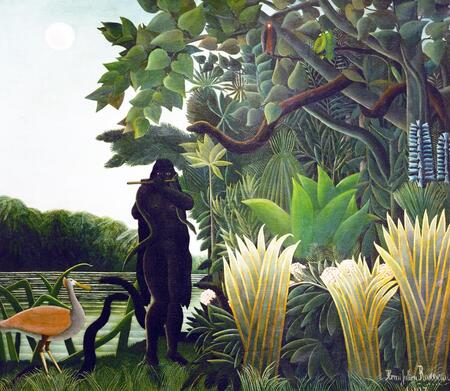
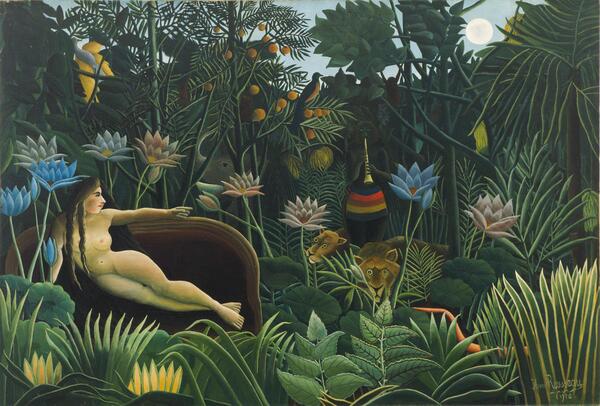
Henri Rousseau, «Snake Catcher,» 1907. Henri Rousseau, «Dream,» 1910.
2. Core Characteristics of Rousseau’s Artistic Language
2.1. Flatness and Conventional Perspective
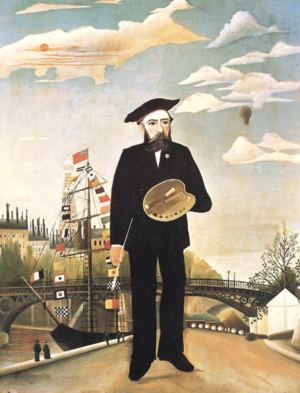
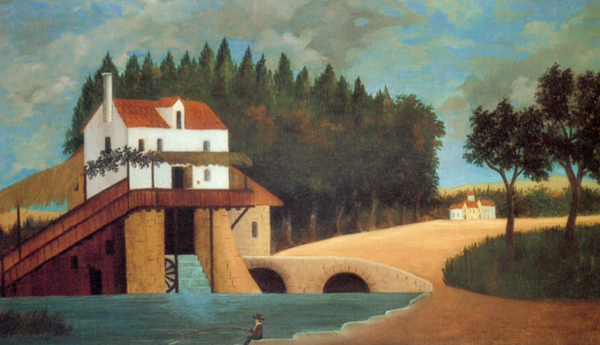
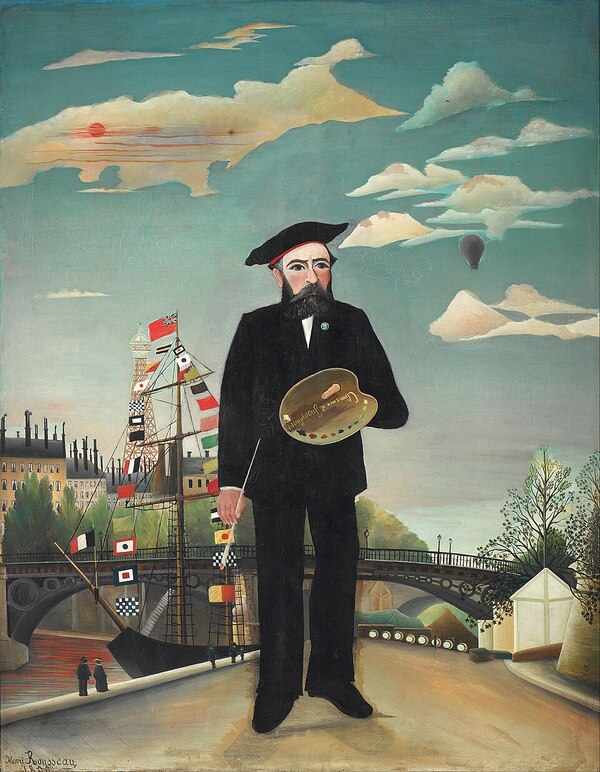
Henri Rousseau, «Self-Portrait,» 1890 Henri Rousseau, «The Mill,» c. 1896
2.2. Decorative Vegetation and Ornamentation
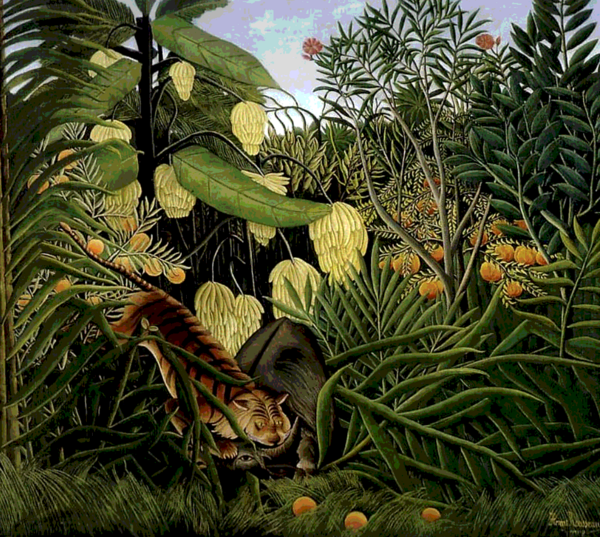
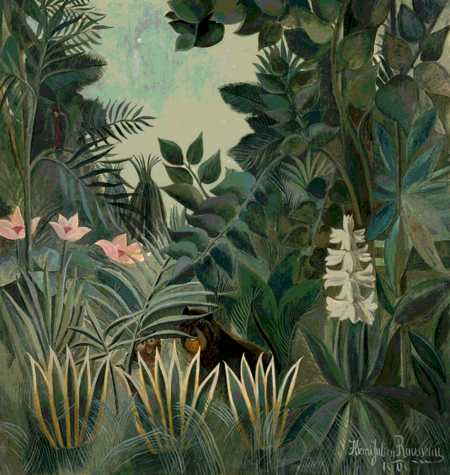
Henri Rousseau, «Jungle in the Tropics. Battle of a Tiger and a Bull, ” 1908. Henri Rousseau, „Jungles on the Equator, ” 1909.
2.3. Rich Palettes and Color Contrasts
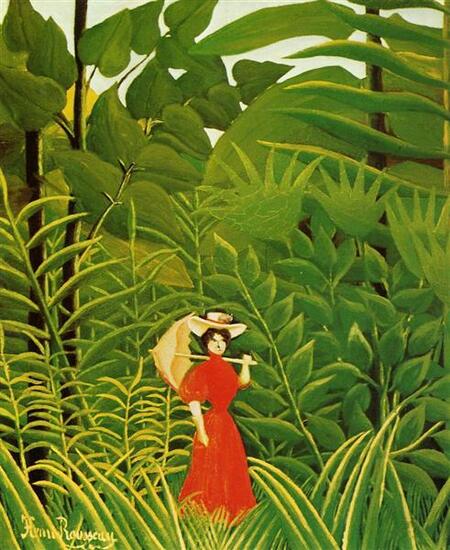
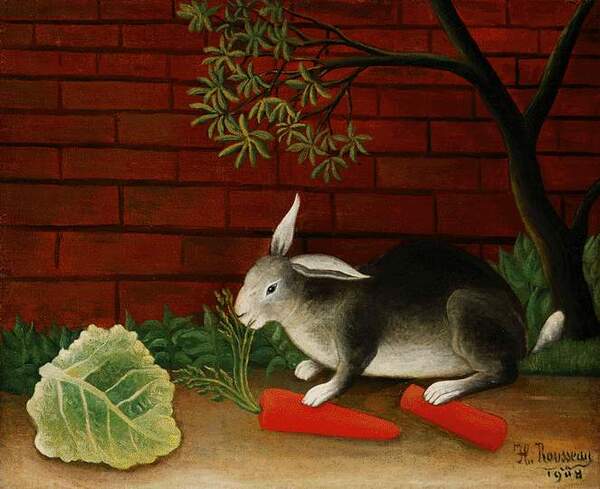
Henri Rousseau, «Woman in Red in the Forest, ” 1907. Henri Rousseau, „Rabbit, ” 1908.
2.4. Fantastic Animals and the Convergence of the Real and the Imagined