Antiquity carved in stone. Reinterpretation of ancient models in the sculpture of Niccolò Pisano. Italy, 1260–1268.
Introduction and Concept
In the 13th century, marble sculpture in Italy became a way to synthesize several artistic languages. In the works of Nicola Pisano, ancient forms intersect with Gothic architecture and Christian narratives. This resulted not in a copy of antiquity, but in a new method of storytelling in stone.
Nicola Pisano is often called one of the masters who rekindled interest in classical sculpture. However, the term «revival» here does not imply a complete return to the art of Ancient Rome. Antique poses, figures, and compositions become the material for a new Christian art.
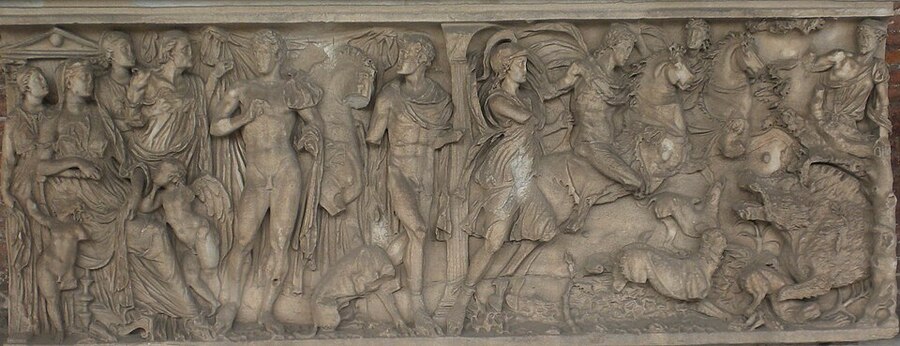
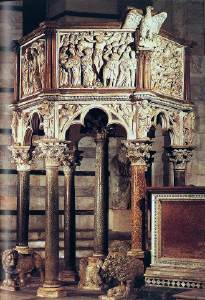
Nicola Pisano and Workshop. Pisano Baptistery Department. 1260, Roman Workshop. Sarcophagus with the story of Phaedra and Hippolytus. 2nd century AD.
This research focuses not on Italian sculpture of the 13th century as a whole, but specifically on the artistic method of Nicola Pisano. The primary materials are the Department of the Pisa Baptistery from 1260 and the Department of the Siena Cathedral from 1265–1268. An additional example is the Ark of Saint Dominic in Bologna.
How does Nicola Pisano reinterpret classical plastic and compositional models in Christian relief? It is important to understand not just which motifs he borrows, but also what changes when classical form acquires a new religious content.
Nicola Pisano’s antique models do not function as literal quotations. Instead, they help lend weight, conviction, and plastic expressiveness to figures, and complex composition to multi-figure scenes. In this process, the meaning of these forms shifts—they begin to narrate a Christian story.
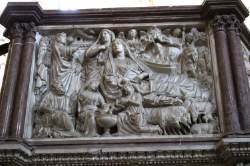
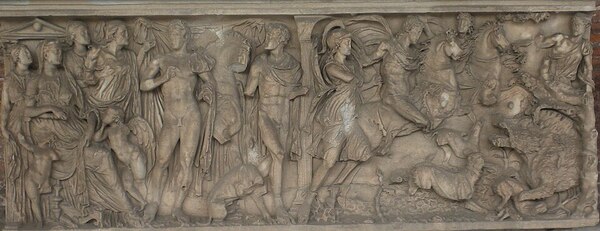
Nicola Pisano and Workshop. Relief: «The Annunciation, the Nativity, and the Adoration of the Shepherds.» 1260, Roman workshop. Sarcophagus with the story of Phaedra and Hippolytus. 2nd century CE.
The chronological framework for the main body is 1260–1268. This period covers two of the master’s most significant departments in Pisa and Siena. Ancient monuments are considered only as visual examples against which individual figures and compositional solutions are compared.
The structure is typological. First, the ancient sample and the principle of working with the human body are examined. Next, individual Christian subjects in Pisa are analyzed. Finally, two departments are compared, tracking how the plastic language becomes richer and more dramatic.
Section I. Pisa and Ancient Sculpture
Pisa was a major commercial and political center. Ancient monuments remained in the city, visible not only in ruins but also integrated into the urban environment. For an artist, this meant that antiquity was not an abstract history but an integral part of the surrounding visual world.
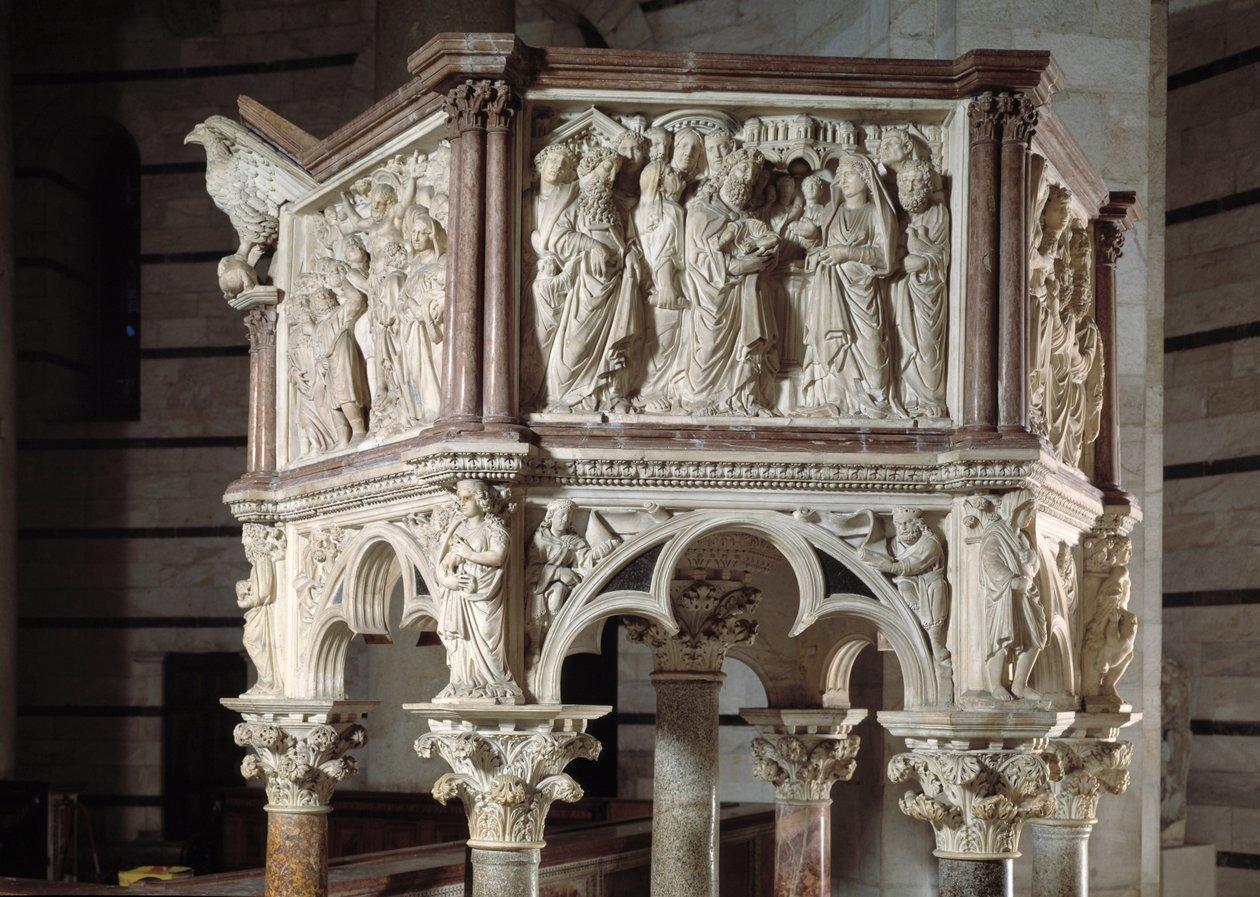
The Pisa Baptistery Department was intended for preaching, yet its form transcends that of a mere utilitarian object. It is organized as a self-contained architectural and sculptural structure: columns, arches, figures, lions, and narrative reliefs function as a single unit.
The Nicola Pisano Department, crafted from marble and dated to 1260, features a hexagonal top supported by seven columns. Five sides are adorned with large reliefs depicting episodes from the life of Christ. One side provides access via a staircase.
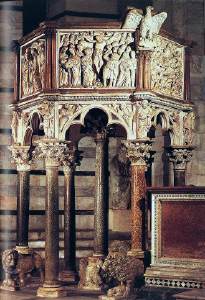
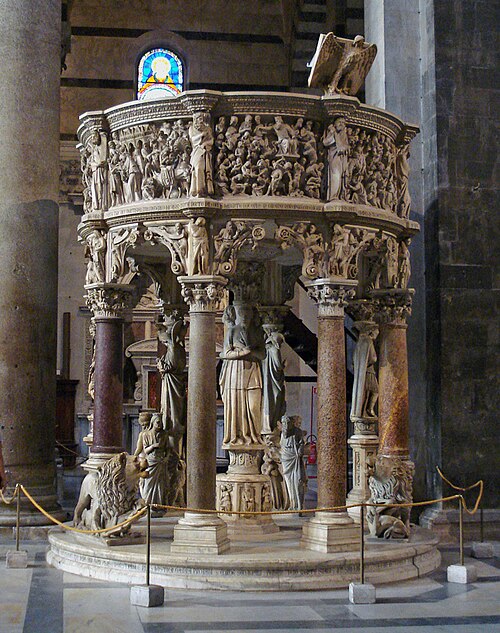
Nicola Pisano and the workshop. Pisano Baptistery Department. 1260. Marble, approximately 15 feet 5 inches high. St. John’s Baptistery, Pisa.
At the base and in the supporting structure, columns, arches, lions, and figures connect. The three outer columns rest on lions, reminiscent of earlier medieval traditions. The upper section, meanwhile, is arranged as a unified narrative band. Here, the ancient and medieval elements do not conflict—they support one another.
The relief cycle encompasses the Annunciation, the Nativity, the Adoration of the Shepherds and Magi, the Presentation, the Crucifixion, and the Last Judgment. Several episodes may be combined within a single field. This allows the surface of the department to be perceived as a continuous narrative rather than a collection of isolated images.
In Camposanto in Pisa was a Roman sarcophagus with the story of Phaedra and Hippolytus. Dating to the 2nd century CE, it was accessible for viewing in the urban environment. It serves as an important object of comparison for research: the reliefs in the Department feature forms reminiscent of the figures and poses found on the sarcophagus.
On the sarcophagus, the figures are assembled into a dense narrative composition. The drapery, the turns of the bodies, and the gestures create a sense of movement within the confined relief field. It is important not to look at the mythological plot in isolation, but rather at how the bodies are organized and how they relate to one another.
In the relief «The Annunciation, Nativity, and Adoration of the Shepherds, ” the figure of the reclining Mary recalls the image of Phaedra on an ancient sarcophagus. Pisano utilizes a massive, calmly posed figure but alters its narrative function. The ancient motif becomes part of the scene of the Nativity of Christ. This is not imitation, but rather the transposition of a visual model into a new context.
In the Pisan relief, several episodes are situated within a single space. The viewer reads the sequence through the characters' gestures and placement. This approach differs from the strict division of scenes into small frames. Yet, the figures maintain a sense of solemnity and a clearly legible composition.
Nicola Pisano and the workshop. Relief «Adoration of the Magi.» 1260.
In the scene of the adoration of the Magi, Mary with the infant occupies a compositionally vital space. The Magi approach them, and the accompanying figures and animals expand the narrative. The Virgin’s posture once again demonstrates Pisano’s interest in a stable, monumental figure, which can be compared to ancient examples.
In the interpretation of the Magi veneration relief, the three Magi can be read as representing the three stages of human life. This enhances the themes of time and the human life within the Christian scene. This layer of meaning demonstrates that the relief operates not only through resemblance to antique forms but also through a complex system of values.
Nicola Pisano and the workshop. Relief: «Encounter in the Temple.» 1260. Marble. Department of Pisano Baptistery.
The bas-relief «Encounter in the Temple» is particularly important to the research theme. It features figures with distinct individuality, an architectural backdrop, and a dense group of characters. Space is created through the overlapping of figures and their placement on different planes. The stone conveys not only contour but also the weight of the body.
In art-historical interpretation, the heads of the prophetess Anna and Saint Elizabeth in the Web Gallery of Art are compared to the figures on the sarcophagus of Phaedra and Hippolytus. Here, the emphasis is not on an exact replica, but on the expressiveness of the aged face—the wrinkles, the tilt of the head, and the emphasized features lend the characters a vital conviction.
In the same relief, researchers perceive the reworking of the ancient motif of the old Dionysus supported by a satyr into the figure of Simeon with his helper. This connection should be presented as an art-historical interpretation of a specific prototype, not as an undisputed fact. The main point here is the manner in which the posture and the supporting group are transferred into the Christian narrative.