Original size 2305x3240

Communication strategy: «Harvest»

PROTECT STATUS: not protected
This project is a student project at the School of Design or a research project at the School of Design. This project is not commercial and serves educational purposes
big
Original size 3840x2160
big
Original size 1920x1080

How communication theory works in the Field of Design
big
Original size 3440x1440

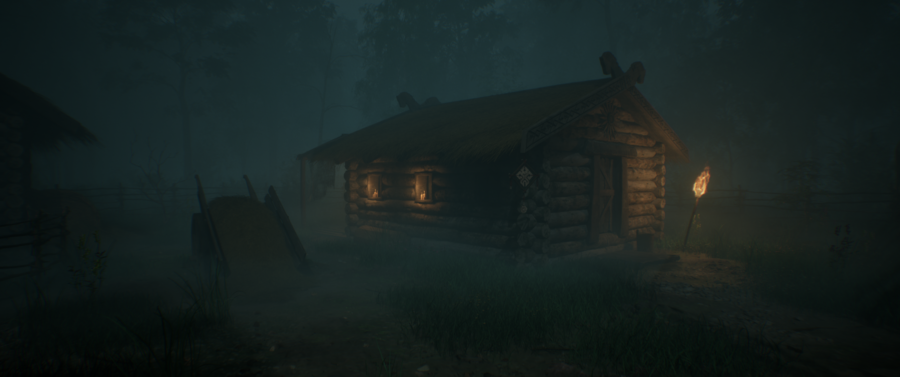
HARVEST is a realistic first-person survival horror game. A royal herald arrives in a pagan village with his retinue to convert the people to a new faith. But due to an unfortunate accident, the pagans' interest turns into a desire to deal with the uninvited guests. However, human anger is not the most frightening thing the hero will encounter on his path to redemption.

Engine: Unreal Engine 5 Platform: PC Perspective: first-person view Age rating: 18+

Game design is a communicative act between the designer and the player—a process of creating and interpreting messages. When we design mechanics, write sound, and build narratives, we encode intentions. The player, as the recipient, decodes them through their own cultural background, experience, and context.

Another distinctive feature of games is that, unlike other media, we move from the level of an outside observer to that of a full-fledged actor, making choices and decisions. This is gameplay.

Original size 3440x1440

The semiotics of the game

Each element is a symbol waiting to be decoded:

• Visual language speaks through color, light, architecture, and animation;

• Mechanics convey possibilities (actions) and limitations;

• Sound design sets the emotional tone: it keeps you in suspense;

• Narrative fills mechanical actions with meaning and sets the context, as well as providing a field of interpretation for the player.

The game becomes a semiotic system where the designer’s intention meets the player’s interpretation. The gap between them is the game.

Semiotics helps create signs that players read intuitively (carved symbols, pillars, talismans), while affordances ensure that the world invites the player to take meaningful actions and shows that it is also in constant dynamics and dialogue with them.

Original size 2468x1388
Original size 3168x1782

Several examples of affordances

• An amulet is not just decoration: its shape, thread color, location, and subtle sound accent form a multimodal sign that says «this house is protected, ” and removing the amulet becomes both a mechanical task and a symbolic violation to which the game responds.

• Tall grass visually invites you to hide.

• A broken, bent fence shows that you can jump over it, unlike a high stockade.

• The loud, muffled footsteps and distorted speech coming from the monster walking through the village cause fear even before you meet it. We sense a force superior to us and try to avoid an encounter for as long as possible.

The player, like the royal herald who has found himself in an unfamiliar pagan environment, learns to read the signs of this hostile and wild world.

Original size 3440x1440

Presentation for a general audience

Original size 3440x1440

Setting and narrative

988 AD. The Christianization of Kievan Rus'.

The main character of Harvest is a herald who carries out the royal’s order to convert pagans to the new faith, visiting large settlements with his retinue. He is pragmatic, treating the task more as a job.

The hero and his retinue arrive at one of the many settlements, paying little attention to the amulets on the houses and trees. But he soon realizes that rituals and symbols are not relics of the past.

After accidentally killing one of the local residents, the main character sets off a chain of bloodshed. First, he loses his retinue in a violent massacre at a feast. Then, during the ritual, he is hunted down by a risen dead man—the Ghoul. Being wounded and humiliated, the hero tears all the amulets from the houses and turns the wrath of the vengeful monster against the pagans themselves.

The herald escapes into the forest. Now his only goal is to find a way out. But nature, physically embodied by Leshy, will not let the hero go until he has completed his journey of atonement.

Forest

The settlement is surrounded by forest. Each part of it is under the control of one of the mythical creatures: the Water Spirit rules the swamp, and the Midday Spirit rules the fields. The Forest Spirit is a fair judge and guardian of peace, standing above everyone as the physical personification of nature.

Original size 2640x1804

Game task for Act 1

The player tears down all the amulets and lays them out at the pillar in the ritual square, burning all the village’s protective artifacts. At the same time, he is chased by the Ghoul. The player uses game objects to avoid colliding with the monster and distracts it by spilling the blood of fallen comrades.

Original size 1920x1920

Amulet for the interior

Original size 832x899

A totem table lamp

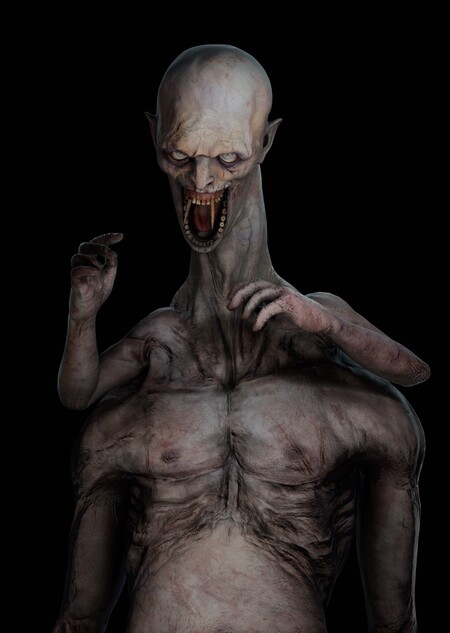
Ghoul

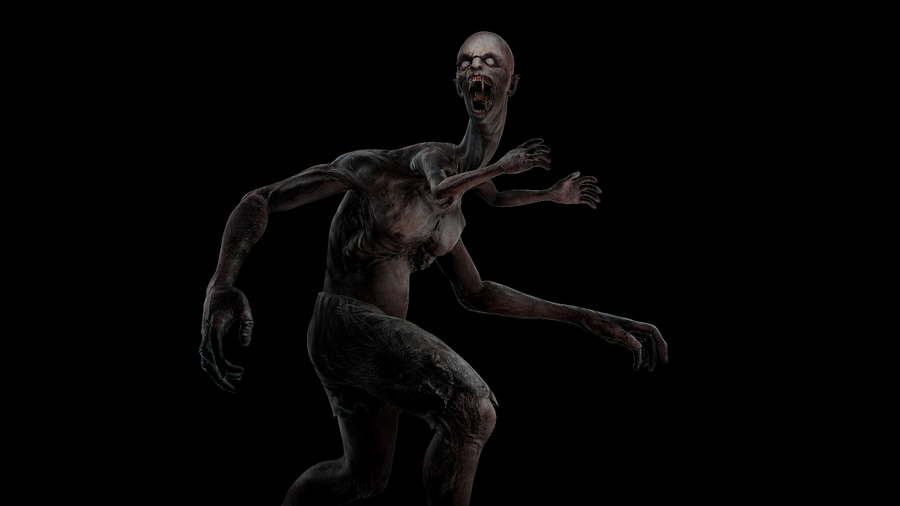
The boss of the first act of the game. He patrols in searching for the player, but with good stealth, he goes to another part of the village or hides himself. When the player makes noise, the Ghoul comes and searches more actively. The monster senses the area where the player is located, so when there is a sound alert, he walks nearby. If the Ghoul spots the player, he will start chasing them, quickly increasing his speed. In open areas, the only way to stay alive is to dodge the Ghoul’s jump. But you can also get away from him by jumping over fences, carts, and other objects that the monster crashes into while running.

Original size 2362x2708

Poster

Presentation for a professional audience

Original size 3840x2160

Сoncept art of swamp location

Target audience

The rating is 18+, and the target audience is fans of horror and story-driven games on PCs and consoles who appreciate suspense, folklore, and the emotional complexity of choice.

Original size 3440x1440

The Idea

Conceptually, Harvest combines two main aspects:

Aesthetic immersion, which we achieve through realistic graphics, detailed animations, cinematic lighting, and sound design.

Diverse gameplay: each episode of the game will have a different killer feature and focus so the player doesn’t get used to monotonous gameplay and has to adapt to new enemies.

• The Ghoul is a patrolling enemy with sharp hearing and dangerous chasing abilities, but the player is equipped with tools to slow it down. Killer feature: spilling the blood of the guards.

• Water Spirit: an enemy that requires the player to calculate timing and positioning: you need to choose the time and route to get through the swamp and not be caught.

Original size 1920x954

Сoncept art of a ghoul

Enemy AI (Ghoul):

• Perception: Fields of view (central 70°, peripheral 180°, back 30%);

• Behavior states: patrol → alertness → chase → recovery;

• Learning: detects the player’s scent; predicts movements based on past encounters;

• Stamina: unlimited; the player’s advantage is agility, not stamina.

Player movement:

• Actions: walking, running, sprinting, sliding, sneaking, jumping;

• Stamina loss: 8–15 seconds of continuous running before fatigue;

• Recovery: 4 seconds of walking — full stamina recovery.

Original size 1920x985

Interface philosophy

Minimal HUD to preserve immersion. By default, only the crosshair in the center is displayed.

Inventory — [TAB], integrated mission log, health status conveyed through audiovisual cues (tinnitus, heavy breathing, red vignette).

How the communication theory served as the basis for creating these presentation

Griffin’s Model

According to Griffin, communication is a process of creating and interpreting messages that provoke a response.

In Harvest, the Ghoul is not just a mechanic; it is a message. His behavior patterns, sounds, spawn rules, and alerts are encoded data that the player must decode. The player’s response — the direction of his movement, resource consumption, risk assessment — becomes new information that the enemy takes into account and reacts to.

This is communication between systems, a hunter-prey dynamic where the second must adapt to the first.

Context as an interpretive lens

Three contexts of Harvest:

  1. Historical context: 988 AD — Christianization of Kievan Rus' — a real historical event, cultural conflict;

  2. Mythological context: Slavic spirits, protective rituals, the image of the Ghoul — folklore, reinterpreted as a living system;

  3. Psychological context: guilt, trauma, redemption — the harbinger’s inner landscape, brought to the surface through his surroundings.

Each context requires the player to switch their interpretive lens. The same forest can be a refuge, a prison, or a sacred place — depending on the dominant perception.

Communication theory calls this «interpretive flexibility.» Harvest is built on this flexibility.

Semiotics in design

The designer encodes: amulets = protection; red moon = danger; NPC names = Slavic authenticity; fire = purification or destruction.

The player decodes: through their experience of horror, knowledge of Slavic culture, moral attitudes, language.

A player from Moscow will interpret the ritual differently than a player from Tokyo. Both interpretations are valid. Neither is «correct.»

This is the key idea of interpretive communication theory in game design. Harvest does not explain ambiguity—it accepts it.

Objective vs. interpretive approach

Harvest uses an interpretive methodology:

• Objective games involve universal rules (chess, puzzles, mechanics based on clear rules).

• Interpretive games involve negotiating meaning (narrative-oriented, culturally specific, symbolically rich).

Harvest is interpretive because:

• The same environment generates different strategies for different players.

• The plot and its ending do not pass moral judgment; they show the consequences that the player must consider.

List of Sources and materials

Bibliography
Show
1.

Griffin, E. A. (2015). A First Look at Communication Theory (9th ed.).

2.

Grunig, J. E., & Grunig, L. A. (2008). Excellence in Public Relations and Communication Management.

3.

Littlejohn, S. W., & Foss, K. A. (2010). Theories of Human Communication (10th ed.).

4.

Juhlin, O. (2010). Social Media and Game Design.

5.

Sicart, M. (2009). The Ethics of Computer Games.

6.

Murray, J. H. (2017). Hamlet on the Holodeck: Updated Edition.

7.

Ryabakov, B. A. (1981). Paganism in Ancient Rus.

8.

Afanasyev, A. N. (1865–1869). Poetic views of nature among the Slavs.

9.

Films: Midsommar (A. Aster, 2019), Viy (K. Kuravlev, 1967).

We use cookies to improve the operation of the website and to enhance its usability. More detailed information on the use of cookies can be fo...
Show more