About Bliss Brew
Bliss Brew — a pause that brings you back to yourself
Tired of city noise and constant rush? Bliss Brew helps you return to your own rhythm.
Just a couple of minutes with a warm cup — and your mind becomes clear, while anxiety dissolves. This coffee helps push away the unnecessary and turns even a small break into real restoration.
For each of us, a cup of coffee is not just a drink, but a personal space for a pause. A cup of Bliss Brew is a space for a calm pause. Step out of chaos and haste into balance, quiet, and a sense of control. Take care of yourself — after all, you are the master of your own time.

The brand’s can packaging of coffee beans.
A scientifically supported way to relax
To preserve flavor and remove stimulation, we use a modern bean-processing method: Swiss Water Process
An eco-friendly way to remove caffeine while preserving the flavor and antioxidants of coffee. The process is based on the principle of osmotic equilibrium: caffeine diffuses from the beans into water already saturated with aromatic components, which prevents the loss of flavor profile. It eliminates stimulation — while preserving the entire ritual.
Active extracts that work in harmony
Active extracts that work in harmony
We enrich the coffee with herbal extracts containing magnesium and L-Theanine. They: — activate alpha waves (meditative calm) — increase levels of GABA, dopamine, serotonin — create a state of «calm focus» rather than sleepiness — relax the muscles — reduce anxiety and symptoms of anxious states — enhance the antioxidant action of coffee
All components are well-studied, safe, and work synergistically. Every sip of Bliss Brew is a step toward an even, calm day.
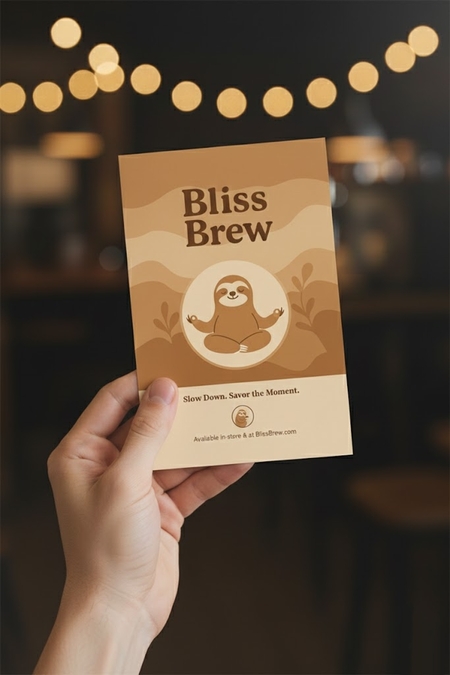

Brand advertising flyers.
How communication theory became the foundation for creating Bliss Brew
Semiotics
Used to create a system of visual signs that evoke a state of calmness: — soft lines → relaxation — warm colors → safety — no strong contrasts → emotional smoothness — the word «Bliss» → association with gentle happiness
Every design element carries meaning.
Narrative Paradigm The presentation for customers is built as an emotional story of returning to oneself: problem → sense of overload → solution → ritual → new state.
This strengthens empathy and trust.
Pragmatic Theories Packaging, website, and communication are designed to: — avoid informational noise — signal calmness through form — reduce anxiety even before the first sip
The brand speaks to people through actions.
Uses and Gratifications Theory Bliss Brew is fully built around the audience’s request: «calmness, but without medication.» The presentation for professionals emphasizes: — scientific foundation — proven benefits — sustainability — market niche
Symbolic Convergence Bliss Brew creates a shared space of «calm culture» — a culture of gentle pause, escape from overload, and mindful self-care.
This unites the audience through shared emotional experience.
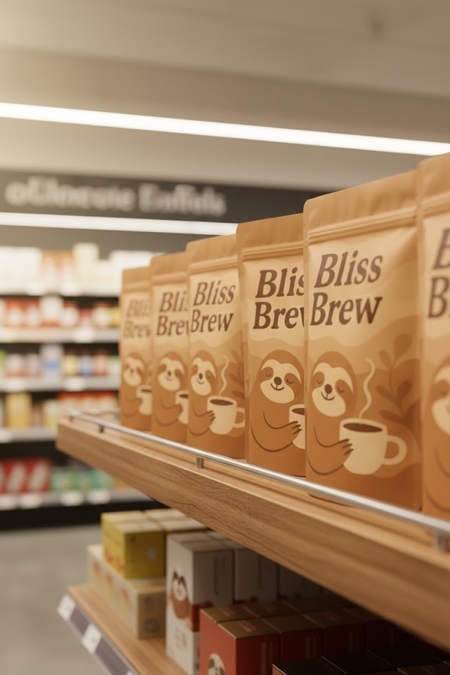
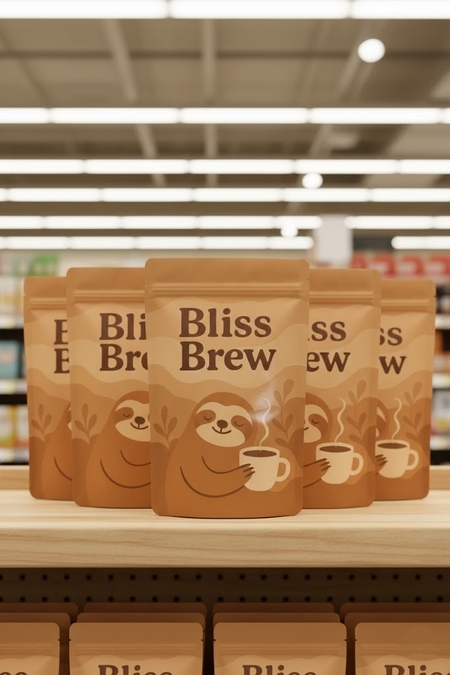
Brand products on the store shelves.
User problem
Modern life makes overload the norm: constant notifications, deadlines, noise, high tension. Coffee has long been a ritual of support but also a source of stimulation that increases anxiety, causes energy spikes and crashes, and disrupts focus.
People want pause and restoration — but end up with acceleration and nervous unrest.
Simple explanation of the solution
Bliss Brew is coffee without caffeine and without stimulation, preserved using the Swiss Water Process and enhanced with natural extracts, L-theanine, and magnesium.
It preserves the flavor, aroma, and the ritual itself, but instead of acceleration it provides: — steady calm focus, — gentle relaxation, — a sense of control over one’s state.
It doesn’t make you sleepy — it restores inner balance. The same coffee experience, but without the «downsides» of caffeine.
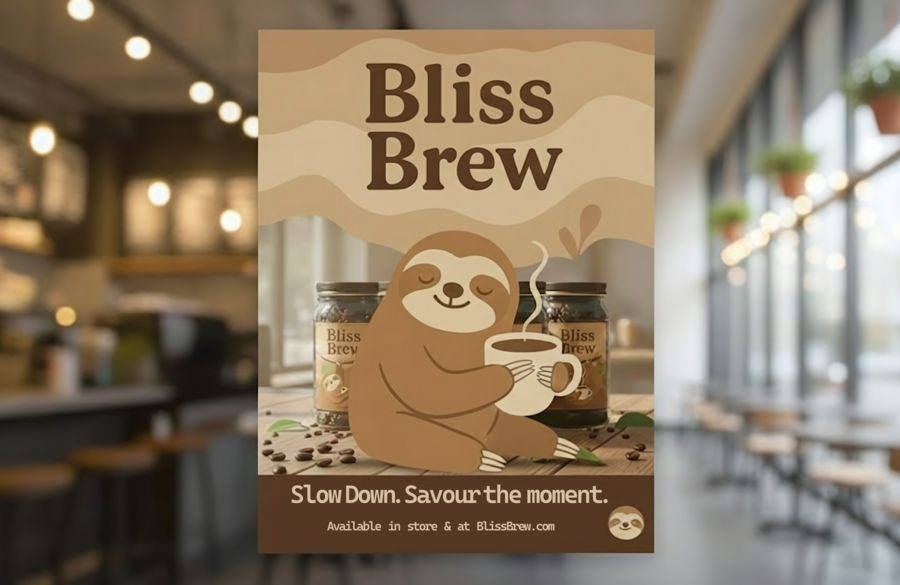
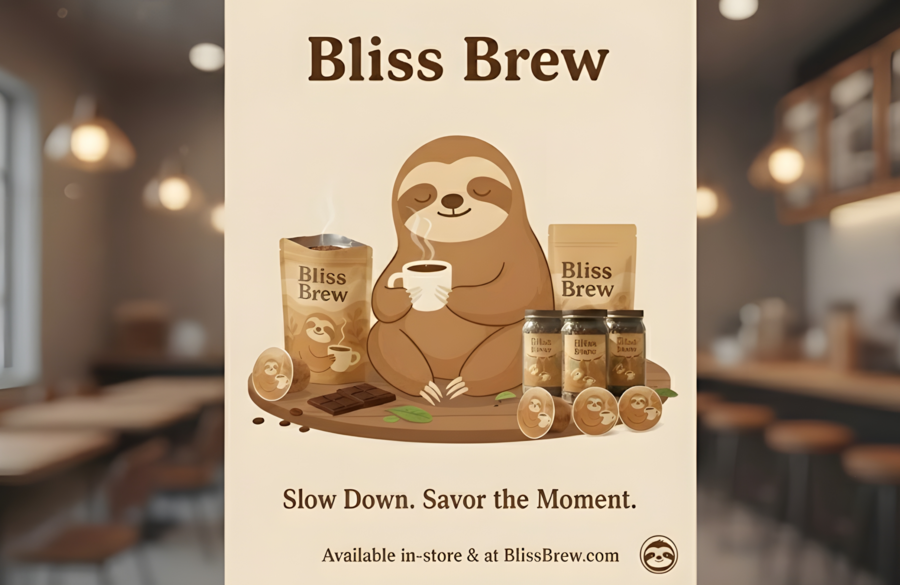
Variants of advertising posters placed in coffee shops or elsewhere.
Brand positioning
Bliss Brew is coffee-pause, not coffee-acceleration. We offer: — a new type of functional beverage for people who want to manage their state, not depend on stimulation; — a daily ritual of gentle restoration; — a natural way to reduce tension without medication; — a more mindful alternative to the habit of «having another cup just to keep going.»
Bliss Brew = a calm breather easily built into any day.
Emotional storytelling
Imagine a morning. Calls, messages, racing thoughts. You reach for your usual cup of coffee — but you already know how it ends: a faster heartbeat, even more chaotic thoughts, slipping focus.
You pour Bliss Brew. The warmth of the cup settles into your hands. The first breaths of steam seem to switch off background noise. From the first sip, a soft slowdown appears in the body, as if the burned-out wires in your head begin to cool.
You finally hear yourself. The world isn’t slowing down — you are reclaiming your rhythm. And the rest of the day — without spikes, without crashes, without anxiety. Just steady, calm clarity. Bliss Brew — a small pause that changes the whole day.


The main brand mascot and its variations.
Bliss Brew brand presentation for professional audience
The functional beverage market is growing rapidly: — the functional coffee segment may reach $4.48 billion in 2025, — with 11.45% CAGR, growing to $7.71 billion by 2030.
Target audience Research shows that Millennials and Gen Z: — choose products that help manage stress without sedative effects — prefer scientifically validated natural solutions over medication — are willing to pay more for functional properties — value ethics and sustainability
Bliss Brew positioning Bliss Brew occupies the niche of «functional calm coffee»: coffee that preserves the taste of a traditional beverage but provides emotional stability without stimulation.
Key brand elements
Color palette Warm earthy tones: — soft sand beige — warm caramel brown — deep roasted-coffee brown These colors evoke comfort, groundedness, and a gentle slow‑living atmosphere, creating an immediate sense of emotional safety.
Typography Rounded, friendly letterforms with smooth transitions — reflecting the gentle curves of the illustrations. No sharp angles, mirroring the slow, calm, approachable nature of the brand.
Tone of communication Warm, comforting, unhurried. The purpose is to ease tension and create a sense of emotional exhale — guiding rather than energizing.
The brand’s palette. The color codes are specified in HEX.
Visual language — stylized soft hills and layered earthy waves — minimal linework — calm, cozy characters (like the relaxed sloth) — shapes that visually echo warmth, stillness, and slow breathing — complete absence of visual noise or strong contrasts
Packaging Matte, tactile surfaces with simple compositions. Warm monochromatic illustrations that instantly communicate softness, comfort, and a gentle «slow coffee» mood.
Assortment — calming roast blends — «slow brew» ground coffee — gentle functional blends with relaxing botanicals — limited cozy editions inspired by comfort rituals (e.g., blankets, warm evenings)
Ethical foundation — mindful sourcing and low‑impact packaging — designs aligned with sustainability and warmth — transparent communication with no overstated promises — just genuine, grounded calmness.
The main pattern for brand design and individual decorative elements.
Signature products