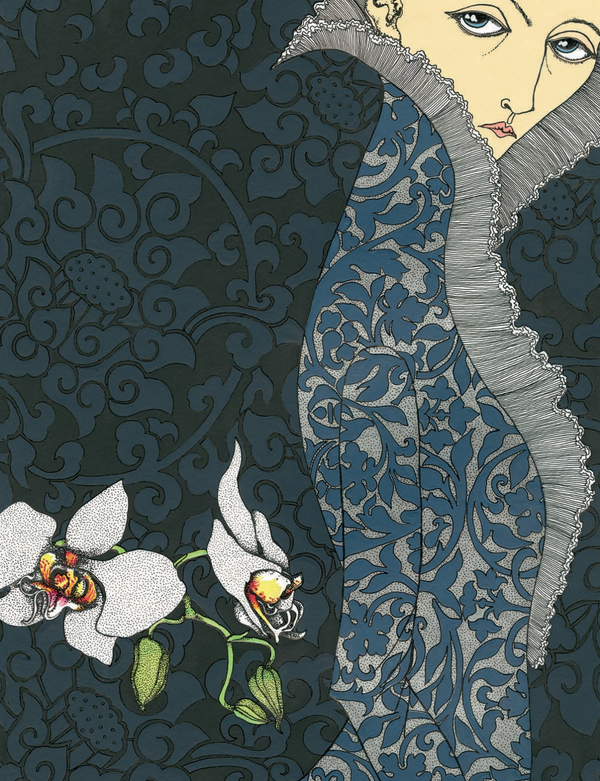
Concept
«The Picture of Dorian Gray» by Oscar Wilde is a paradox novel in which beauty and ugliness exchange places, and the portrait serves as the main witness to the protagonist’s moral decay. The illustrator faces an immensely complex task—not merely to depict scenes from the book, but to illustrate the very mechanism of this moral collapse. Where the writer can defer the revelation, hide the painting under a sheet, and allow Dorian to view it in solitude, the illustration is compelled to decide what to show, what to conceal, and what space to yield to the reader’s imagination. The study utilized two Russian-language illustrated editions of the novel, both published by the «Rech» publishing house: «The Picture of Dorian Gray» illustrated by Olga Venediktovna Grablevskaya (2018, «Malaia Klassika Rechi» series) and «The Picture of Dorian Gray» illustrated by Ksenia Ruslanovna Lavrova (2020, «Obraz Rechi» series). Both editions feature the translation by Maria Yefimovna Abkina. The research problem arises from the discrepancy between the plot and its potential visual representation. If the artist focuses only on the hero’s outward beauty, there is a risk of reducing the novel to a story about a charming socialite. If she immediately foregrounds the ugliness, the necessary contradiction for the plot vanishes—the secret is exposed too soon. Therefore, the central question is not about the degree of illustrative detail, but about the distribution of the visible versus the concealed. Where does the evil reside in the depiction? Is it on Dorian’s face, in his double, in the surrounding people, in the decorative environment, in the color, or in the very composition of the page?
Relevance of the Topic
The modern history of illustration views the book as a single visual organism. Studying how various female artists approach the problem of the «unrepresentable» (moral decline through visual imagery) allows one to understand how contemporary illustration engages with the psychological depth of text.
Research Objective
The goal of this research is to demonstrate that illustrating a classic work is not a neutral adjunct to the text. The choice of how to render the protagonist—whether to show their face, where to dwell the viewer’s gaze, how much negative space or ornamentation to include, and how literally to depict the portrait—establishes an independent interpretation of the novel. The outcome will be a comparison of two representational strategies and a conclusion on how visual art can address the moral decay that the plot is meant to keep invisible.
Hypothesis
The tested hypothesis is that in Olga Grablevskaya’s work, moral decline acquires increasingly heavy emotional and chromatic density as the narrative unfolds, whereas in Ksenia Lavrova’s work, the conflict is transposed onto the structure of the depicted world: a smooth, ornamental surface coexists with grotesque faces and an anxious spatial density. These artistic choices are not qualitatively opposed; rather, they offer two models of interpretation—a psychological-event-based one and a decorative-symbolic one. In the first instance, the viewer witnesses a gradual tragedy; in the second, they observe a world whose own alluring surface inspires doubt.
Key Question
What graphic means do Olga Grablevskaya and Ksenia Lavrova use to depict the novel’s central conflict—the preservation of Dorian’s beautiful exterior despite the destruction of his moral self—and how does the selection of illustrated episodes alter the understanding of this contradiction?
Visual Material Selection Principle
The material was selected based on the principle of common motifs (scenes with portraits, scenes in interiors, final images). The analysis is based on reproductions of illustrations from the publications of O. Grablevskaya and K. Lavrova (published by «Rech»).
The Principle of Tabulation
- Introduction (concept, relevance, objective, research question, hypothesis).
- Workshop and Garden: The Birth of Beauty
- Cybele and Theater: Beauty as Role, Mr. Isaacs
- Visualizing Ugliness: Metamorphoses of Portraiture
- Basil’s Murder and the Covering Up of Evidence
- Light and Vices: Society in Lavrova and the Abyss in Grablevskaya
- Finale: The Shattering of the Mask
- Conclusion (confirmation of the hypothesis).
- Bibliography
2. Workshop and Garden: The Birth of Beauty
In the first chapter of the novel, Basil Hallward paints Dorian, and Lord Henry meets the young man and discovers in him the embodiment of external perfection. For two artists, this is not simply an introduction; a specific viewer’s stance must arise here—Dorian is beautiful, and therefore the world is ready to admire him, without yet knowing anything about him as a personality. At the same time, the portrait image at the beginning of the story serves as a promise of future catastrophe. Before the image of the young man, there are no visible traces of crime, but it is the appearance of such an image that makes the tragedy possible.
Illustration by O. Grablevskaya for Oscar Wilde’s novel «The Picture of Dorian Gray» (published by «Rech, ” 2018)
«I know you’ll laugh at me, ” the artist countered, „but I truly cannot display this portrait… I put too much of myself into it.“ Lord Henry burst into laughter, settling more comfortably into the sofa.
Illustration by O. Grablevskaya for Oscar Wilde’s novel «The Picture of Dorian Gray» (published by «Rech,» 2018)
In Grablevskaya’s The Youth and Beauty of Dorian Gray, the character’s aura is conveyed through the softness of his silhouette, a light color palette, and the proximity of hues. It is more appropriate to speak not of a documentarily precise depiction of the hero, but of the impression of his charm—which exists within relationships and is therefore vulnerable to external influence. The unfinished edges of the drawing compel the viewer to perceive the character not as a frozen, picturesque relic, but as a living presence.
Illustration by K. Lavrova for Oscar Wilde’s novel «The Picture of Dorian Gray» (published by «Rech,» 2020)
Lavrova offers a different perspective. Right at the first turn, which depicts Lord Henry, the artist uses the technique of hyperbole to emphasize his cynicism and moral corruption. The frame’s space is filled with an aggressive, toxic pink and turquoise ornamentation on the sofa and dense monstera greenery; the figure and furniture seem almost merged into a single decorative system, creating the image of a suffocating, decadent world.
Illustration by K. Lavrova for Oscar Wilde’s novel «The Picture of Dorian Gray» (published by «Rech, ” 2020)
On the next major stage, the faces and figures of the characters are set against a richly saturated red pattern. Dorian, shown in profile, is separated from the other participants more by a graphic outline than by spatial distance. His external appeal emerges against the backdrop of an already visually over-complicated, artificial world. Beauty here is not opposed to the setting—it is an integral part of the decor.
The Garden as a Space of Temptation
Wilde’s garden is a place where beautiful nature, discussions of youth, and the influence of Lord Henry intersect. Grablevskaya depicts the young Dorian amidst scattered patches of color and blossoming branches. Lilac and turquoise tones evoke a sense of air, and the figure is not entirely separated from the plants. But this very lightness is unsettling in the context of the novel: Dorian is susceptible to Lord Henry’s words, and the idyllic scene becomes the beginning of an internal shift. The disconnect between the purity of the visual impression and the subsequent ramifications of the conversation is significant.
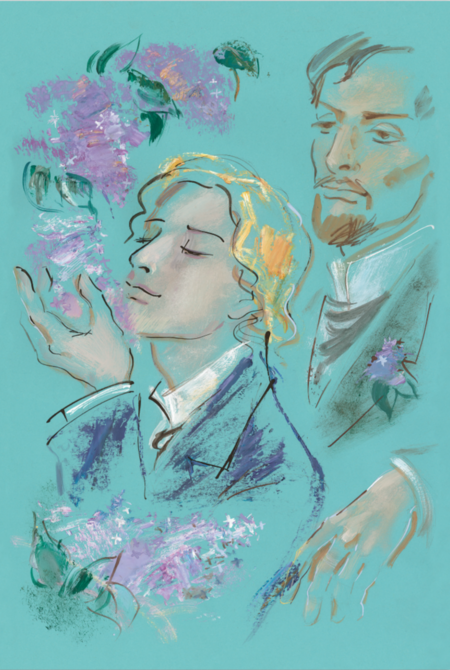
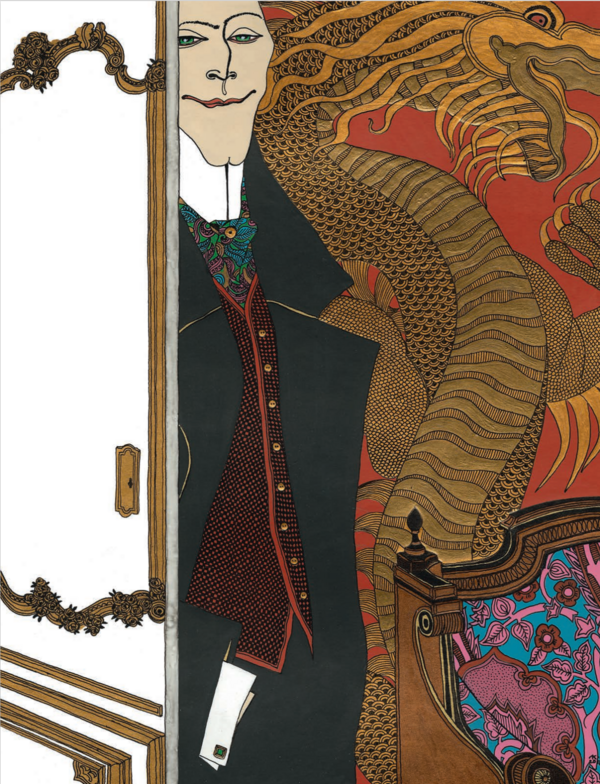
Left: Dorian Gray and Lord Henry, O. Grablevskaya, illustration for «The Picture of Dorian Gray, ” 2018. Right: Lord Henry, K. Lavrova, illustration for the same novel, 2020.
In Lavrova’s work, dialogues about influence and youth are accompanied by images with a denser graphic environment. Vertical ornaments, cropped figures, and the emphasized role of clothing lend the space an almost theatrical convention. Instead of an immediately felt garden, we are presented with a world of aestheticized surfaces, where the character seems poised to become an «exhibit» under someone else’s gaze. The richness of the framing extends beyond the setting; it helps us understand why Dorian’s beauty is perceived by Lord Henry as an opportunity for artistic and psychological experimentation.
3. Sybilla and Theatre: Beauty as a Role; Mr. Isaacs
Dorian’s love for Sibyl Vane is the first test of his aesthetic ideal. The young man is in love primarily with the actress and the roles she embodies. When Sibyl begins to feel genuine love and loses her ability to perform, Dorian rejects her. The tragedy demonstrates that the worship of beauty can turn another human being into an object of consumption: while Sibyl is magnificent on stage, she is loved; as soon as she steps outside the role, her personality becomes superfluous.