The School of Design shifts from project to product.
The diploma thesis topic is now conceptualized as an investment proposal, and the defense is viewed as a market launch. For most concentrations, this translates into publication—a journal, a book, or a digital release. For «Game Graphics, ” this means something different.
I. Opportunities Await
The crisis facing today’s gaming industry manifests not so much in the disappearance of major companies or mass staff reductions, but in the fact that the contract position of a freelancer working to someone else’s technical specification becomes obsolete precisely when the number of people eager to take it increases.
A tectonic shift is occurring, similar to the one that once swept through the film industry and publishing—a change that cannot be addressed by simply increasing the number of graduates or raising their level of preparation.
Alongside this crisis, and directly resulting from it, indie development has ceased to be a marginal means of survival on the periphery of the «mainstream» industry. Instead, it has become one of the integral—in a way, foundational—components of gaming as a pastime, a cultural phenomenon, and a lifestyle. Tools, engines, distribution platforms, and promotion channels—all of this is now accessible not only to a small team of like-minded individuals but also to a single artist. This accessibility does not imply a lowering of quality standards; a significant portion of the celebrated masterpieces of the last decade was conceived and created precisely in this manner.

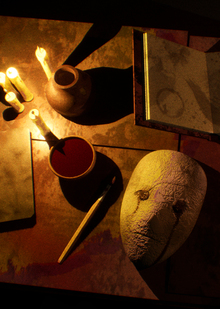
Ad Extremum (Valery Mannanov’s project)
The range spans from complex, demanding games like Gorogoa or the recent Blue Prince, to titles such as Arctic Eggs, where mechanical simplicity and deliberate restraint in visual expression do not merely not impede, but instead aid in articulating a radically unique authorial vision.


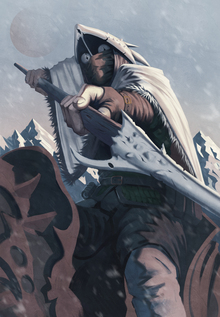
The Giant Quest (Elena Serostanova’s Project)
In times of crisis, the constant search for a compromise between creative ambition and market realities becomes less relevant. A graduate of the «Game Graphics» program, who is capable not only of designing a project but also of bringing that project to release, finds themselves in a fundamentally different position: they do not aim to fill a role within someone else’s structure, but rather to create their own—whether alone, in partnership with another graduate, or, over time, as part of an independent studio.
This is the future scenario that modern artistic education must deliberately prepare students for, starting from the very first year.
II. Question to a Stranger
The traditional model of art education, including the former version of «Game Graphics,» operated on a skills-improvement principle: students gradually refined their technique by completing assignments, presenting their work for review, receiving a grade, and moving on to the next checkpoint. This model has its advantages, but they are outweighed by one fundamental limitation: an assignment completed merely to receive a grade answers only one, somewhat closed-off question—does the work meet the committee’s standards?
At the same time, a product released to the market answers a question of an entirely different nature: is this work needed by anyone other than the author and their immediate circle?
Kolmanskop (Anastasia Smirnova’s project)
The questions may seem similar, but the second is much tougher because the answer to it does not depend on the audience’s goodwill, pre-established criteria, or a shared context between the artist and the audience. Unlike a review committee, a stranger who sees your game is under no obligation to understand what you are offering or to assess your proposal fairly. They either pay or they don’t, and both of these decisions are an opinion—one that holds more weight than any committee’s evaluation.
The question, «Why should someone pay for this?”—and this needs to be emphasized to avoid misinterpretation—does not simply substitute for artistic ambition; rather, it sharpens it. One cannot evade it with a formal disclaimer, but must address it specifically, relating it directly to this particular project and this specific audience.
Those who manage to bring their work to fruition—even if the release is small or relatively modest in scope—gain an experience that no mere viewing can replicate: the experience of connecting with a stranger, for whom your alma mater, your curator, or your grades hold no significance. This experience, paradoxically, makes every subsequent piece feel freer; after experiencing an encounter with a stranger once, the artist stops fearing such encounters in the future.
III. The Verdict of Anonymity
Contrary to popular belief, what makes an indie project vulnerable is not just the gameplay and programming—which is becoming an increasingly solvable task even for a solo developer—but how the project looks. The vast majority of indie games are technically functional, many featuring engaging or even original gameplay, yet visually, they are indistinguishable from the thousands of other works at a similar level. Their provocative, bordering-on-ugly blandness—and not competition or lack of budget—is the root cause of audience indifference.


Smile, Sir! (Project by Anna Osipova and Maria Lapina)
Students in «Game Graphics» hold a unique position: for them, visual language is primary by definition, and their resulting product is visually complete from its first day, unlike in most indie developments. Games such as Ashen, Below, or Stray embody this same principle, where the visuals do not just support the gameplay—they carry the core narrative weight; remove the visual design, and there is no reason to play.
A project whose cornerstone is original graphic design does not require external validation or outside interference—this very autonomy in creative expression is what defines the specificity of our program.
In a market where graphic design is no longer mere embellishment but a primary determinant of both recognition and initial judgment, this is not simply an academic virtue of our program—it is a competitive advantage unavailable to most of your future rivals.
IV. Platform Over Committee
The School of Design’s digital ecosystem allows student projects to find an audience even at the thesis defense stage—without external intermediaries or the need to establish distribution independently. The implications for «Game Graphics» are quite clear: a game created as part of a diploma startup is published on the School’s platform, features a price set by the author, and is open to donations from those the project has moved.
Every buyer who pays 300 rubles for the student’s work makes a judgment—not an academic one, but an economic one—and it is this verdict, not the evaluation of the examination committee, that constitutes the true outcome of the thesis project.
The mechanism that makes this outcome possible has long been established and requires no innovation: selling a build is a direct parallel to selling a release, while subscriptions and donations are identical to crowdfunding development. All the school platform needs to do is integrate this mechanism into its own ecosystem so that a graduate can utilize it starting the very day after their defense, without unnecessary intermediaries or burdensome formalities.
V. Not a Module, Not Starting from Scratch
The Diploma Startup in «Game Graphics"—and this should be clarified upfront to preempt the inevitable question regarding development timelines—is not a game created from scratch over two academic modules. Rather, it involves bringing to release a project that begins in the third year as part of the curriculum and continues to evolve in the fourth year, no longer as an academic assignment but as an independent artistic work.