CONCEPT
Sketches and Visualization
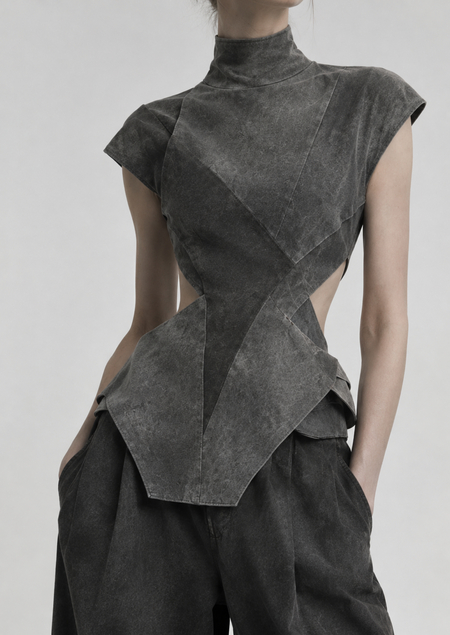
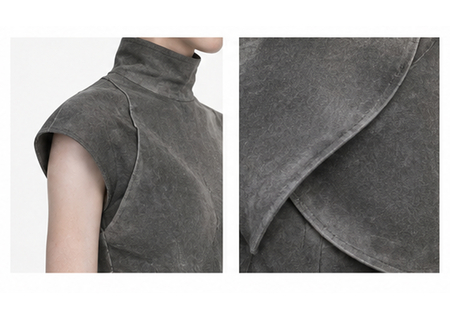
The t-shirt features a fitted silhouette with a high mock neck, short set-in sleeves, and asymmetrical appliqué details that create a sculptural volume across the torso. The garment’s construction is based on the intersection of geometric panels, which produce a distinct relief and emphasize the waistline. The hem is finished with asymmetrical, elongated elements featuring sharp angles. The piece balances a minimalist foundation with deconstructed details, maintaining both functionality and suitability for mass production.
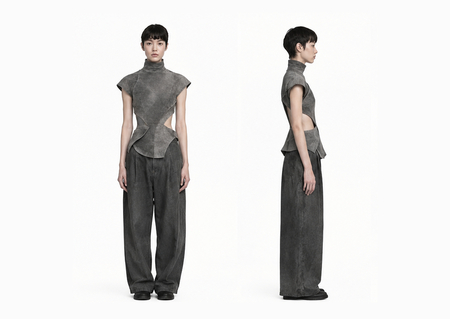
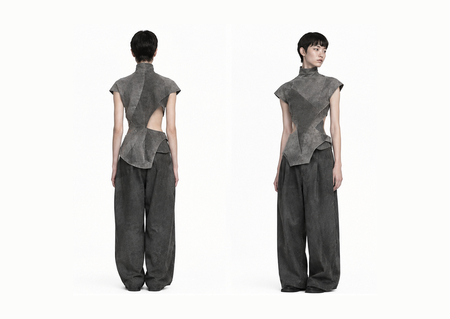
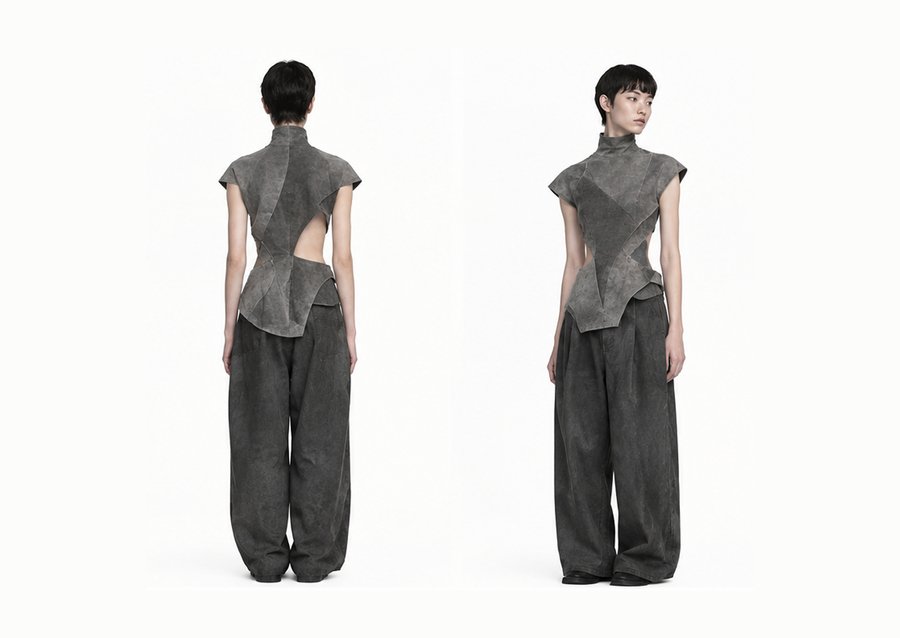
The primary constructive and decorative element is the multi-layered panels, arranged diagonally on the front and back pieces of the garment. They create an effect of interlacing and visual displacement of the layers without the need for complex three-dimensional structures. The back panel features a shaped cutout at the waistline, which supports the overall asymmetrical composition. The material’s surface has a subdued, heterogeneous texture resembling washed fabric, emphasizing the garment’s industrial character.
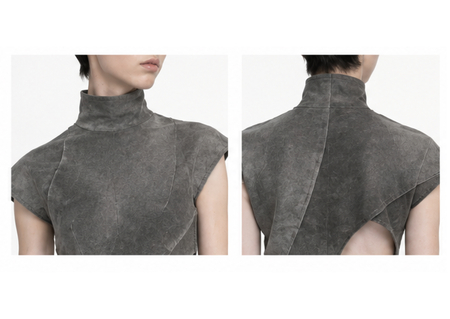
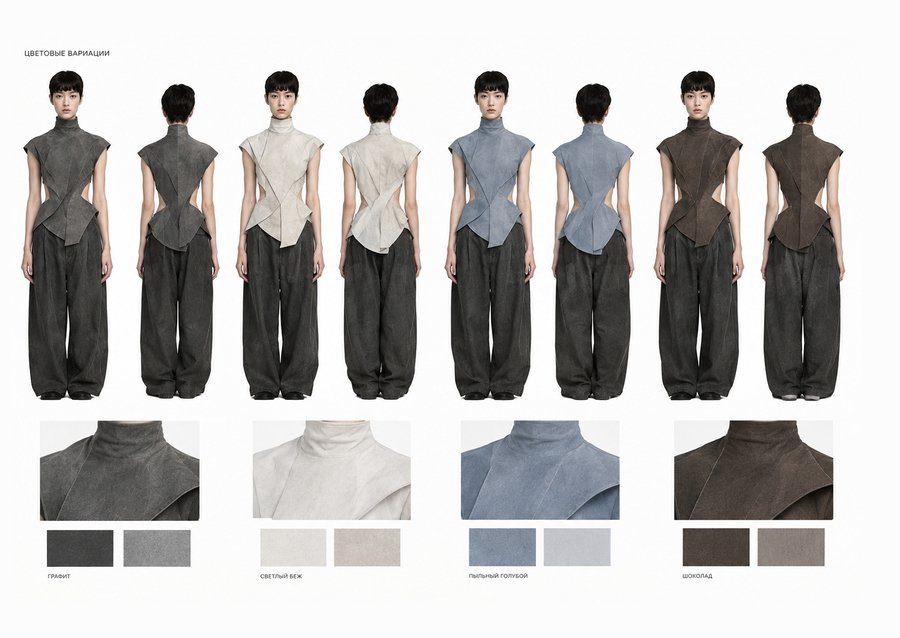
The item is offered in several color variations: graphite, light beige, dusty blue, and dark brown. The monochrome color palette emphasizes the geometry of the cut, and the lack of intricate decoration allows focus to remain on the construction. For manufacturing, it is recommended to use a dense, elastic knit fabric or a thin fleece with elastane that maintains panel shape and ensures wear comfort. To achieve the appearance of a washed surface, ready-made knit fabric with the appropriate finish may be used.
Technical Documentation
The shelf and back panel of the item are cut from the main material, taking into account the grain line and the fabric’s stretch. Additional asymmetrical panels are cut separately according to the developed patterns. To minimize the number of manufacturing steps, it is recommended to use components with simple geometric shapes and smooth or straight joining lines. The construction does not require complex draping, specialized equipment, or laborious hand finishing.
The garment is assembled on a four-thread overlock machine using a stretch stitch. First, the shoulder and side seams of the main body are joined, and then the overlay panels are processed and secured according to the technical drawing. The edges of decorative elements can be finished with an overlock or folded under, depending on the chosen material and the desired visual effect. The neckline is finished with a separate stand collar, while the sleeve edges and the bottom hem are finished with a stretch stitch or a hem. The contoured cutout on the back is reinforced with facings or a stretch trim to prevent stretching and deformation.
To maintain the shape and expressiveness of the construction, it is necessary to control the precision of assembling asymmetric parts, the uniformity of stitching, and the absence of material tension. Decorative panels are secured with machine stitching along predetermined lines, which ensures the stability of the construction during use. The washed effect is achieved primarily through the selection and preliminary finishing of the material; therefore, the additional application of complex prints or the use of expensive hardware is not required.
Materials and Hardware
Base Fabric
Dense, elastic knit fabric with a matte surface Recommended composition: 90–95% cotton, 5–10% elastane Recommended density: 220–280 g/m² Recommended width: 140–180 cm
Finishing material
Main fabric matching the garment Used for making asymmetrical appliqué panels and stand collars.
Sewing threads
Composition: polyester Type: universal sewing thread Color: matching the main material
Thread for topstitching
Composition: polyester Type: sturdy threads for knitwear Color: matching the garment or one shade darker to emphasize structural lines.