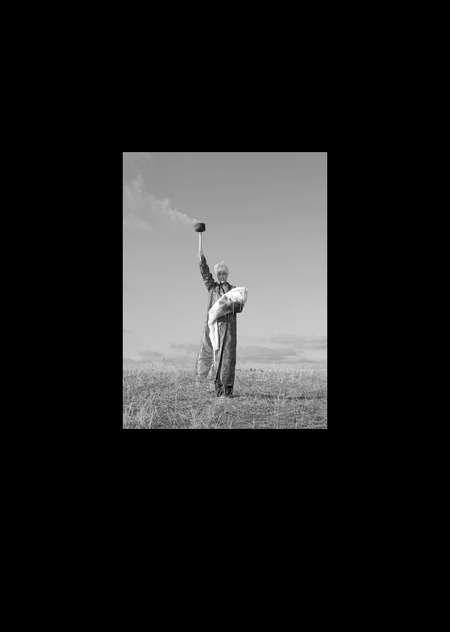
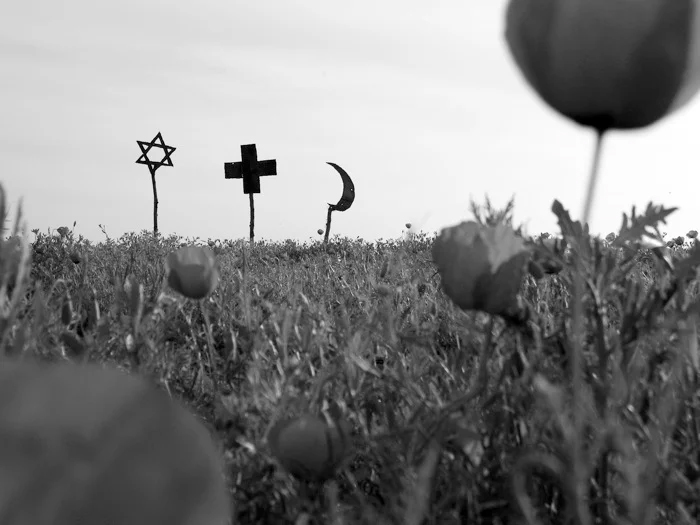
Abilsaid Atabekov photo from the «Road to Rome» project, 2007. Kazakhstan
Art is perhaps the best tool for… purification
Madina Tlostanova’s article, «Postcontinental Theory and the Rehabilitation of Place, or Does a Post-Soviet Chronotope Exist?», is highly significant within the context of contemporary philosophical and cultural discourse concerning the problem of overcoming the «coloniality of thought and being”—a condition that persists even after the dissolution of classical colonial empires. The idea that we must move away from „relating any knowledge to the epistemology and history of the European continent“ was articulated by the Puerto Rican philosopher N. Maldonado-Torres in his 2006 work.
Postcontinental theory posited that instead of the ontological unity of continents as the foundation of being, the primary task should be the symbolic, epistemological, and material liberation of autochthonous or marginal (emigrant, per the author’s note) populations. In the sculpture «Elevation of Worlds,» Alicia Kwade examines the necessity of overcoming the coloniality of thought and being.
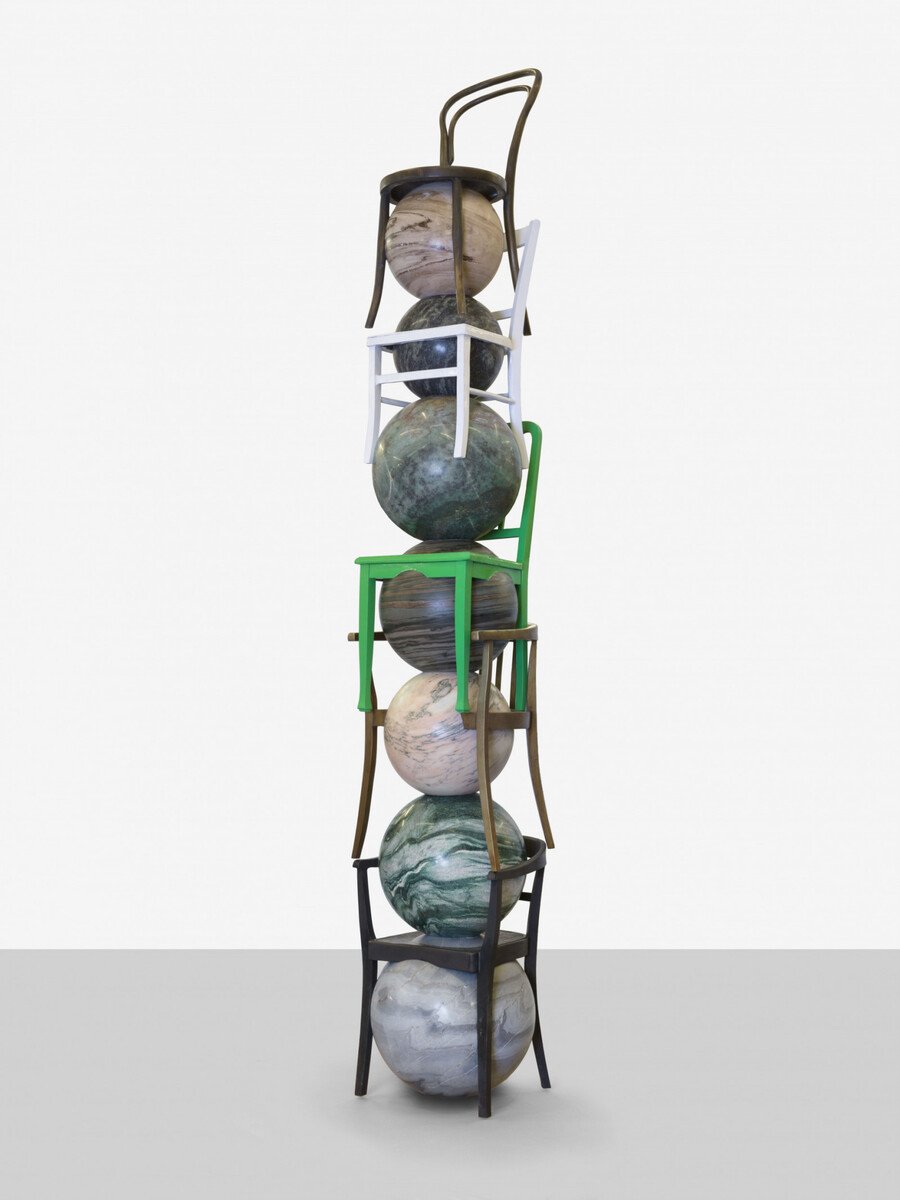
Alicia Kwade «Order of Worlds» 2022. Germany
Building on this discourse, Doctor of Historical Sciences YarGU Gavristova and Candidate of Historical Sciences Khokolkova identify three phases in the process of epistemological renewal as a consequence of the postcolonial turn: «awareness of crisis; deconstruction of previous epistemes—decolonization of knowledge; and the creation of new epistemes and narratives.» YarGU historians emphasize the importance of «knowledge extrapolation… through the actualization of historiographical concepts» of precolonial and postcolonial spaces—places where intellectual sovereignty crystallizes, producing ideas and knowledge that must be converted «into collective property as a counter to the traditions of imperialism, colonialism… and all forms of domination.» Thus, Gavristova and Khokolkova appeal to the same idea of place rehabilitation that Tlostanova put in the title of the article we are analyzing.
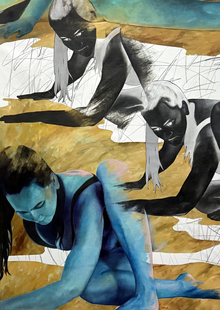
Almagul Menlibaeva. Before the solar eclipse. 2009. Kazakhstan
In her work, Almagul Menlibayeva advocates for the «Kazakhization» of modern art imagery.
When examining post-continental theory, Tlostanov utilizes the concept of «colonization of space-time, ” which is connected to what is partly is a „typically Western understanding of the post-Soviet as time rather than place… [the] term ‘post-Soviet’… could exist for Western consciousness only in the sense of a temporal follow-up to the Soviet era. …[however], our bodies, existing and wandering in space, inevitably interweave memory and place.“
Vaziko Chachiani, «Living Dog Among Dead Lions.» Venice Biennale, 2017. Georgia
An authentic, abandoned house—brought by artist Vaziko Chachiani from Georgia and reassembled by him as an art object for the 57th Venice Biennale—illustrates the interweaving of memory and place, emphasizing the significance of the home in contrast to the Soviet concept of homelessness discussed by Tlostanova: «Soviet colonial identity had similarities to post-colonial… self-identification, rooted in homelessness and in-betweenness.»
Lora Adams, a specialist in Central Eurasia at Harvard University, analyzes Tlostanova’s methodology, concluding that the prefix «post» in the words «postcolonial» and «post-Soviet» is equivalent. Adams notes that applying postcolonial theory provides researchers with a new lens, helping to «refine [this]… theory by applying it to a broader range of imperial projects, particularly those rooted in non-capitalist methods of dominance.»
Exploring the trends in post-Soviet art, Tlostanova points out that many artists in this circle «surpass the conventional opposition between tradition and modernity, ” basing their work on the interaction and blending of archaic elements of national cultures with the relevant traits of today. Thanks to their „liminal position, ” such artists possess a unique stereoscopic vision, allowing them to achieve a harmonious fusion of heartfelt emotion with the conceptual interpretation of a „cultivated and aesthetically sophisticated individual who is excellently oriented within contemporary (defaulting to Western) art.“
Faig Ahmed «Carpet.» Azerbaijan
Azerbaijani artist Faiq Ahmed creates carpets where partially preserved ornamental symbolic elements abandon their traditionally rigid compositional arrangement and dissolve into abstract patterns in their chaotic confluence.
The propositions of Tlostanova are supported and further developed by other researchers. Reaching the conclusion that a post-Soviet chronotope exists, Tlostanova emphasizes its importance as a liminal space where «art proves effective in the process of liberating knowledge, being, and… the limitations of modernity.»
Bibliography
- Tlostanova M. Post-continental Theory and the Rehabilitation of Place, or Does a Post-Soviet Chronotope Exist?
- Maldonado-Torres N. Post-Continental Philosophy: its Definition, Contours and Fundamental Sources // Worlds and Knowledges Otherwise. Postcontinental Philosophy, vol. 1, dossier 3, Fall 2006.
- Gavristova T.M. Khokolkova N.E. YarGU. Postcolonial Epistemology: African Registers. RUDN Bulletin. International Relations Series 2022. Vol. 22. No. 4. pp. 688–699. https://cyberleninka.ru/
- Adams L. Can We Apply a Postcolonial Theory to Central Asia? // Central Eurasia Studies Review. 2008. Vol. 7. No. 1. pp. 2–8 / Translation by: Laura Adams. Is Postcolonial Theory Applicable to Central Eurasia? / Journal «Inviolable Reserve» No. 4, 2009. https://magazines.gorky.media/nz/
List of Illustrations Ill. 1 — Abilsaid Atabekov, photo from the «Road to Rome» project, 2007. Kazakhstan https://www.moscowartmagazine.com/article/97 Ill. 2 — Alicia Kwade, «Order of Worlds» 2022. Germany https://theartteacher.net/2026/02/10/the-formal-elements-of-art-2/?like_comment=5671&_wpnonce=370e13e1e4&utm_medium=organic&utm_source=yasmartcamera Ill. 3 — Almagul Menlibaeva. Before the Solar Eclipse. 2009. Kazakhstan https://www.andakulova.com/artists/almagul-menlibaeva? Ill. 4 — Vaziko Chachiani, «A Live Dog Surrounded by Dead Lions.» Venice Biennale 2017. Georgia https://www.dezeen.com/2017/05/16/venice-art-biennale-2017-top-picks-highlights-pavilions-exhibitions-installations/?utm_source=Pinterest&utm_medium=organic Ill. 5 — Faig Ahmed, «Rug.» Azerbaijan https://myartguides.com/exhibitions/dubai%2C-sharjah%2C-abu-dhabi/faig-ahmed-black-sheep/?utm_medium=organic&utm_source=yandexsmartcamera