Concept
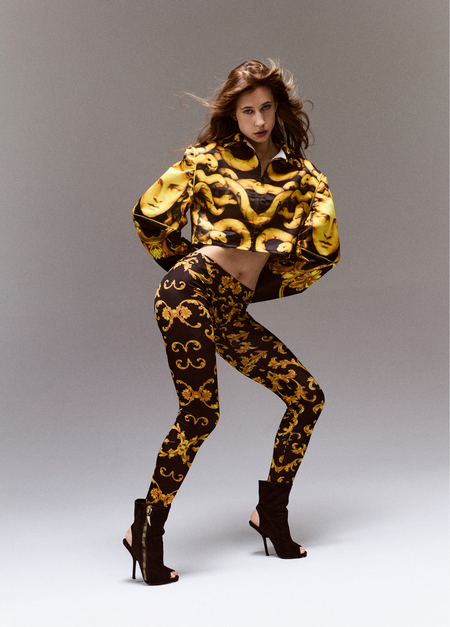
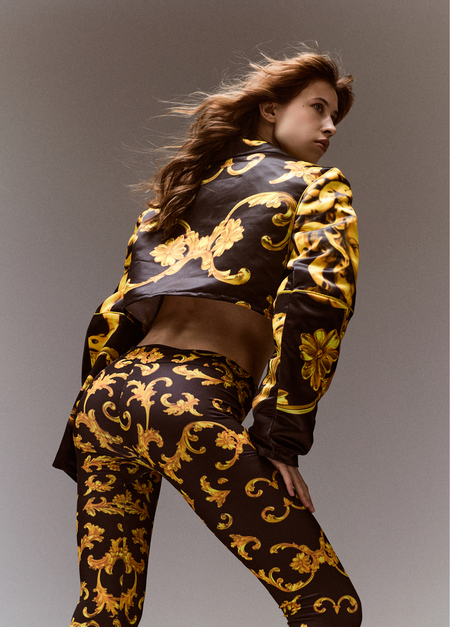
The jacket was created as part of a project analyzing the DNA of Versace, drawing upon ancient myths and the image of the Gorgon Medusa, reinterpreting them within the context of contemporary female identity and women’s right to self-determine their place in culture and life.
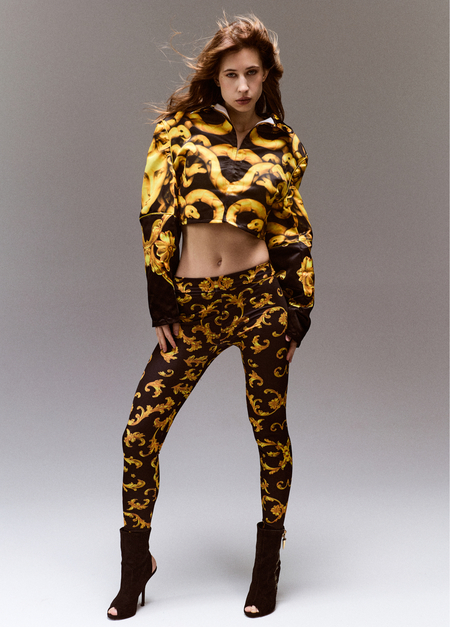

The item’s key feature is its unusual sleeve cut, which transforms them into «rhomboid» shapes, paired with a Versace-esque print.
Visualization

Technical Requirements
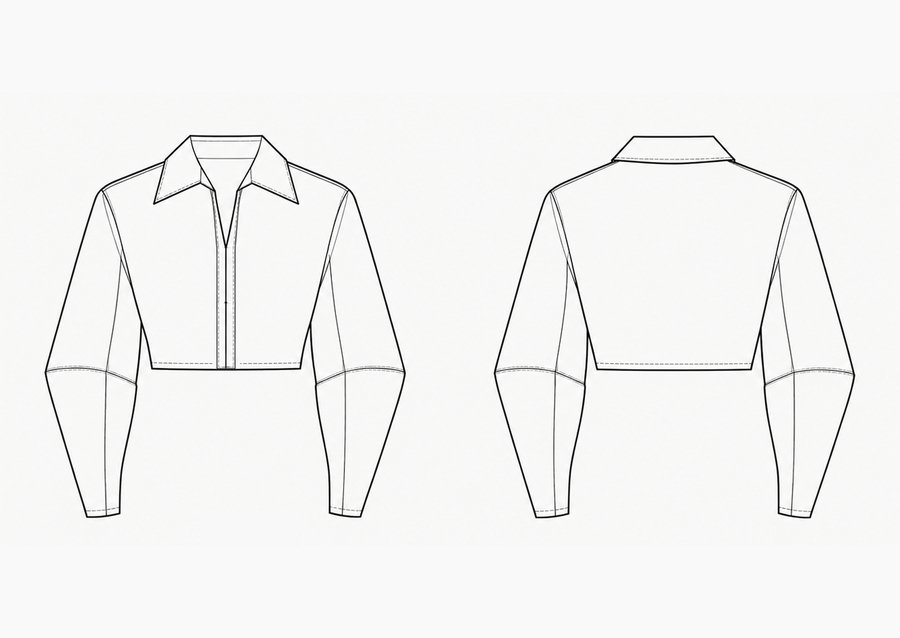
Signature designer jacket featuring rhombus-shaped sleeves crafted from thick printed satin.Developed size: 44. The garment’s main dimensions are calculated for size 44 with an assumed height of 170 cm. Silhouette: relaxed straight fit.Material: Satin (main fabric), 3 cm bias tape for internal seam finishing.Colors: Black, yellow, gold.
Materials and manufacturing cost estimation
Cost for one experimental sample: ₽7,860.Cost of a small drop at a run of 10 units: ₽63,600 (excluding re-patterning).Total budget for producing the sample and the main batch: ₽71,460.Estimated retail price per item: ₽12,000–₽15,000.
Manufacturing Stages
A unique design for a cropped silk satin jacket featuring a print that merges motifs from ancient mythology with baroque ornamentation has been developed. The concept for the garment is based on reinterpreting ancient heritage through the image of a modern woman who independently defines her identity and her relationship with traditional notions of femininity. The serpentine motif, referencing the Medusa Gorgon, is combined with decorative elements characteristic of Versace’s aesthetic. The contrast between the dark background, the golden print, and the sheen of the satin intensifies the expressiveness of the print and underscores its connection to the brand’s visual code.The jacket’s silhouette is constructed by combining a cropped body with voluminous, complexly shaped sleeves. The sleeves flare at the elbow and gradually taper toward the cuff, creating a distinctive diamond-like silhouette. A central front slit runs down to the bottom edge of the garment, maintaining an open structure and allowing the print to remain the primary visual element. A golden diagonal belt and metal hooks support the decorative concept without overloading the garment with extra details.The body and sleeve patterns are being developed, taking into account the intended silhouette and the characteristics of the satin fabric. The main body components—the front and back—are constructed using half-patterns, which are mirrored to create the full pieces. The sleeve is designed with separate upper and lower sections, whose shape ensures the flare at the elbow and a smooth taper toward the wrist. During development, the alignment of seams, the fit of the armhole curve, and the garment balance are checked.Additionally, seam allowances, the finishing of the central slit, and the bottom edge of the jacket, as well as the areas where sleeve parts join, are considered. Control marks and the lengths of joining seams are refined if necessary. Special attention is paid to the symmetry of the pieces and maintaining the intended volume of the sleeve after the garment is assembled.
The jacket is made from satin featuring a custom print applied to the fabric through printing. For one garment, 1.6 meters of the main material is required. Before cutting, the print direction, scale, and the placement of the most expressive elements on the front, back, and sleeves are checked. Components are arranged to maintain the visual integrity of the print and prevent accidental pattern shifts at seam junctions.
Cutting is performed using the prepared patterns, taking into account the grainline direction and seam allowances. Since satin has a smooth surface and can shift during handling, the material must be secured and laid out without tension. After cutting, the pieces are marked, and control notches are transferred to the wrong side of the fabric to ensure accurate subsequent assembly.
In the first stage, the main pieces of the front and back are joined to form the body of the cropped jacket. Next, the upper and lower sections of the sleeves are assembled, which creates the characteristic volume with an expansion at the elbow and a gradual tapering towards the cuff. After the sleeve shape is verified, it is attached to the body along the armhole seam. During assembly, symmetry, seam length consistency, and even distribution of volume are monitored.
The center front seam is maintained down to the bottom edge of the garment and finished according to the selected construction. A 2-meter long golden bias tape is used for finishing, which accentuates the edges and links the construction to the print’s color palette. Golden metal hooks are installed in the designated locations to function as closures. Their placement is checked to ensure symmetry of the front panel and ease of fastening.
After assembly, the garment undergoes a damp-heat treatment, taking into account the specific characteristics of the satin and the applied print. The temperature regime and treatment method are selected according to the fabric composition and the printing manufacturer’s recommendations. To prevent the appearance of shiny spots, creases, or damage to the pattern, the treatment is performed carefully, after preliminary testing on a small section of the material.
In the final stage, the quality of the component connections, the symmetry of the front and back panels, the shape of the sleeves, the neatness of the central seam and the bottom edge, and the reliability of the attachment of the gold loop and hooks are inspected. The placement of the print is assessed separately: the design must support the garment’s structure and maintain visual integrity on the main panels. The final check includes the finished jacket’s correspondence to the original sketch, the accuracy of proportions, the quality of the seams, and the overall unity of the constructional and decorative elements.