Фильтр карьерных возможностей
Themes
«Student Worklist» gathers relevant opportunities that could represent the next professional step: competitions, internships, open calls, residencies, grants, junior job openings, and selective educational programs.The main editorial question of the project is: is this opportunity suitable for someone who doesn’t yet have extensive experience or a large portfolio of completed projects?The media helps users understand the feasibility of applying, what is required to do so, and what professional outcomes they might achieve—a new case study, experience, a job, publication, exhibition, or professional connections.The focus is on opportunities that can impact a beginner’s portfolio and professional development; outside the scope of the project are general design news, senior job openings, inspiration collections, non-selective courses, and unvetted open calls and user listings.
Media Goal
To help students and aspiring visual specialists quickly understand which opportunities match their entry level, application costs, and potential career outcomes.
Currently, individuals see many opportunities, but they have to determine for themselves each time whether a specific internship, competition, or open call is right for them and if it is worth the time to apply.
Ultimately, the user needs to make decisions faster: «I see an opportunity and immediately understand if it’s for me, what’s required to apply, and what I can gain from it.»
Editorial Assignment
The editorial team curates opportunities and explains them from the perspective of a novice specialist: who the offering is suitable for, how difficult it is to apply, and what results it might yield.
How were competitors analyzed?
To understand how the project could differ from existing media, I looked not only at the subject matter but also at how competitors utilize opportunities and assist users in making decisions.(01) Five criteria were used for comparison: (02) How closely the audience aligns with ours. (03) What types of opportunities are published. (04) Whether the material is limited to a link or provides further explanation. (05) How easy it is to search for and compare publications. (06) How the cards, visual system, and publishing frequency are organized.Competitors were divided into three types.(01) Direct competitors aggregate contests, internships, open calls, and other opportunities for designers and visual artists. (02) Indirect competitors address only part of this task, such as job openings, competitions, or career content. (03) Potential competitors operate more broadly or in an adjacent niche but already serve a relevant audience.
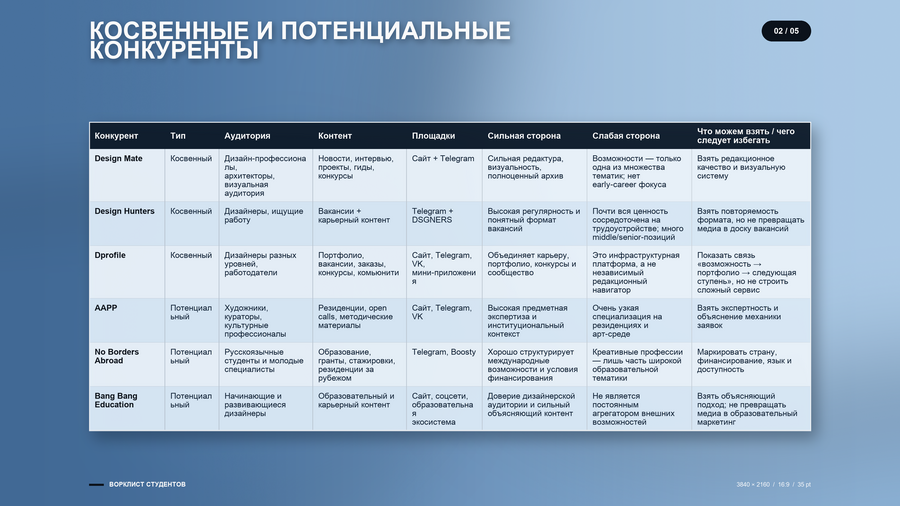
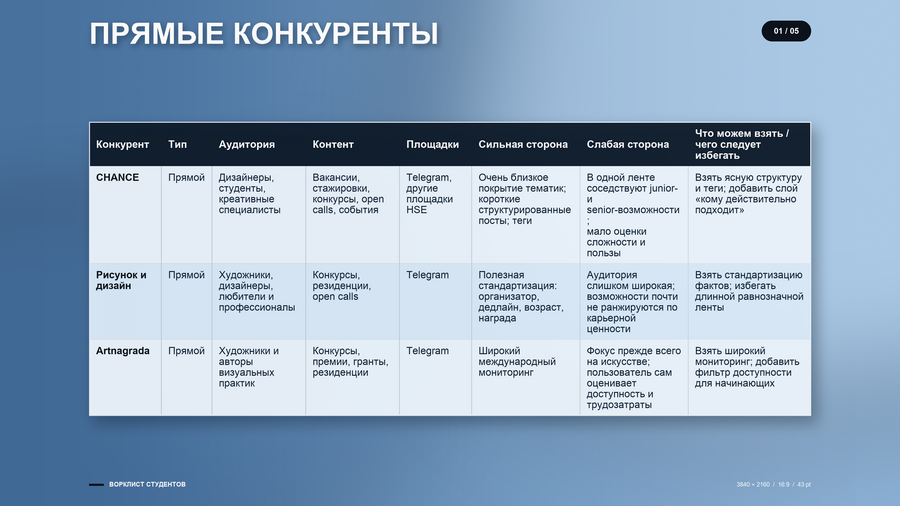
What the competitive analysis revealed
(01) Information regarding opportunities is scattered across various sources. Job openings, contests, residencies, and international programs are frequently housed on different platforms. The user must manually assemble their own search system from multiple channels and sources.
(02) Deadlines, requirements, and application links are now standard fare. Since these elements are common among many competitors, they do not inherently create a noticeable distinction.
(03) Almost nobody explains how realistic the application process is for a novice professional. The user sees the requirements but must determine for themselves whether they have sufficient experience, portfolio, and preparation.
(04) It is often unclear from announcements how much time and effort an application will require. A simple 30-minute form and a contest requiring the development of a separate project can look identical in a feed.
(05) The market features both very broad and highly specialized platforms. Some cover nearly all design content, while others focus exclusively on job openings, contests, or residencies. There is a space for a more focused media outlet dedicated to opportunities for beginners between these existing formats.
Project Format Guidelines
The unified card structure simplifies the comparison of opportunities. This principle should be preserved and enhanced with your own editorial judgment. For this task, a complex service is unnecessary. The foundation of the project remains the editorial media, which independently selects opportunities and provides users with guidance for decision-making.
Studio: Four Different Scenarios
Сегментация строится не столько по профессиям, сколько по следующему шагу
Project core: Segments 1 and 2.Secondary audience: Segments 3 and 4.The primary segment for recruitment includes students in their second through fourth years and recent graduates.These students have limited real-world project experience, and it is difficult for them to independently gauge whether their work meets the required standards. This audience can be reached through university and design communities without requiring a large advertising budget.
JTBD (01)
When I have the academic skills but almost no real projects, I want to find an accessible external opportunity to gain my first professional project for my portfolio.Functional job: find a suitable opportunity and prepare an application.Emotional job: feel like I am capable of entering a professional environment.Social job: gain experience that I can show to instructors, employers, and other designers.
JTBD (02)
When I’m already working as a designer but feel stuck between junior and the next level, I want to choose opportunities that will genuinely help me grow, strengthen my portfolio, and move into more significant projects.Functional job: finding the next career step.Emotional job: escaping the feeling of stagnation.Social job: being perceived not as an inexperienced beginner, but as a specialist with notable achievements.
JTBD (03)
When I want to take my personal practice beyond social media and small projects, I want to find relevant programs, open calls, and other professional opportunities to gain resources, professional connections, and public visibility.Functional job: to find a suitable opportunity and successfully apply.Emotional job: to view myself more confidently as an independent artist or specialist.Social job: to receive recognition from the professional community.
JTBD (04)
When my current specialization becomes too narrow, I want to find opportunities at the intersection of disciplines to expand my professional network and explore new avenues.Functional job: finding a new application for my skills.Emotional job: maintaining a sense of professional growth.Social job: becoming part of a broader creative community.
What channel is truly necessary?
According to Mediascope, in the second quarter of 2025, the average monthly reach of Telegram among Russians aged 12+ was 74%, and the average user spent about 45 minutes per day there. An earlier Mediascope age group analysis showed particularly active use of Telegram by the 12–24 age demographic.VK also remains an important channel. In the second quarter of 2026, the average daily audience for VKontakte in Russia was 65.2 million users.
Solution
Telegram will serve as the primary channel. The main reason for this choice relates to deadlines. The user must see the opportunity in a timely manner, without having to actively search for it.