NAVIGATION
- Concept
- Understanding Harmony in the Middle Ages
- Geometry in Byzantine Art
- Mosaics as Embodiment of Geometric Order
- The Gothic Cathedral as a Geometric System
- The Geometry of Light and Stained Glass
- Comparison of Byzantine and Gothic Art
- Conclusion
- Bibliography and Image Sources
CONCEPT
As in other areas of medieval art, geometry played a vital role in creating a harmonious artistic image in Byzantine and Gothic architecture. Symmetry, proportions, circles, lines, and repeating forms helped organize space, build composition, and lend works a distinct expressiveness. Particular interest lies in how geometry manifested in two directions of medieval art. In Byzantine mosaics, it became the foundation of compositional order: helping to highlight central figures, establish symmetry, and unify individual elements into a cohesive image. In Gothic architecture, geometric principles achieved a more spatial expression—they appeared in the structure of cathedrals, pointed arches, vaults, stained glass, and rose windows.
Byzantine mosaics and Gothic cathedrals became important monuments of medieval culture, where geometry helped embody conceptions of beauty, order, and harmony. Despite differences in artistic techniques, both movements illustrate how closely geometric forms are connected to the perception of art and architecture. Studying these works through geometric analysis allows one to view familiar monuments from a new perspective: to uncover the principles behind their compositions, identify recurring forms, and understand how geometric order influenced the artistic impact.
Structuring
The main part of the research proceeds in three stages: • Examining medieval conceptions of beauty and harmony, as well as the role of geometry in the art of that period;• Analyzing the geometric principles of Byzantine art using mosaics and architectural monuments as examples;
• Studying the geometry of Gothic cathedrals—their structural elements, stained glass, and rose windows—followed by a comparison of the Byzantine and Gothic approaches.
This approach to outlining allows for a gradual transition from general ideas about medieval harmony to the analysis of specific works, revealing how geometry was utilized across different art forms.
Objective of this Study — to investigate the role of geometry in creating artistic harmony, using Byzantine mosaics and Gothic cathedrals as case studies, and to trace how its application methods evolved in medieval art and architecture. Research Hypothesis: Geometry was one of the primary means of creating harmony in medieval art: in Byzantine mosaics, it organized the image and its composition, while in Gothic architecture, it became the principle for structuring space and individual architectural elements.
UNDERSTANDING HARMONY AND BEAUTY IN THE MIDDLE AGES
In medieval culture, harmony was perceived as a reflection of divine order, to which the entire surrounding world was subservient. Beauty was understood not merely as external appeal, but as the coherence of parts—symmetry, proper proportion, and the unity of the whole. Art was expected not just to convey visible reality, but to reveal the spiritual meaning behind events. Therefore, symbols, light, color, and geometric forms took on particular significance. These concepts were particularly vividly manifested in Byzantine mosaics. For instance, in the composition «Emperor Justinian with his Entourage» from the Basilica of San Vitale, the figures are arranged almost frontally, forming an ordered line. The central placement of the emperor, the repetition of vertical silhouettes, and the radiant golden background create a sense of solemnity and stable order. Here, harmony is achieved not through the naturalness of movement, but through rhythm, symmetry, and the subordination of all elements to a unified composition.
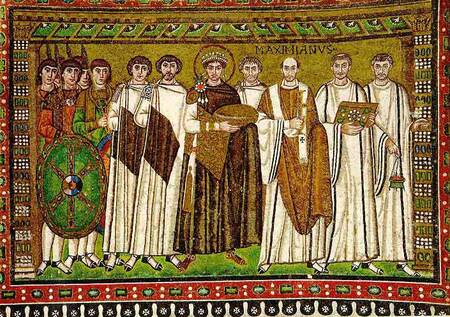
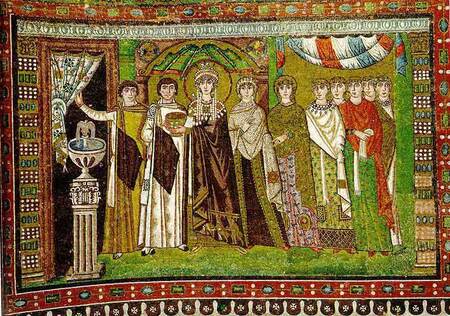
«Emperor Justinian with his retinue» and «Empress Theodora with her retinue, ” mosaics from the Basilica of San Vitale, circa 547 // Ravenna, Italy.
Another example is the mosaic ceiling of the mausoleum of Galla Placidia. The dark blue surface, covered with countless golden stars, creates the image of a celestial expanse. The repetition of identical elements forms a rhythm, and the arrangement of stars around the central cross unifies the composition. Thus, geometric order becomes a means of conveying the concept of cosmic harmony.
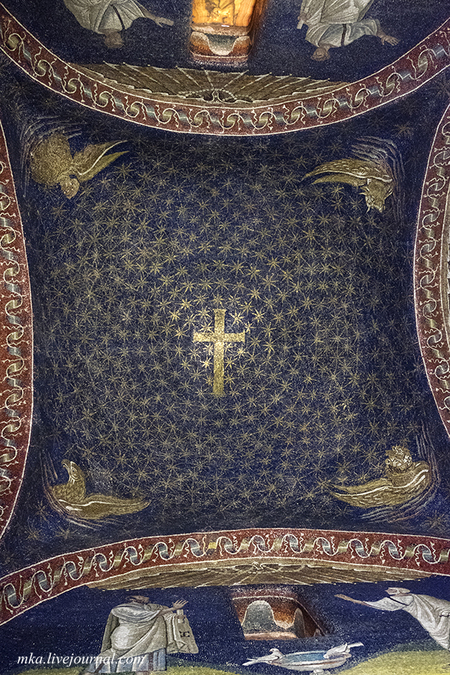
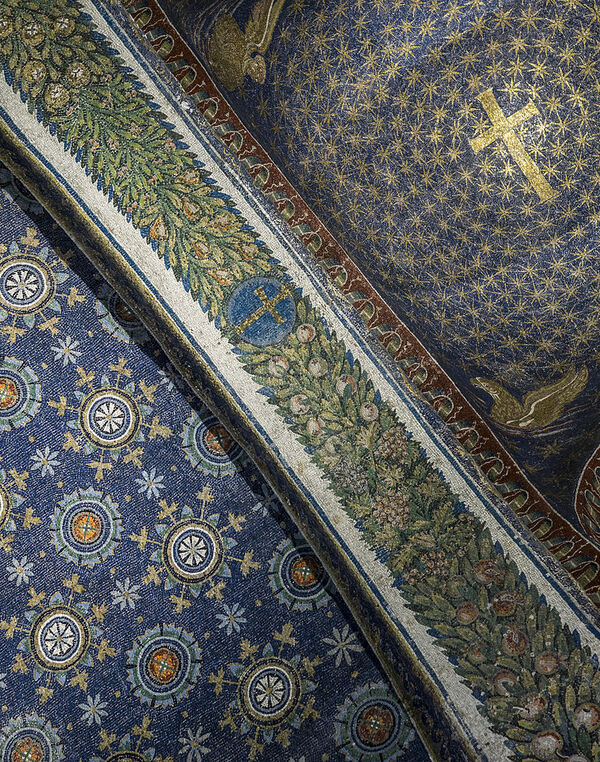
Mosaic «Starry Sky, ” Mausoleum of Galla Placidia, circa 425–450 // Ravenna, Italy.
This pursuit of unity and order was evident not only in mosaic art but also in medieval architecture.
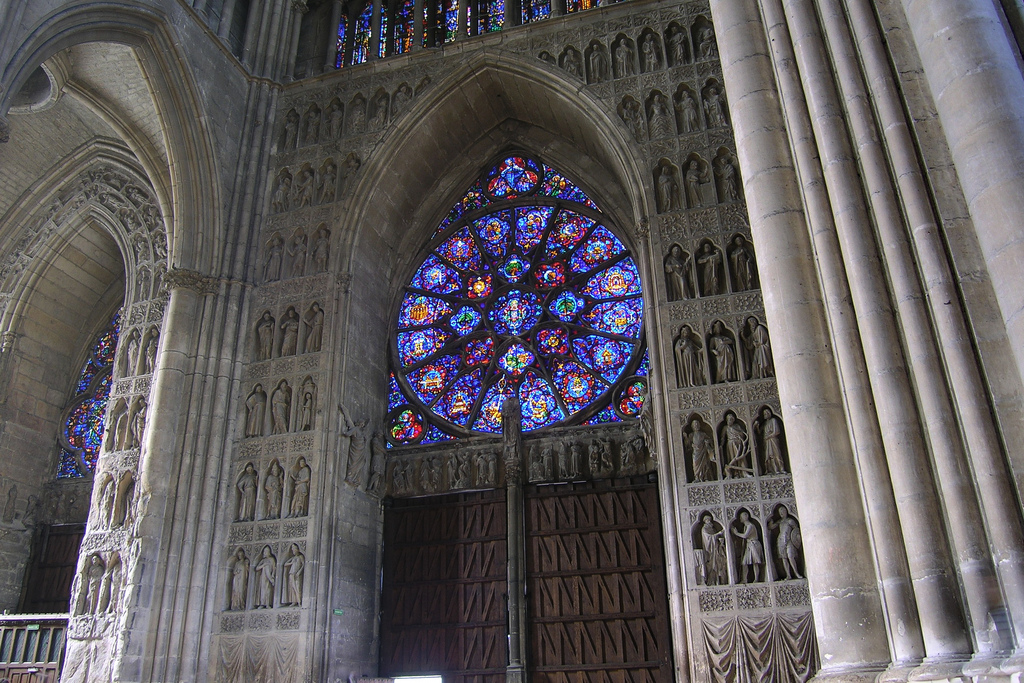
In Gothic cathedrals, harmony was expressed through the relationship between height and width, the repetition of pointed arches, the intersection of ribbed vaults, and the symmetrical arrangement of facades. For example, the rose window of Notre-Dame Cathedral in Chartres is based on the circle: its composition is organized around a central point from which repeating elements radiate. Thanks to radial symmetry, individual details coalesce into a cohesive pattern.
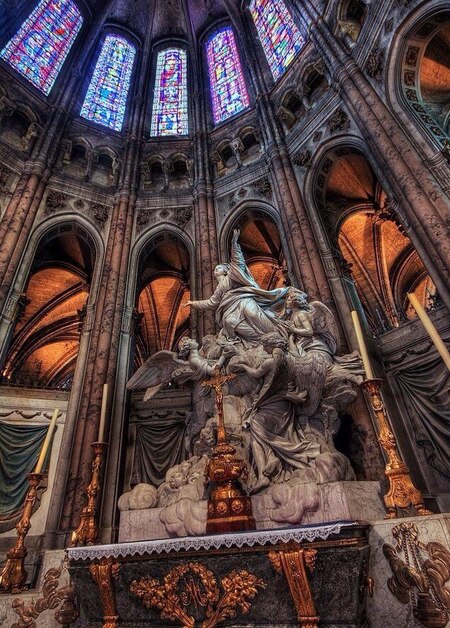
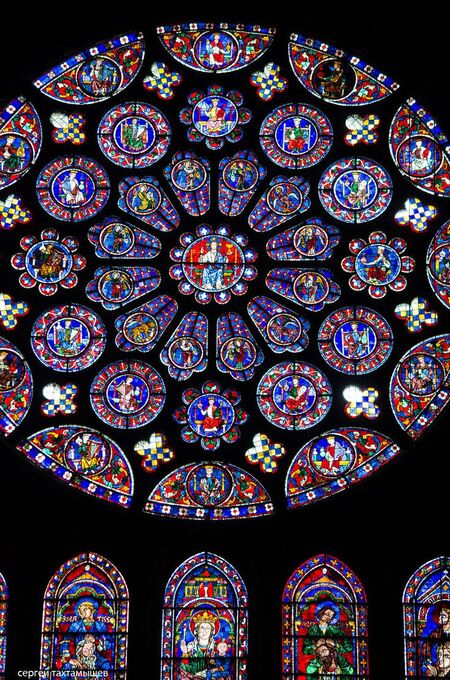
Rose window of Notre-Dame Cathedral in Chartres, circa 1230 // Chartres, France.
Thus, in medieval art, harmony was revealed through order, proportion, and the unity of form. If geometry organized the image and helped convey spiritual meaning in Byzantine mosaics, in Gothic architecture, it became the fundamental basis for the structure of the building and the interaction of light, space, and form.
GEOMETRY IN BYZANTINE ART
Byzantine art was founded on the concept that the visible world is a reflection of a higher, divine order. Therefore, geometry played a crucial role in the creation of artistic imagery: through symmetry, repetition, central axes, and circular compositions, masters sought to convey a sense of eternity, stability, and spiritual harmony. This was especially evident in mosaics, where individual images and decorative elements were governed by a unified system.
I. Geometry of Mosaic Composition One of the key principles of Byzantine mosaic was the construction of the image around a central figure or axis. The placement of characters, the direction of their gestures, and the surrounding architectural elements helped unify individual details into a cohesive composition.
Mosaic «The Baptism of Christ, ” icon from Nea Moni Monastery, circa 1049–1055 // Tilos Island, Greece.
At the center of the composition is the figure of Christ standing in the Jordan River. John the Baptist and angels are positioned on either side of him. The figures are organized around a central vertical axis, which lends the image stability and visual balance. The depiction of the Jordan River plays a particularly important role: its undulating lines guide the viewer’s gaze toward the central figure while simultaneously introducing movement into an otherwise static composition. The contrast between the vertical figures and the horizontal lines of the water helps organize the mosaic’s space. Thus, geometry is manifested here not only in symmetry but also in the relationship between directions, forms, and rhythms. Because of this, the narrative is perceived as a unified work of art.
II. The Circle as a Symbol of Wholeness and Harmony The circle holds a special place in Byzantine decorative art. It appears in ornaments, floor compositions, halos, and architectural embellishments. Thanks to its closed form, the circle allows numerous elements to be unified around a central point, creating a sense of completeness.
Geometric marble floor of the iconostasis in Zigi Monastery, 11th century // Athos, Greece.
At the center of the composition is a large circle surrounded by four smaller circles. They are all interconnected and inscribed within a unified ornamental structure. The inner surfaces are filled with small geometric fragments that vary in color and orientation. The combination of large, rounded forms and numerous small triangular elements is particularly striking. The circles create a stable foundation for the composition, while the recurring details establish a decorative rhythm. Here, geometry serves as the primary artistic medium: the image does not narrate a religious subject but is built upon the relationship between form, color, and repetition. Because of this, the whole is perceived as a single, cohesive system where every element is linked to the others.
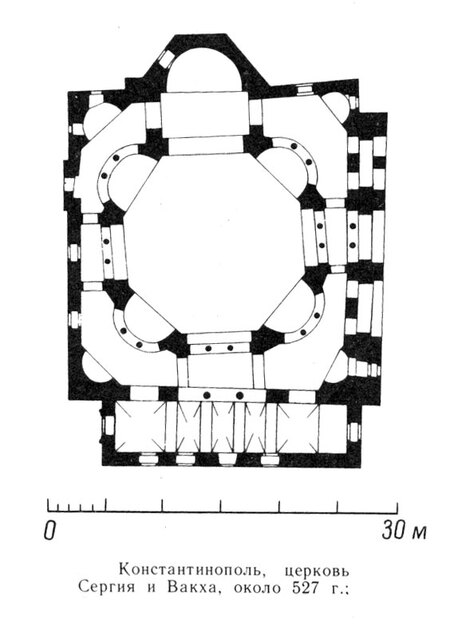
III. Geometry of the Dome and Architectural Space The geometric principles of Byzantine art were manifested not only in decorative imagery but also in the architecture of the churches themselves. Central plans, arches, domes, and supporting structures held particular significance. Using these elements, artisans created complex spaces where individual architectural components adhered to an overarching system.
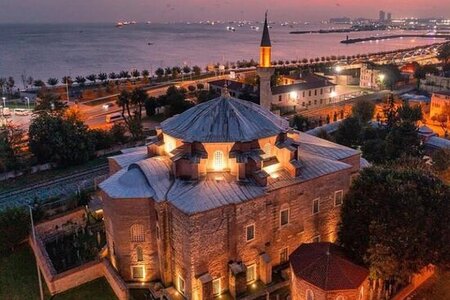
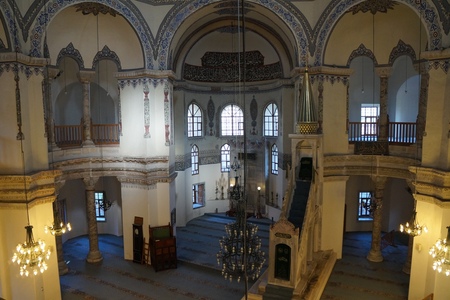
Church of Saints Sergius and Bacchus, circa 527–536 // Constantinople (modern Istanbul), Turkey.
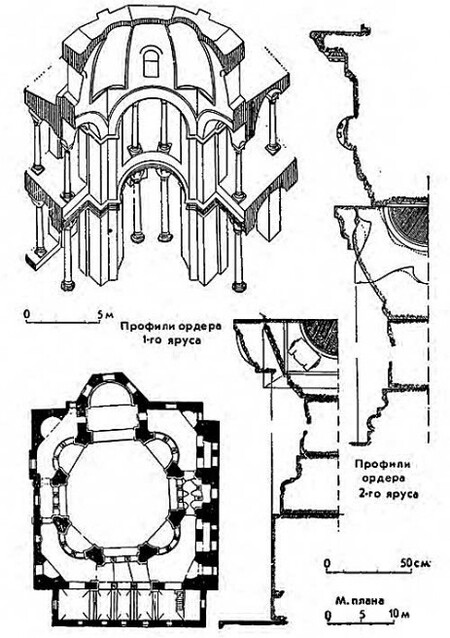
The building’s core is built upon a plan close to a square, featuring a central octagonal space. This space is formed by eight supports connected by broad arches. Above the central section rests a dome that unifies the architectural composition vertically. The structure’s distinguishing feature is the combination of several geometric forms. The square exterior outline transitions into the octagonal central section, and then into the circular space of the dome. This transition creates a sequential change in architectural forms, allowing the base of the building to integrate with its upper structure. The interior space is organized around a central axis. Arches, columns, and galleries form repeating elements that maintain the overall rhythm of the interior. Moreover, the dome serves as the principal compositional focus, drawing the viewer’s attention.
Comparing the monuments reviewed reveals that geometry in Byzantine art served multiple functions.
In the Nea Moni mosaic, the central axis helped organize the figures and create compositional balance. In the floor ornament of the Zigi Monastery, circles and repeating elements formed a unified decorative pattern. In the Church of Saints Sergius and Bacchus, geometric forms defined the structure of the architecture and unified the space around the dome. Through these techniques, individual images, ornaments, and architectural elements coalesced into a harmonious system that reflected the Byzantine culture’s view of the world’s unity and order.