HOW COMMUNICATION THEORY WORKS
The modern rise in the use of mobile fitness and health applications, particularly accelerated following global public health challenges, necessitates an in-depth analysis of communication strategies. These very strategies have become a key tool for disease prevention and the formation of healthy habits among users.
In the context of healthcare digitalization, effective in-app communication acquires special significance for long-term motivation.
Key Concepts of Health Communication
Health communication is characterized by the necessity to provide accurate and reliable information, which is critical for users' informed decision-making. The effectiveness of such communication directly depends on the level of trust in the source and its perceived authority.
Trust in the source of information is a fundamental factor determining its influence on health behavior.
In mobile fitness and health applications, the central concepts are feedback and content personalization. Feedback allows the user to track progress and adjust their actions, while personalization ensures the adaptation of provided information to individual needs and goals. These elements contribute to increased user engagement and motivation, making interaction with the application more relevant and effective.
Overview of Relevant Communication Theories for Digital Interfaces
The Uses and Gratifications Theory provides a framework for understanding how users actively choose and use fitness applications based on their individual needs. This theory explains that the choice of such applications is motivated by the pursuit of specific health goals and self-regulation. Users purposefully seek content and functionality that satisfies their needs, whether it’s tracking activity or receiving personalized recommendations.
The Social Influence Model emphasizes the significance of social connections and reference groups in the process of forming healthy habits.
In the context of fitness applications, this manifests through the integration of social support features, such as the ability to share achievements or participate in group challenges.
These elements foster the creation of a community where users can receive support and motivation from others. As researchers note: «Social influence can be a powerful incentive for behavior change, especially when it comes from significant others or reference groups.''
Analysis of Communication Strategies in Popular Fitness Applications
In fitness applications, motivational communication strategies are often based on Albert Bandura’s Social Cognitive Theory.
This theory emphasizes the importance of observing and imitating the behavior of others for forming new skills and motivation. Applications utilize mechanisms of social comparison, such as leaderboards and public achievements, so that users can observe the successes of their peers.
This creates conditions for vicarious learning and increased self-efficacy through observational experience.
An example of this theory’s implementation is the Strava feature, where users see the training results of other participants. The ability to track the progress of community leaders stimulates users to imitate and strive to improve their own metrics. Social proof of successful practices contributes to the formation of positive behavioral models. Thus, the application creates a virtual environment for social learning, which aligns with the principles of Bandura’s theory.
Personalized messages and push notifications in fitness applications implement the principles of James Prochaska’s Transtheoretical Model of Behavior Change.
This model describes the change process as a sequence of stages a person goes through before achieving sustainable behavior change. Applications adapt the content of notifications depending on the user’s current stage of readiness, be it precontemplation, contemplation, or action. For example, in the initial stages, the emphasis is on raising awareness, whereas in the maintenance stage, tips for sustaining results are offered.
The Strava application actively employs Leon Festinger’s Social Comparison Theory, implementing it through segment and leaderboard features. This approach allows users to compare their athletic results with the achievements of other participants. It creates a competitive environment that stimulates increased physical activity. As a result, users strive to improve their metrics, which contributes to the formation of consistent workout habits
MyFitnessPal applies the principles of B.F. Skinner’s Operant Conditioning, providing instant feedback upon achieving set goals. A system of rewards in the form of virtual badges and commendatory messages reinforces desired user behavior.This mechanism creates positive associations with the process of tracking nutrition and physical activity.
Regularly receiving rewards for completing daily tasks strengthens the habit of self-monitoring. Users begin to perceive the process of maintaining a food diary as a positive experience, which increases the likelihood of repeating the target behavior. Thus, operant conditioning promotes long-term engagement with the application.
Both applications incorporate elements of Ajzen’s Theory of Planned Behavior through progress visualization and social commitments. As noted in the source: «The application will build a graph of weight changes, calculate body mass index and other important metrics, and offer advice on what to eat for breakfast to achieve an ideal shape. These features help users assess their capabilities and expected outcomes, which influences the formation of behavioral intentions.»
ABOUT THE BRAND
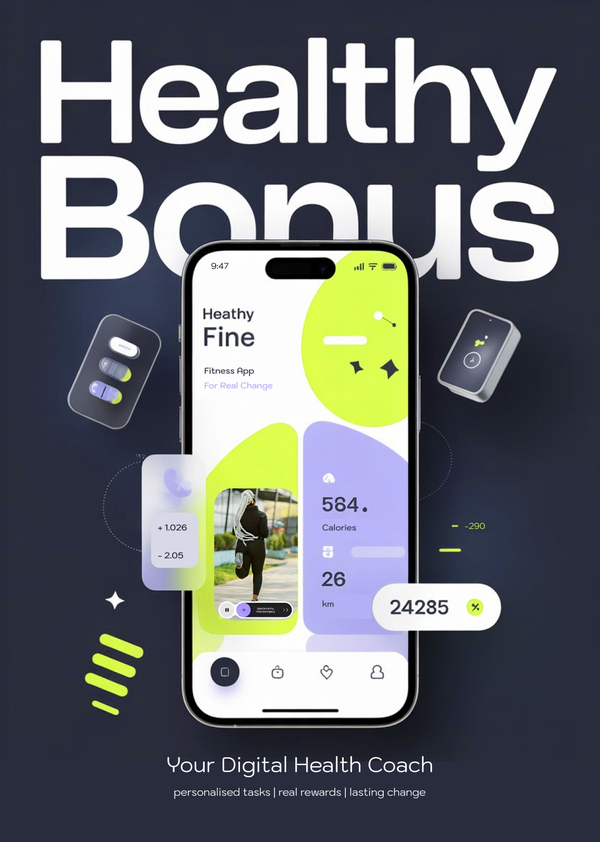
«Healthy Bonus» is a human-centered health mobile app that gently helps people build sustainable healthy habits, adapting to their lifestyle and rewarding progress with real benefits.
«Healthy Bonus» acts as your personal digital coach: it adapts to your rhythm of life, offers personalized tasks, and gently introduces changes, supporting motivation and self-discipline.
The reward for progress is a system of bonuses and discounts from your favourite Russian brands. Unlike standard apps that focus only on tracking activity, «Healthy Bonus» emphasizes real behavioral change: it helps you stay on track, adopt a healthy lifestyle step by step and without stress, and takes into account your individual health characteristics.
These tasks may include activities such as: regular walks, workouts, improving your diet, or even meditation.
For completing tasks and achieving their goals, you will receive bonuses and discounts on products that contribute to improving your health.
PRODUCT ADVANTAGES
The innovation of our product is understanding and humanity towards the user. The development takes into account the nuances of human behavior, possible disruptions to proper nutrition, laziness or poor health on days when exercising, and informational articles that explain to people how to live in harmony with their bodies and not develop dangerous eating habits. Product differences from competitors:
Our product is focused on the Russian market and offers bonuses for activity that are relevant to our target audience partners — grocery and sports stores (e.g., VkusVill, Azbuka Vkusa, Spar, Sportmaster, etc.)
Why will people buy our product?
//1 — Motivation through real benefits Users receive not just virtual achievements, but real bonuses and discounts from popular Russian brands (VkusVill, Azbuka Vkusa, Sportmaster, etc.). This makes a healthy lifestyle not only beneficial, but also profitable.
//2 — Personalization and a comprehensive approach The app not only tracks activity, but also offers individualized tasks (workouts, nutrition, sleep, meditation), helping users improve their health systematically.
//3 — Convenient integration with gadgets Support for synchronization with fitness apps (iOS/Android) and smart watches simplifies use: all data is automatically tracked on a single platform.
//4 — Gamification and ease of earning rewards Transparent mechanics: points for activity — exchange for prizes. This makes the process fun and encourages regular use of the app. Focus on the Russian market.
//5 — Focus on the Russian market Partners and bonuses are selected based on the preferences of the local audience, which increases the value of the offer compared to foreign counterparts.
Why will customers distinguish it from competitors' products/services and give it preference?
Customers will prefer our app because of the relevance and usefulness of the prizes from partners that can be obtained.
Moreover, there will be a mechanism for receiving these prizes: points are awarded for physical activity or other actions that support a healthy lifestyle, which can be exchanged for the offered bonuses directly in the app. From a technical point of view: users can allow access to other health-related apps on their devices — such as Fitness or Health in iOS — or link the app to a smartwatch (to track sleep duration, heart rate, etc.).
MARKET ANALISYS
All competitors focus on monitoring the physical activity of users.
The description of each one includes the words «tracking», «for walking/running», «monitor», «GPS», and «motivation», but only the «Sweatcoin» app mentions long-term habits and health analysis.
Apps that give points/rewards for progress do not take into account the user’s initial data (other than physical), emotional and hormonal background.
Therefore, the apps are suitable for short-term motivation or people who are already quite organized. Bonus programs are mainly for specialized stores or partner fitness centers, which are far from the average person situation.
TARGET AUDIENCE
Priority consumer segment:
«Healthy lifestyle zoomers» (aged 20–25)
— Interested in mental and physical health, but in a light, casual format
— Focused on self-expression and self-improvement, so they see the service as a way to improve themselves
— Constantly online: TikTok, Telegram — highly engaged and quick to respond to trends
— Open to new things, easily influenced by digital ambassadors and micro-influencers
— Value an individual approach and visual style; respond well to challenges, memes, and customization
Target audience needs:
— Lead a healthy lifestyle
— Stop downloading multiple apps and have everything you need at your fingertips
— Have more personalized recommendations
— Optimize healthy lifestyle expenses
PROBLEMS AND SOLUTIONS
1 — Lack of a systematic approach to lifestyle monitoring.
Solution: We offer not just individual features, but create a multi-platform that integrates all elements of healthy living, sleep and diet.
2 — The difficulty of maintaining motivation and implementing sustainable healthy habits.
People who have no one to help them establish a rhythm of life and get themselves together will not find downloaded apps helpful in taking the first step (apart from consulting dietitians and professional organizations).
The «average» user with stress and problems has no chance of gradually and carefully readjusting their lifestyle.
Solution: — Add the option to consult with specialists in the app (for the same bonuses) — Add AI that will analyze the completed data to determine whether it is necessary to recommend that the person consult with a specialist. The ability to fill out a health status form at any time and receive feedback. — Add the ability to connect with other health apps that are already on the phone (for example, Zeal Step, which connects to Apple Health).