Navigation
Concept
Chapter I. The Wheel of Fortune
Chapter II. Allegories of Virtue
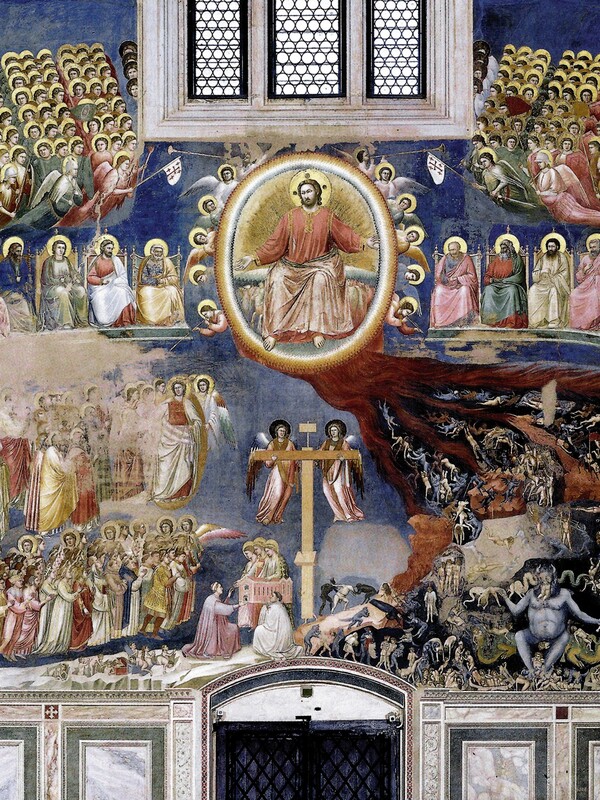
Chapter III. The Last Judgment
Conclusion
Bibliography
Image Sources
Justification for Topic Selection
Medieval art from the 12th to 14th centuries featured a sophisticated system of personifications. Abstract concepts were given human form and a consistent set of attributes—such as swords, scales, vessels, wheels, or pipes. Identifying these objects preceded the reading of inscriptions and texts and significantly shaped the viewer’s perception of the image. By the beginning of the 15th century, this system had been mastered and functioned as a language. Masters creating maps for the Milanese court were not inventing a new visual repertoire; rather, they utilized the established one and adapted it to a different scale. Examining how the image changed when scaled down allows us to determine which elements of the iconographic scheme were mandatory and which allowed for variation.
Concept
Проблема и гипотеза, Хронология и принцип деления, Метод
The work began with an observation of a group of images generally attributed to early Italian Tarot cards—the Woman with the Scales, the Wheel with figures rising and descending around it, and the Angel with the trumpet above open coffins. Each of these motifs appears in European art long before the mid-fifteenth century and in stable, recurring variations.
Consequently, these images possess a history of their own, a history longer than the history of the cards themselves. The focus of this research is precisely that history: the combination and evolution of the iconographic schemes of the Wheel of Fortune, the personifications of virtues, and the Last Judgment in European art from the twelfth to the fifteenth centuries. The cards are considered material for comparison, not the primary object of the study.
How did the iconographic schemes of the Wheel of Fortune, virtues, and the Last Judgment evolve in European art between the twelfth and fifteenth centuries, and what unique characteristics of their visual organization are evident in early Italian Tarot cards?
The iconography of the Wheel of Fortune, virtues, and the Last Judgment in early Italian Tarot cards reveals a connection to earlier medieval artistic traditions. When transitioning to the playing card format, individual elements of these traditions are preserved, while the composition and relationship between visual components may change.
The chronological scope of the work is the twelfth to the fifteenth centuries. The material concludes in the mid-fifteenth century, when the cards under examination were executed. The mosaics of Torcello are included as a boundary example of art from the turn of the eleventh and twelfth centuries.
The chapters are organized by subject matter rather than by century. Within each chapter, a consistent order of presentation is maintained: first, the combination of the scheme and its variations from the twelfth to the fourteenth centuries, then the card, and finally, the comparison.
The primary method employed is comparative visual analysis. Each work is examined according to a unified set of criteria: the construction of the composition and its center; the number and placement of figures; gestures and poses; attributes; the organization of space and the role of the background; the relative scale of the figures; and the color scheme.
Comparison is conducted based on the presence or absence of individual elements. A description of observable features precedes interpretation; where a certain explanation is impossible, it is noted as an assumption.
Chapter I. The Wheel of Fortune
Как складывалась схема и что от неё осталось в карте
Wheel of Fortune. Miniature from the Rudopis of «Karmina Burana.» Circa 1230. Bavarian State Library, Munich
The meaning of this miniature is simple and brutal. A person ascends, stays up for a short time, and falls back down. Fortune here is not a goddess or a lady, but the mechanism of the movement itself. The wheel spins, and the fate of everyone on it is already decided. The composition is built on a vertical axis. The line runs from top to bottom, and the states are distributed along it. At the top sits one who has succeeded. On the sides, some ascend and others fall, while at the bottom lies one who has already lost everything.
The inscriptions in the miniature are integrated into the image, relating each position on the wheel to a specific state: the reigning, the one who will reign, the one who has reigned, and the one who is deprived of kingship. The four-element formula belongs to the stable elements of the schema and appears in many artifacts.
The direction of movement is conveyed through the postures. The figures are not simply arranged in a circle; they are in motion—one is rising, another is descending—and this is shown by the inclination of the body and the position of the hands. The medieval master did not use a graphical arrow, so the movement is read through the configuration of the figures.
Wheel of Fortune. Miniature from a Latin manuscript. 12th century. John Ryland Library, Manchester
The miniature featuring the Wheel of Fortune is located in Gregory the Great’s manuscript, «Moralia in Job.» The codex itself dates to 914, but this date does not automatically apply to the miniature. It is a later addition to the manuscript, and its precise date remains unestablished based on current records. Therefore, this artifact cannot be dated to 914 without qualification.
The Wheel of Fortune schema lacked a single canonical interpretation. In some manuscripts, the figures seem to hang from the rim; in others, they grasp it with their hands and bodies. In the latter case, the wheel is perceived as a physical object rather than a symbolic sign. There are also variations in the role of fate’s personification and the method of depicting the wheel itself.
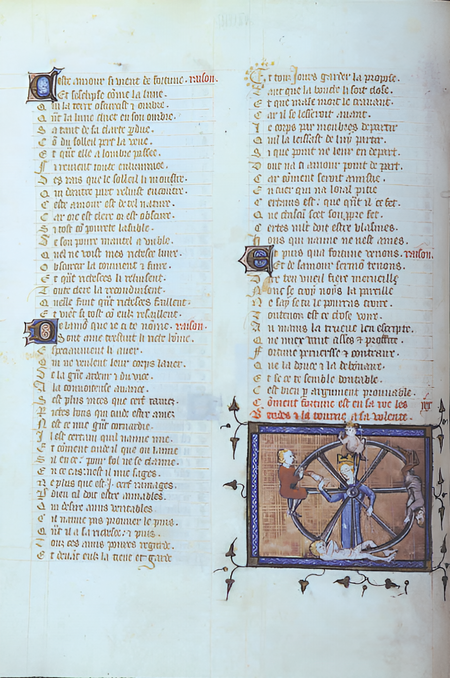
For comparison, a miniature from «The Romance of the Rose» (The Morgan Library & Museum, MS M.324, fol. 34v; Paris, circa 1350) has been featured. Fortune is depicted crowned and blindfolded; with her right hand, she holds an object, and with her left, she turns the wheel’s spindle. Four male figures are placed on the rim: one ascending the rim, a crowned king sitting at the top holding a scepter in his left hand, one descending, and one lying at the bottom, holding the lower edge of the rim. Above the miniature is the inscription: «COMMENT FORTUNE EST EN SA ROE LES YEX BENDES ET LA TOURNE A SA VOLENTE.» This inscription explains the symbolism of the miniature. The blindfold («les yex bendes») and the action done at her own will («a sa volente») emphasize the blindness, unpredictability, and capriciousness of fate—a force that elevates some people to the heights of power while casting others down without merit or logic.
Classification of Western European Art Monuments from the 11th–15th Centuries Depicting Fortuna and Her Wheel: M. A. Gorbunova’s proposal, which uses this typology as a general guideline without recounting her specific findings. Compositional Variations The wheels of Fortune vary based on several features: the position of the figures relative to the rim, the method of depicting the wheel, and the role of the personification of fate. In some monuments, Fortuna is absent, and the wheel moves autonomously; in others, she is shown at the center or to the side, driving the wheel; and in a third set, she is imbued with symbols of power or, conversely, deprived of them. The notion of a gradual and unidirectional development of the iconography—such as the idea that by the 14th century, the wheel was increasingly depicted from the side—is not supported in the literature by a specialized study and is not used in this paper. The material demonstrates the coexistence of various compositional solutions within a single period. The miniature from the Utrecht manuscript is dated to 1470. It belongs to a time when maps already existed and therefore cannot serve as evidence of an earlier tradition. Its place in this chapter is different: it shows that the same compositional variations persisted into the second half of the 15th century—meaning they coexisted with maps, rather than preceding them.
By the mid-fifteenth century, various versions of the Wheel of Fortune coexisted in European art. The examined monuments include: a schema with four positions on the rim; a personification of Fortune, which may be depicted with eyes closed; inscriptions that fix each position; and in several variations, the figure of a ruler at the top of the wheel. The latter motif is significant because it transitions into the map. Now we will examine what happened to these elements when the subject was transferred to a palm-sized map.
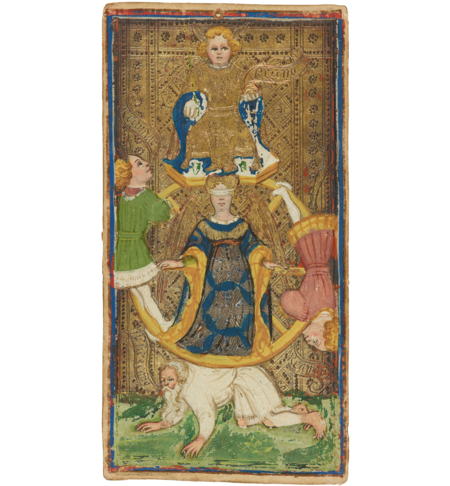
Wheel of Fortune. Map from the Visconti-Sforza set. Milan, c. 1450–1480. The Morgan Library & Museum, New York Each figure is accompanied by a scroll bearing a Latin inscription. The inscription on the upper figure reads — REGNO, on the left — REGNABO, on the right — REGNAVI, and on the bottom — SUM SINE REGNO. Thus, the inscriptions do not disappear when transitioning to map format; they are retained as part of the composition, even though their placement and the nature of their support change. In the miniature, the text is inscribed within the image field and correlated with the figures; on the map, it is moved onto scrolls held by the figures, thereby becoming integrated into the action. This observation is significant for the overall conclusion of the work. It shows that the transformation of the image is not merely about selecting the primary and eliminating the secondary: in this case, the element that ensured accurate reading in the medieval tradition has been preserved.
One detail does not correspond to the medieval monuments under review: two figures display donkey ears, and one of them has a visible tail. This characteristic is absent in the miniatures of the Wheel of Fortune used for comparison. The motif of donkey ears is associated with the set of stories concerning a ruler who has lost his human form. Such a correlation remains a hypothesis—we lack the sources that would allow us to determine the mapmaker’s guiding principle. We can only note that the grotesque element in the map’s composition is intensified compared to the miniature renderings, and this intensification relates to tone rather than structure.
Micro-conclusion
The Fortune Wheel diagram remains almost entirely in the map. The circle, the four positions on the rim, the personification of Fortune with her eyes bound, and the Latin inscriptions remain. Grotesque details are added—donkey ears and a tail. The character of the inscription carrier changes: instead of text in the image field, scrolls appear in the figures' hands. The changes affect not the structure, but individual attributes and the overall tone of the image. This distinguishes the Fortune Wheel from the two other subjects discussed below.
Chapter II. Allegories of Virtue
Фигура, атрибут и жест
In images of virtues, the arrangement is different. There are no scenes here: there is a single figure and one or two objects. On the surface, there seems to be nothing to condense. However, it is precisely in this type of material that one can see how the relationship between the figure and its attribute is constructed, which objects are associated with the virtue, and how firmly that association is established. The same virtue could possess different attributes, and comparing these images reveals the limits of iconographic tradition.
Allegory of Good Governance. Ambrogio Lorenzetti. 1338–1339. Fresco. Palazzo Pubblico, Siena
In Lorenzetti’s composition, Justice sits on a throne. Above her is a figure connected to the scales, whose pans hold angels embodying distributive and retributive justice. Strings extend from the pans to the figure of Concord, who imparts them to the citizens, and through this chain of connections, governance is linked to justice. The meaning of the composition is formed by the relationships between the figures, the length of the strings, and the distance the viewer’s gaze traverses. This structure is designed for a large wall. It is impossible in a small format, such as a separate print, because the spatial relationships among many of the figures would not fit.
This raises the question of whether the relationships between figures can replace the figures themselves in the image. In the Map of Justice, examined below, meaning is conveyed through the objects held by one figure. The scales are connected to the idea of weighing, and the sword—to the idea of judgment. This interpretation relies on established tradition and aligns with the descriptions of personifications in the monuments under review; however, it remains an interpretation, not an established fact about the artist’s intent.
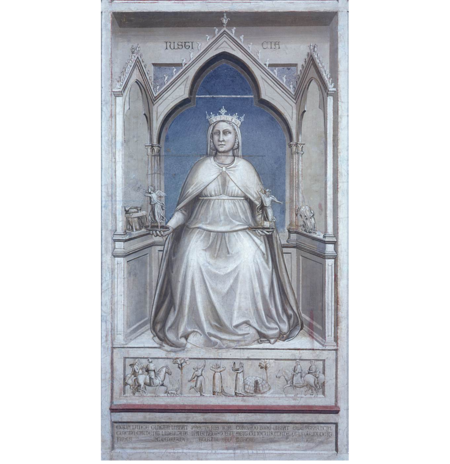
Justice. From the Cycle of Virtues and Vices. Giotto. Scrovegni Chapel (Arena), Padua. c. 1305–1306. Justice is larger than the other figures in the lower register and occupies a central position. She is seated on a wide Gothic throne; in her hands she holds scales, on the pans of which, according to the description, are shown punishment and mercy. At the base of the seat is laid out a small scene of peaceful life. The composition features a nested structure: beneath the figure of Justice is depicted what is related to her action. This construction is possible in a large work that allows for a secondary plane. The reasons why Justice is emphasized by size and placement are not formulated in the sources; the described arrangement only allows us to state her special status within the program of the lower register.
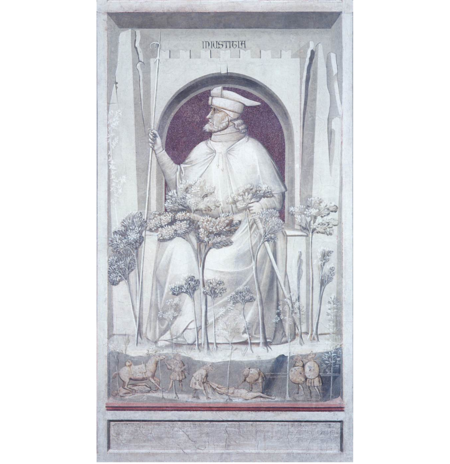
Injustice. From the Cycle of Virtues and Vices. Giotto. Cappella Scrovegni (Arena), Padua. Circa 1305–1306. The vices are located on the opposite wall, forming pairs with the virtues. Opposite Justice is depicted Injustice. The space of the chapel is thus integrated into the comparison. This paired arrangement is designed for a viewer who moves their gaze from one wall to the other. This mechanism is not present in a single map, since the map represents one figure.
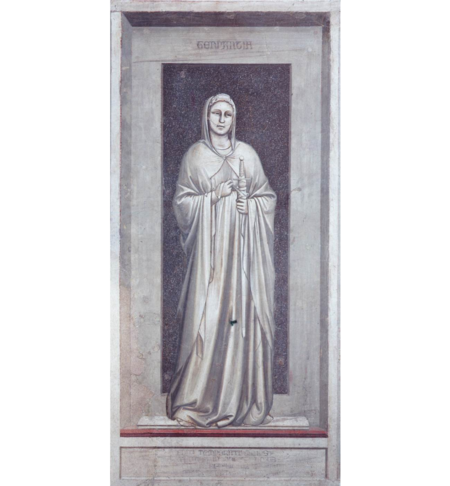
Temperance. From the Cycle of Virtues and Vices. Giotto. Cappella Scrovegni (Arena), Padua. Circa 1305–1306. Giotto depicts Temperance as a female figure standing in a niche. She holds a sword in her hands and wraps the hilt with a ribbon. The gesture of pouring liquid between two vessels is absent from the fresco—this motif is associated with another iconographic derivation of Temperance. The depiction of the figure in this form corresponds to the caption in the Web Gallery of Art; the meaning of the ribbon and sword motif in literature requires separate verification and is not interpreted here. Comparing it to Justice reveals differences in scale and composition. Justice is larger, seated on a throne, and is accompanied by a scene on the seat’s base; Temperance stands in a niche and has a single attribute. The difference concerns the figure’s placement within the fresco cycle, not just the collection of objects.