Navigation
I. Research Concept
II. Glass as a Material: From Decorative Element to Structural Basis
III. Transparent Architecture: Transformation of Boundaries and Space
IV. Transparency in Interiors: Furniture and Space Organization
V. Product Design: New Forms and Structures Through Glass
VI. Conclusion: The Impact of Glass Technological Development on Contemporary Design
Research Concept
Glass is one of the few materials that possesses both physical strength and visual lightness. Throughout history, its application has gradually transformed: from small decorative elements and luxury goods to large-scale architectural structures, furniture, and standalone objects in product design. This process became particularly noticeable in the 20th century, when advancements in glass manufacturing and processing technologies opened up new possibilities for its use.
The central theme of the research is the transformation of glass’s role in 20th and 21st-century architecture, interior design, and product design.
The study examines how material refinement has influenced object construction, principles of spatial organization, and the visual perception of the environment. Glass ceased to be merely a filler for window openings or a decorative addition—it became a full structural element capable of shaping space, defining the building’s exterior appearance, and altering the perception of familiar objects.
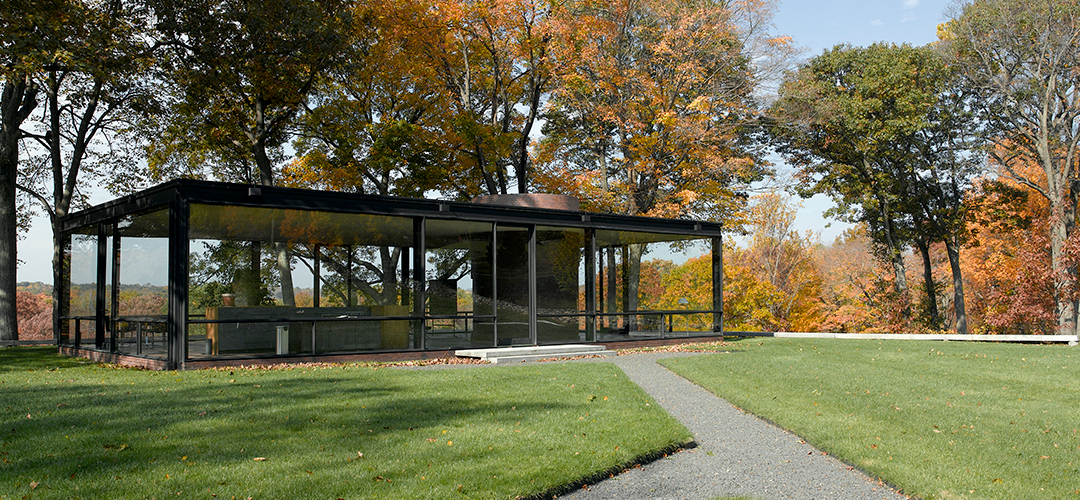
Philip Johnson’s Glass House 1949
Special attention is paid to the relationship between technological development and design thinking. The advent of new production methods—such as tempering, laminating, molding, and glass fastening—has allowed for the creation of larger, stronger, and more complex elements. This has enabled architects to experiment with transparent facades, frameless structures, and open spaces, while allowing designers to reimagine traditional furniture forms and create objects where the structure becomes visually less prominent.
Glass House Planning
Research Problem
How has the evolution of glass manufacturing and processing technologies influenced the transformation of 20th and 21st-century architecture and product design? In what ways has transparency changed the traditional perception of boundaries between interior and exterior space, as well as the construction and visual experience of objects?
Blocks of Glass
Hypothesis
The advancement of glass production and processing technologies has been one of the factors that significantly transformed the architecture and product design of the 20th and 21st centuries. Improvements in the strength, size, and methods of securing glass elements allowed the material to evolve from a predominantly decorative and infill element into an independent structural and form-defining element.
Apple Fifth Avenue by Bohlin Cywinski Jackson 2006
This opened up opportunities to create visually light architectural structures, open interiors, and objects where the physical structure remains present but becomes virtually imperceptible.
Research Objective
To trace the evolution of glass application in 20th and 21st-century architecture and object design, and to determine how technological changes in the material have influenced the form, construction, and perception of objects.
Glass as a Material: From Decorative Element to Structural Foundation
Joseph Paxton — Crystal Palace
Glass has been known to humanity for several millennia. The first artificial glass artifacts appeared in the Middle East and Ancient Egypt around the 3rd millennium BCE. Initially, glass was used primarily to create beads, ornaments, and small objects. As technology advanced, it became possible to produce larger items, and the invention of glass blowing in the 1st century BCE made its production significantly more accessible.
Glass Factory in Worksop, 1930s — Archive Film
During the Middle Ages, glass became widely adopted in architecture—primarily in the form of stained glass. Later, with the development of industrial production in the 19th century, it became possible to create large glass surfaces. This gradually shifted the perception of glass: it began transforming from a material for ornamentation and filling openings into an essential element of architecture.
Roman Glass Vessels
Basic Properties of Glass
Color and texture, transparency, reflection, form generation
The main characteristic of glass lies in the combination of its physical and visual properties. It can transmit light, reflect its surroundings, change color, and alter its degree of transparency. Simultaneously, the material maintains its hardness and its ability to retain a defined shape.
Glass Processing Technologies
Technological advancements have become a key factor in expanding material capabilities. The introduction of the industrial float process in the 1950s allowed for the production of large sheets of glass with a smooth surface. Tempering increased its strength, lamination made the creation of safe multilayered structures possible, and molding and bending technologies opened up new possibilities for shaping.
Sheet Glass Early Production Scheme