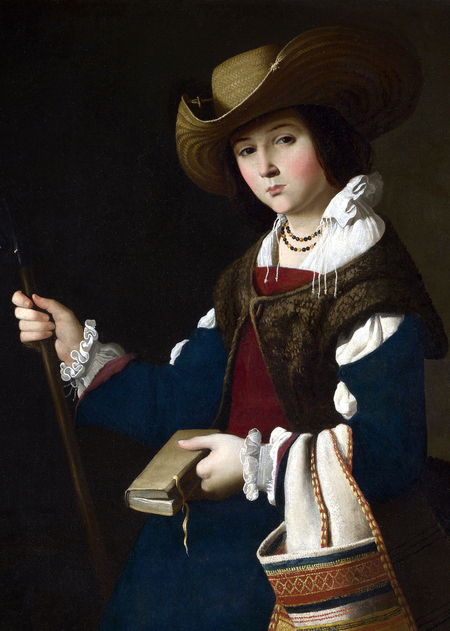
This timeline covers the major periods—from ancient Iberians to the modern era. The focus is not only on political events but also on the specific characteristics of the art of each stage. We will trace how the shift between civilizations—Roman, Visigothic, and Arab—shaped the unique cultural blend that defined the development of Spanish architecture, painting, and sculpture. From Roman aqueducts and Moorish carvings to the golden age of painting and the 20th-century avant-garde—art serves as the key to understanding Spain’s historical journey.
V век до н. э. — I век до н. э.
Ancient Iberia
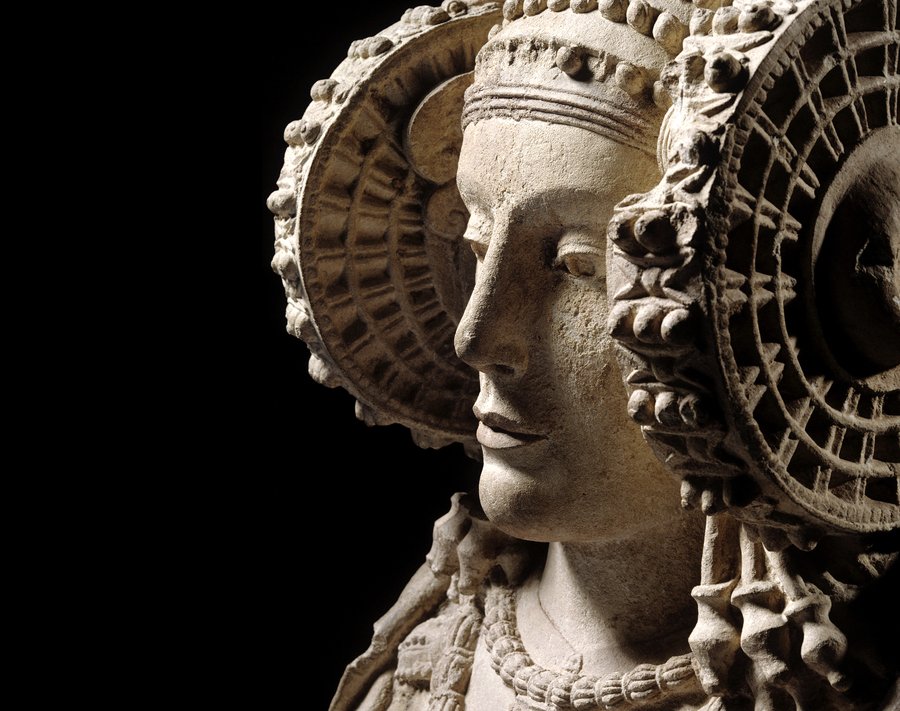
Lady from Elche. 4th century BCE.
Ancient Iberia is a term referring to the civilization that existed on the eastern and southern coasts of the Iberian Peninsula before the Roman era. The Iberians, as they were called by Greek and Roman authors, were an autochthonous people. Their society was divided into classes—nobility, priests, artisans, and dependent farmers—and was governed by kings or chieftains; in some regions, particularly along the eastern coast, a system of city-states (oppida) developed. Iberia’s economy was based on agriculture, horse breeding, and, crucially, the extraction of silver, tin, and copper, as well as the production of iron weaponry, such as the falcata.
The art of ancient Iberia demonstrates a synthesis of local traditions and Mediterranean influences, creating a unique and recognizable style. The most significant works were created in sculpture, which is divided into several regional «styles» (Levantine, Southern, Central, and Western). Prominent examples include the «Lady of Elche» and the «Lady of Baiza"—stone busts that combine Greek realism in facial representation with the distinctive Iberian geometric, architectural composition, and rich decorative embellishment. In Iberian sanctuaries, often located in grottos and near springs, thousands of bronze votive figurines of warriors, riders, and animals have been found. The polytheistic religion of the Iberians, influenced by neighboring cultures, included deities associated with the earth and horses, which is reflected in the images of the Great Goddess and the «God of the Tamer of Horses.» The Iberian script itself (a syllabic-alphabetic system of 28 signs) was in use until the full Romanization of the peninsula.
III век до н.э — IV век н. э.
Roman Spain
Ceiling panel depicting a battle between a Christian knight and a Muslim. 1300
The Roman conquest of the Iberian Peninsula began after the Second Punic War (218–201 BCE) and spanned two centuries, concluding only after the Cantabrian Wars (29–19 BCE) under Octavian Augustus. The territory was divided into provinces: Tarraconensis, Lusitania, and Baetica. Roman Spain became one of the most vital and most Romanized regions of the empire, having yielded three emperors to the state—Trajan, Hadrian, and Theodosius I. The economy flourished due to the extraction of gold, olive oil, wine, and the famous fish sauce, garum, which was exported throughout the empire.
The art of Roman Spain demonstrates a high degree of integration of local traditions with Roman canons. Majestic structures emerge in the architecture: the aqueduct in Segovia, the theater in Mérida, and the bridge in Alcántara. Sculpture, like throughout the empire, served the purposes of propaganda and funerary rites; magnificent portraits of emperors and local nobility, as well as mosaics, have survived. The most significant literary phenomenon of Roman Spain was one of its natives—the Stoic philosopher Lucius Annaeus Seneca the Younger. The Romanization process led to the widespread adoption of Latin and Roman law, although local languages persisted in the more distant regions of the province. The crisis of the 3rd century and subsequent invasions by Germanic tribes led to the decline of Roman authority, which concluded in the 5th century CE.
V–VII века
Visigothic Kingdom
King Recared I’s Conversion to Catholicism in 589
Following the collapse of the Roman Empire in the 5th century, the Visigoths settled on the Iberian Peninsula, establishing one of the most significant Germanic states of the time. Initially, the Arian kingdom was established with its capital in Toulouse, but later, after a defeat inflicted by the Franks in 507, it moved to Spain, settling in the new capital of Toledo. The conversion of King Recared I to Catholicism in 589 at the Third Council of Toledo strengthened the alliance between the crown and the Church and accelerated the fusion of the Visigothic and Hispano-Roman nobility. The political history of the kingdom was rife with civil strife, but its legal system, codified in the «Book of Judgments» (Liber Iudiciorum) under Recceswinth, became a model for subsequent eras.
Art of the Visigothic Period represents a unique synthesis of late Roman traditions, Germanic elements, and Byzantine influences. In architecture, stone churches dominate, distinguished by their simple, massive forms and the characteristic horseshoe arch. Notable examples include the Church of San Juan de Banyos (whose inscription confirms its foundation by King Receswinth) and San Pedro de la Nave. Sculpture is primarily found in stone carvings on capitals and altarpieces, featuring ornamentation such as interlacing patterns, rosettes, and animals. Jewelry reached its zenith through the techniques of cloisonné and garnet inlay, evidenced by finds from the Guarrasar treasure hoard, which includes magnificent golden votive crowns suspended above the altar.
VIII век
Arab Conquest
Kordovskaya Cathedral Mosque. Construction began in 784.
In 711, an Arab-Berber army led by Tariq ibn Ziyad crossed Gibraltar and decisively defeated the Visigothic king Roderic in the Battle of Guadalete. By 720, most of the Iberian Peninsula had been captured by Muslim forces, ending the Visigothic Kingdom. The conquest was characterized by its speed and relative ease, facilitated by internal strife among the Visigothic nobility and the support of the local population—who were dissatisfied with Gothic oppression—for the Muslim forces. The conquered territories became part of the Umayyad Caliphate, known as «Al-Andalus, ” with Córdoba as its capital, initiating an almost eight-century Muslim presence in the region.
Al-Andalus Society formed as a complex conglomerate of Muslims, Christians (Mozarabs), and Jews. A period of active cultural and economic exchange began. In the arts and architecture of this era, Byzantine, Visigothic, and Eastern Islamic traditions synthesized. The foundations of the Cordoban architectural school were laid, with the Great Mosque of Cordoba (begun in 785) being the most brilliant example—it is known for its characteristic horseshoe arches and tiered arcades. Agriculture (new crops and irrigation systems were introduced), sciences, and crafts developed intensively. At the same time, small Christian states began to form in the north of the peninsula, initiating the Reconquista.
Jaime Hugue. Archangel Michael. 1455–1460
The Reconquista was a prolonged process during which Christian states reclaimed the Iberian Peninsula from the Muslim rulers of Al-Andalus, beginning in the 8th century after the Battle of Covadonga (c. 722) and concluding in 1492 with the capture of Granada. The process proceeded unevenly, marked by both military campaigns and periods of peaceful coexistence. Key milestones included the capture of Toledo in 1085, the victory at Las Navas de Tolosa in 1212, and the gradual annexation of territories by Castile and Aragon. By the 13th century, only the Emirate of Granada remained under Muslim control, and it had become a vassal of Castile.
The era of the Reconquista forged a unique culture where Christian, Islamic, and Jewish traditions intertwined. In art, this manifested in the flourishing of the Mudéjar style, characterized by the use of brick, tilework, plaster carving, and wooden ceilings in buildings constructed by Muslim artisans for Christian rulers (such as the Monastery of San Juan de los Reyes in Toledo). Simultaneously, Romanesque and Gothic architecture developed (cathedrals in Burgos, León, and Toledo). A pivotal cultural phenomenon was the School of Translators in Toledo, which facilitated the transfer of ancient and Arab knowledge to Europe. The conclusion of the Reconquista and the unification of Castile and Aragon under Isabella and Ferdinand created the preconditions for the formation of a unified Spain and the beginning of the Age of Great Discoveries.
The Union of Aragon and Castile
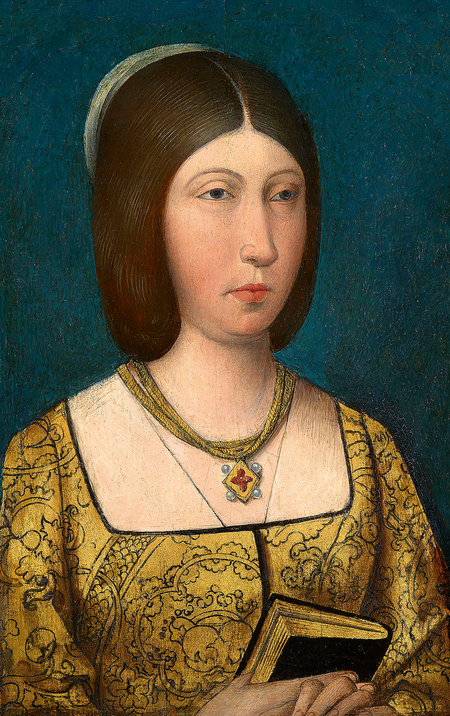
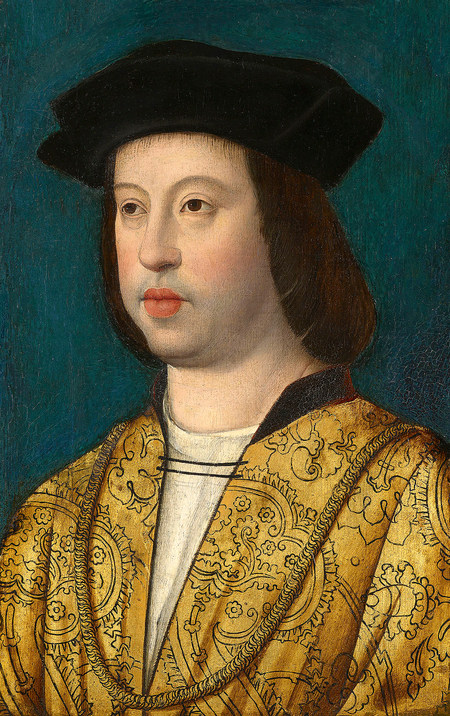
Left: Isabella I of Castile, Queen of Castile and Leon Right: Ferdinand II of Aragon, King of Castile and Aragon
The key event that predetermined the formation of a unified Spain was the marriage between Isabella of Castile and Ferdinand of Aragon, concluded in 1469. This dynastic union led to the unification of the two largest kingdoms of the Iberian Peninsula, which, while retaining their own laws and institutions (fueros), began to conduct coordinated foreign and domestic policy. Their reign—marked by the completion of the Reconquista with the capture of Granada in 1492 and the establishment of the Inquisition (1478)—laid the foundation for a centralized Spanish state. The annexation of Navarre in 1512 became a crucial symbolic act, finally uniting almost the entire territory of modern Spain under a single crown.
The era of the «Catholic Monarchs» (Los Reyes Católicos) marked a period of cultural flourishing and profound social transformation. In architecture, the late Gothic style (Isabelline) became enriched with elaborate ornamentation, exemplified by the San Juan de los Reyes Monastery in Toledo and the Royal Chapel in Granada. Simultaneously, the consolidation of royal power was reflected in monumental civil structures, such as the Infanta Do Palace in Guadalajara. The monarchs' support for the sciences and arts—notably their patronage of Christopher Columbus, who discovered the New World in 1492—ushered in Spain’s Golden Age. However, the expulsion of Jews (1492) and Morisco populations damaged the economy and ended centuries of cultural coexistence, firmly establishing Catholicism as the bedrock of national identity.
Discovery of America
Theodore de Bry. Christopher Columbus arrives in America. 1594
Christopher Columbus’s discovery of America in 1492 marked a turning point in world history. The expedition, funded by the Catholic monarchs Isabella of Castile and Ferdinand of Aragon, reached the shores of the New World on October 12, 1492, when the ships Santa María, Pinta, and Niña anchored off San Salvador Island (Guanahani) in the Bahamas archipelago. This voyage initiated subsequent expeditions in 1493, 1498, and 1502, during which the Greater Antilles, the coast of Central America, and the northern coast of South America were discovered—laying the foundation for the establishment of the Spanish colonial empire.
The opening led to the «Columbian Exchange"—a massive transfer of plants, animals, cultures, technologies, and ideas between the Old and New Worlds. In Spanish art and culture, contact with new lands spurred a surge of interest in exoticism, which was reflected in decorative arts and the ornamentation of architectural structures. However, colonization had catastrophic consequences for the indigenous populations of the Americas, resulting in a demographic disaster due to imported diseases and the exploitation of local labor. The Treaty of Tordesillas, signed in 1494, divided spheres of influence between Spain and Portugal, securing Spain’s rights over most of the New World, which defined the geopolitical map for centuries to come.