Every place holds its own secrets and history. Some of them are close to us in knowledge, while others remain undiscovered, shrouded in mystery and new questions for which there are yet no answers.
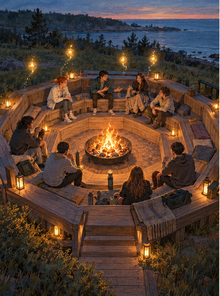
Currants, linden, domestic goats, and wild snakes—and the cherry pit that accidentally falls onto them—as you walk across a dry, overgrown field toward the beach in the evening after the midday heat, stuffing berry after berry into your cheek. And then there are the evenings, the creaking of a bed, the whispers of children, and the scary stories told under the glow of a single flashlight passed from hand to hand. At some point, it flickers out, and someone inevitably gasps because the joke succeeded: it had silently crept up behind the bed, and in the first second of darkness, it had seized their ankle.
In moments like those, the local legends sounded particularly compelling. Whether it was the abandoned house in the field (Do you know why it was never finished? I think I saw a light there last night… Silly! It wasn’t a light at all. Ghosts? Ghosts), the gate a little further down the road, fenced off from other structures (If you open it, you end up on «the other side.» And what’s there? I don’t know, no one ever came back from there), or the water tower with rusty streaks (It’s not rust! Then what is it? Think about it… Oh!).
It’s a shame we didn’t know about the underground passages in those times, the origin of which remains shrouded in mystery to this day.
As soon as the word «catacombs» is mentioned, our ears perk up. What is so special about them? History? Speculation? Truth? There is no single answer. Such things are «other» to us—they are hidden from the mainstream and become unique. Their very existence raises questions: for what purpose, and for what reason? There are far more potential explanations than one can imagine, and perhaps the majority of them are true, just like all the theories about how these underground tunnels were used.
The Catacombs of Henichesk witnessed much: smugglers, ordinary merchants, military personnel, and thieves. They sheltered anyone who needed to remain unseen. They were salvation, they were a path, and they were death.
After all, the core concept of such places is always the same—if you want to hide something, you bury it underground. But to utilize these things requires courage.
And you also need faith.
Myths and legends often speak of underworlds—places where the deepest shadows reside. Light flickers only from candles; breaths are ragged, as if oxygen is scarce, and the heart beats heavily, resonating in the tips of the fingers. The deeper you venture into the dungeon, the more you contemplate what might be hiding around the next corner. It is not just the location that is frightening; it is the unknown. Stories of ghosts cease to sound like nonsense when shafts of light sink into the darkness crafted by the earth’s mass. How many people have truly perished here? You flinch at the thought, calculating how old the catacombs are—likely two millennia.
No one ever sought out the catacombs. People stumbled upon them by chance, as if the underworld itself beckoned them to see what lay hidden beneath their feet—it promised secrets and treasures, it spoke in an ancient tongue, and it guaranteed that everyone who entered would brush up against history. Or perhaps, become a part of it, leaving the warmth of their own body beneath the earth.
Sometimes a nagging, ticklish unease, originating deep within, proves to be correct. The catacombs were never scattered; they were always an integrated system—a boundary defining what the human imagination is capable of conceiving. The earliest reference that can be connected to this enigmatic land stretches back, like a thread, to Herodotus: his records from the 5th century BCE contain accounts of sacred sites in the Priazov and Black Sea regions, where local tribes performed rituals honoring chthonic deities. There is no precise location—the concepts of time and world structure diverge too greatly from geography, making it increasingly difficult to align coordinates with each century—but the region itself—Syvash, the Rotten Sea, and the coastlines riddled with lagoons—has been considered a frontier for centuries, not only geographically but in some other, more profound sense.
In lands where reality grows thin.
Later, Scythians settled here, followed by Sarmatians. Then, the Yenichi fortress emerged under the Turkish flag, inheriting pathways that already existed in the ground, rather than creating them. Here, the historical record ends. What was excavated as an ancient sanctuary, what was built out as a defensive passage, and what is a natural karst cavity inhabited by people—no one can say today.
Too few studies, too many collapses, and the earth stubbornly keeps its own silence, even as it calls to be heard.
But if one falls silent, others speak for them.
People love to talk. Legends are passed down from one generation to the next, accumulating new and new details. Where fiction ends and truth begins—the boundaries blur. Whispers send a shiver down the spine, the storyteller lowers their voice, and shadows stretch longer. There’s no flashlight anymore, and we are far from children, but in the dark, the images of the past still emerge clearly.
The Yenichi Fortress was drawing to a close, power had shifted, and amid the everyday routine, oddities began to emerge—confined within uninvited guests. They were educated and carried themselves with dignity—straight backs, lifted chins, a slight nod as a greeting to almost every passerby. Yet, the locals kept their distance from them. There was something in the way these newcomers spoke, their measured words and careful selection of language, and an accent far from the capital, though no one could pinpoint the peculiar sensation tickling their ears.
Some locals mentioned in gossip another peculiar feature of the guests: it seemed their housing choices weren’t arbitrary. Some shrugged off these observations, suggesting they simply kept to themselves and stayed close to one another—what was the big deal? But others didn’t dismiss the notion of design; it wasn’t about their proximity to each other, but the fact that they were situated near the entrances to the old underground passages.
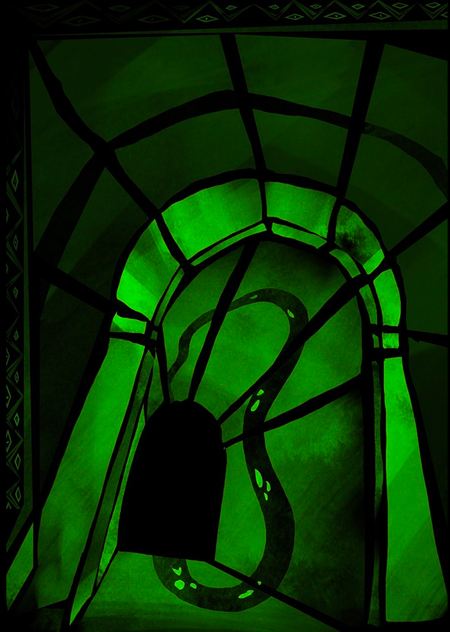
Their societies spread across the entire country. Not people who enjoyed crowds, they hid wherever it was permissible. Catacombs became just one of their meeting places. The earth knows how to keep secrets; beneath it happens what is not allowed on the surface. There, scales do not glisten in the sun, tongues divide, whispers grow louder, but the rustle does not overpower. Tunnels are more familiar than roads; the stone is cold and damp, but the blood still does not warm—they have nothing to complain about.
The catacombs retained ancient rituals; history remained within the walls. Some worships gave way to others, the underground changed its inhabitants, yet it seemed to retain its core essence. The passages deepened, connected, and bore new markings. They brought with them their faith and oaths, and with them, a mystery.
A place where the veil between realities is thin, and something else strives to break free, will always attract interested parties. Like a magnet, it draws in adherents and opens before them different paths—paths filled with darkness, salt, and the taste of iron on the tongue. It always knows what it desires, and this is not about gold—though treasures might still be hidden somewhere within on the lower levels, long claimed by the water. This place awaits what is hidden within the human being itself: desire.
Once a year, when the moon turned its dark side toward people, when the lagoon fell under the spell of silence, and when fishermen refused to go out to sea without explanation, locking themselves in their homes and staring at the crosses, a quiet hiss spread through the surroundings. The lanterns went out, the candle flames flickered in a wild dance, fading away and freezing with a smoking wick. Shepherds stood inside the barn, one hand holding a torch, the other a rifle, but it was useless—as soon as they blinked, captured the moment of darkness, the goats began to bleat, and among them was one missing member—a small, black kid goat.
Among the trembling residents, there were brave souls. Two or three people slipped out of their homes quietly—not even the doors creaked, and the dry earth muffled their steps. They didn’t look back, clutching the small bundle in front of them, their lips parted in silent prayer. If they met near the church, they didn’t speak to each other or offer a nod; they stood humbly by the entrance, until the cold ran down their spines and their eyes were covered by a thick bandage that carried the acrid smell of mold.
They were moved quickly; after turning the third corner, their heads began to spin, and nausea rose in their throats. In the furthest hall, they were forced to kneel and place the bundle on the stone floor. The oath rumbled from the walls—the words were indecipherable—but the melody compelled them to bow their heads even lower. They were told to swear, and they swore.
Among the trembling residents, there were brave few. Two or three individuals slipped out of their homes, silently—not even the doors creaked, and the dry soil muffled their footsteps. They didn’t look back; they clutched their small bundles to their chests, their lips parted in silent prayer. If they met near the church, they didn’t speak to one another or nod; they shifted humbly at the entrance until the cold prickled their skin and their eyes were hidden beneath thick bandages that smelled strongly of mold.
They were hurried along, and after the third turn, their heads began to spin, and nausea rose in their throats. In the furthest hall, they were made to kneel and place their bundles on the stone floor. The oath rumbled from the walls—the words were unintelligible—but the melody compelled them to bow their heads even lower. They were told to swear, and they swore.
The lamb stamped its hooves, rearing up, crying out in a long, drawn-out wail. Someone involuntarily flinched at its cry. There was something human in its «me, ” a call for a mother’s child, nothing less. But this lasted only a short while—the dagger hung in the air, a precise movement poised to take a life. Even the supplicants felt something unravel inside; a cold enveloped their legs, something heavy settled on their shoulders, and a hiss deafened them. They involuntarily extended their hands; there was no pain, only the warmth of blood trickling downward. They were asked to voice their petitions; miracles were promised to them, and the volunteers pleaded—for the dying to have health, for success in a ruined venture, for the return of what could not be recovered.Miracles did happen. The spilled blood was not in vain, but it carried something far more sinister than the unattainable hopes of a human who dared to defy fate. The scales lost their balance, swinging back and forth; the pans tilted to one side, then the other, hanging suspended, and ultimately made the wrong choice: death claimed the wrong person, and poverty struck their neighbors. Coincidences swept through the entire settlement, street by street. Fate turned away, but only slightly, veering toward another house, reminding those who dared challenge it of its presence.
Whether it was truth or a lie, the fear still burrowed under my skin.
People noticed it, even if they couldn’t logically explain their suspicions. Every new moon seemed like a curse, even though the moon never went underground; it whispered of the arrival of something that lived beneath the earth, trading fates for blood, waiting for those willing to take a risk for a desired outcome.
Time passed, and the legend endured, passed from mouth to mouth, fearful of being forgotten.
Fear gave way to curiosity; people began going underground, studying and comparing findings, even though the new moon is still considered a suboptimal time for such excursions.
Some even advise against taking anything with them and, under no circumstances, spilling a drop of blood on the stone floor—what if the boundary has become thinner?
The Genichesk Catacombs — The Legacy of Great Serpents // Khersonci. — URL: https://khersonci.com.ua/public/19907-genicheskie (accessed: 10.09.2026).
The Genichesk Catacombs and the Arabat Spit Burials: Mysteries, Puzzles, Facts // Na More. — URL: https://namori.com.ua/ua/blog/genicheskie-katakombyi-i-kurganyi-arabatskoy-strelki-taynyi-zagadki-faktyi (accessed: 10.09.2026). An overview of the legends and origin theories of the catacombs, as well as information on the Arabat Spit burial mounds.
Yu. Belichko. The History of Henichesk: The Genichesk Catacombs // Genichesk.com.ua. — URL: https://genichesk.com.ua/other/katakomby/ (accessed: 10.09.2026). A detailed study by local historian Yu. Belichko, connecting the catacombs to ancient myths, sacred complexes, and underground springs.
Genichesk Catacombs — Belichko // Henichesk.ru. — 2024. — April 4. — URL: https://henichesk.ru/articles/15-genicheskie-katakomby-belichko.html (accessed: 10.09.2026). An excerpt from Yu. Belichko’s work describing the structure of the tunnels, theories of their origin, and their use across different historical periods.
«The Kherson Compass»: A City at the Crossroads of Water and Land, Reality and Legend // Henichesk.ru. — 2026. — February 16. — URL: https://henichesk.ru/articles/25-hersonskii-kompas-gorod-na-grani-vody-i-sushi-realnosti-i-legendy.html (accessed: 10.09.2026). A popular essay on Henichesk, featuring legends of underground passages, «eternal pits, ” and Scythian treasures.
The Genichesk Catacombs // Henichesk.ru. — URL: https://henichesk.ru/dosug/4-genicheskie-katakomby.html (accessed: 10.09.2026). An article discussing the catacombs as an ancient architectural project linked to myths of serpent-men and the «Herodotean hoard.»