Rubric: 1. Introduction 2. Research Question 3. Research Hypothesis 4. Basilica 5. Transitional Dome System 6. Cross-Domed Church 7. Conclusion
The concept of my visual research is based on an in-depth study of the transformation process from a basilica to a cross-in-square church, using religious structures in Armenia and Georgia as case studies. The specificity of this work stems from my personal interest and acquaintance with the traditional architecture of these countries. When selecting sources, I relied on authoritative publications and articles on architectural history in general, as well as in the context of the countries I am examining. The structure of the visual research is organized around examining three main stages of the architectural tradition’s transition from the basilica to the cross-in-square church. Within each stage, I provide an example of one church building from each country. This methodology allows for a comparison not only of the basilica, the transitional dome system, and the cross-in-square church, but also of Armenian and Georgian architectural traditions against each other.
The key question of my visual research is: How did the transition from the basilica to the cross-in-square system alter the structure, architectural appearance, and spatial organization of the Eastern Christian church in Armenia and Georgia?
The research hypothesis is built on the assertion that the shift to the cross-domed system represents a complex, nonlinear process that led to fundamental changes in the spatial and volumetric organization of church architecture. Influenced by cultural, technological, aesthetic, and political factors, the longitudinal orientation of the basilica transforms into a centralized composition that becomes increasingly relevant over time. Crucially, the transformation process in Armenia and Georgia occurs asynchronously and not always for the same reasons.
Basilicas
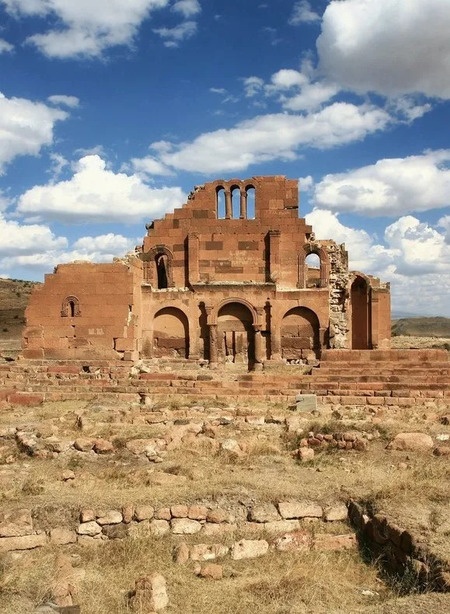
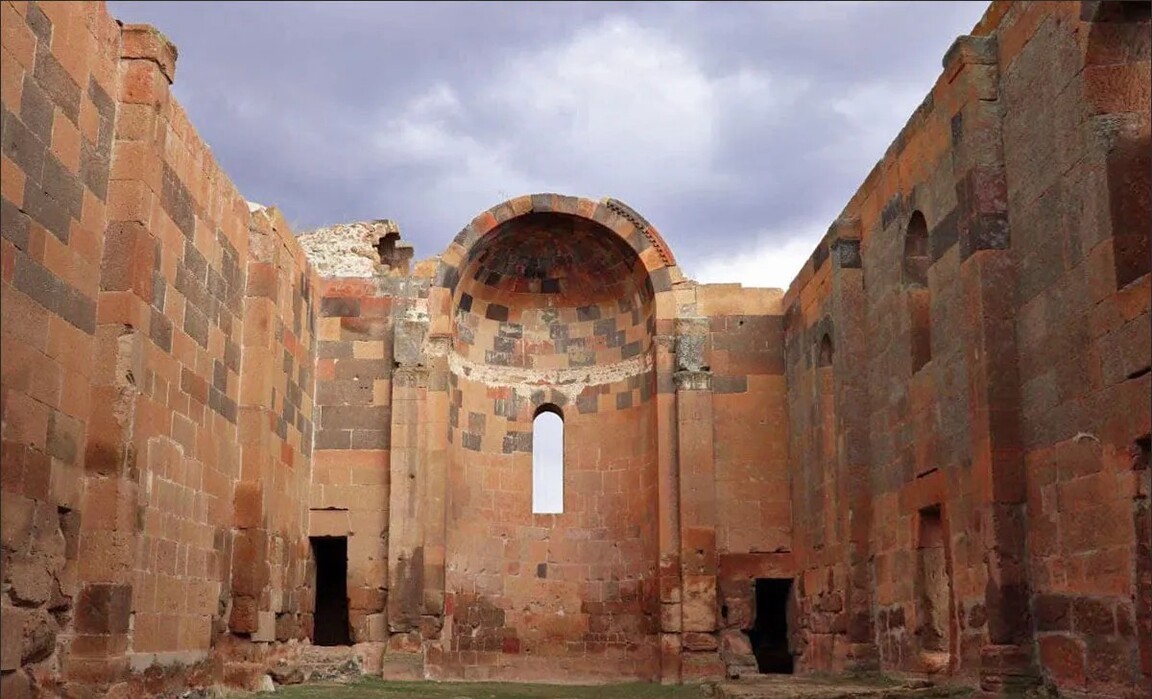
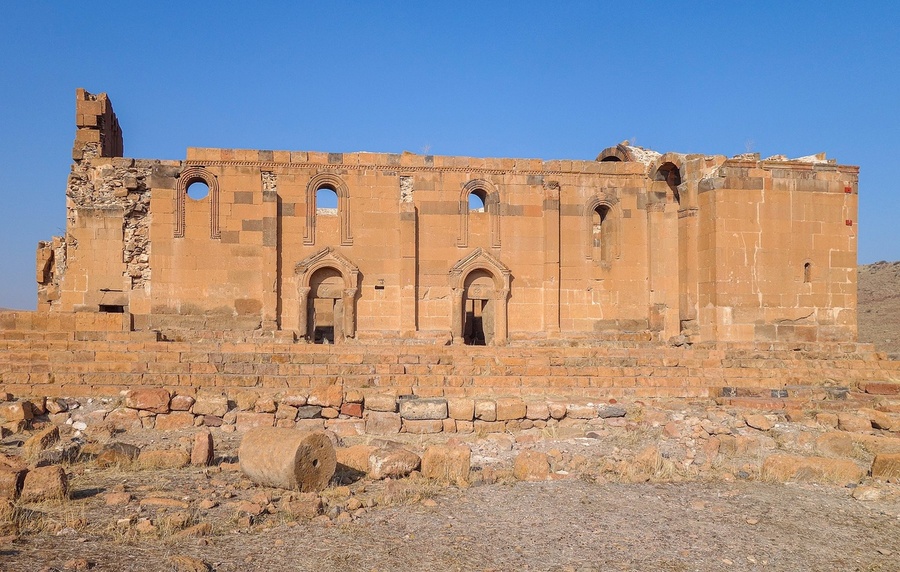
The Yerruyk Church is a three-aisled basilica constructed from light tuff stone in the Shirak Province of Armenia. I view it as the starting point for my research because, dated to approximately the 5th–6th centuries, it is one of the finest examples of ancient Armenian early Christian architectural tradition.
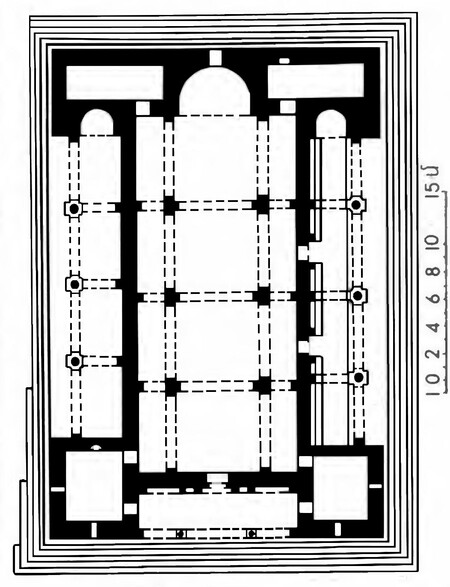
The core of the church’s spatial composition is based on a three-aisled basilica scheme. The central nave forms the primary axis, establishing a longitudinal orientation for the interior space, which is sectioned by rows of supports. The side aisles play a subordinate role. This architectural structure creates a sequential perception of space, extending from the entrance to the sanctuary, which serves as the compositional culmination. The church features apses projecting from the main volume at its sides. They were likely connected by galleries—a detail that remains uncertain because Yereruyk is partially ruined.
https://photocentra.ru/images/main52/525010_main.jpg (accessed November 9, 2026).
https://avatars.mds.yandex.net/i?id=8738f5c8a951803969ffefab22033ef7_l-12260990-images-thumbs&n=13 (accessed November 15, 2026).
https://upload.wikimedia.org/wikipedia/commons/9/9a/Yereruyq_bazilik_plan.jpg (accessed November 16, 2026)
https://avatars.dzeninfra.ru/get-zen_doc/271828/pub_674dcaa190159b1cf8bf0610_674dccc22256fe386c863854/scale_1200 (accessed November 16, 2026)
https://i0.wp.com/www.armgeo.am/wp-content/uploads/2022/02/photo_2021-03-27_14-19-23.jpg?w=1200&ssl=1 (accessed November 16, 2026)