Artist Statement
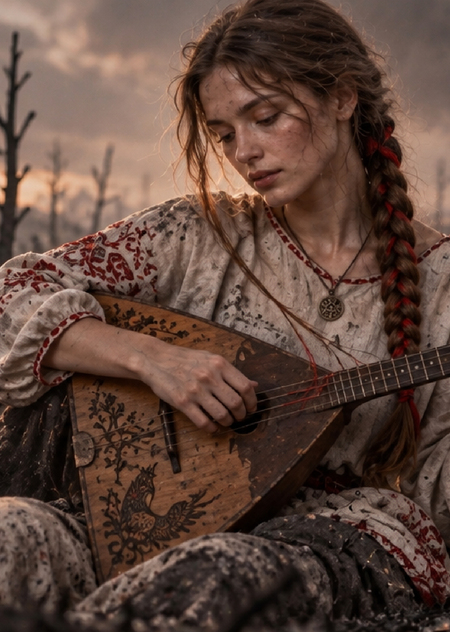
LADANA’s real name is Aglaya Vetrova; she is 24 years old. She was born in a remote northern village near Khanty-Mansiysk. Her grandmother, a shaman, taught her ancient songs and the magical power held within words and voice. The girl often practiced these traditions, which led to ridicule at her local school.At 16, Aglaya moved to St. Petersburg to escape the mockery and start life anew. The northern capital was full of grit, noise, betrayal, and hard labor. She almost abandoned her «roots» to conform to others’ standards of «normalcy.» One day, when things became overwhelmingly difficult, she found a cassette tape in an old bag—a lullaby recorded by her grandmother. Her voice pierced right through the girl.Aglaya realized that her «difference» was her armor. She gathered a small group of rockers and «folk artists» who wanted to play something authentic and unique. They adapted her grandmother’s songs for heavy guitars and traditional instruments. This is how the project «LADANA» was born, with her becoming its central figure and lead vocalist.
Overall Concept
The mythology references the Slavic goddess Lada, the patron of spring, love, marriage, and rebirth. This is the archetype of «eternal femininity, ” bringing warmth, light, and life. In Old East Slavic, „lada“ means beloved or spouse, and „lad“ means harmony. This underpins the concept of bringing chaos (like fate) into harmony (the folk).
The entire vocal and musical concept is built on the contrast between delicate vocals, folk elements, and heavier instrumental work, all carrying a clear, bright message. The songs explore how to achieve inner harmony through pain, history, and the myths of ancestors.
Identity
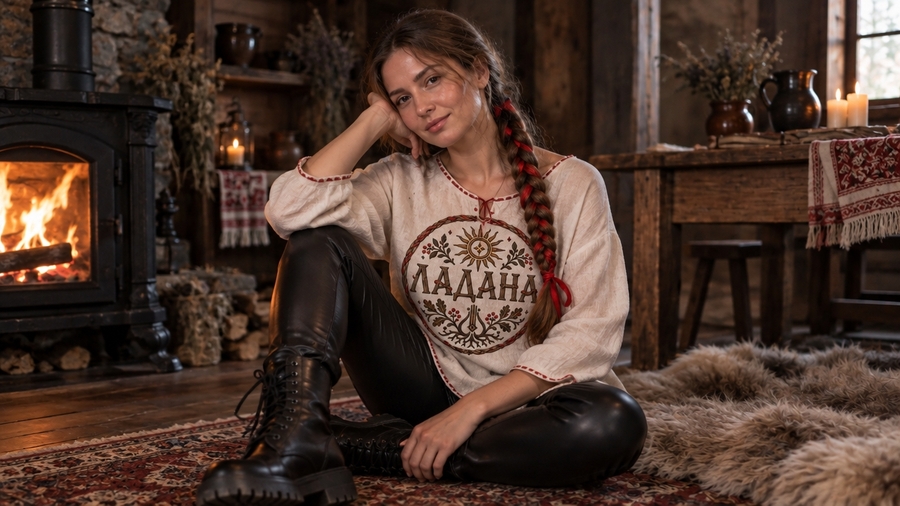
Logo: A circle symbolizes harmony, the sun, and the cycle. Custom antique typography with a «natural» wood texture, a musical instrument at the bottom to represent musicality, and a red thread as a symbol of fate and an amulet from Russian mythological symbolism. There is a subtle ornamentation inspired by Russian ethnic motifs. The sun symbolizes divine beginning, and also denotes life and light.
EP «HAIRCUT»
Lada’s debut release functions as a rite of passage, unfolding in five stages. «Postrigi”—an ancient Slavic ritual of the first haircut—signifies the transition from childhood to adulthood, or perhaps the shift of divine guardianship from feminine to masculine forces (depending on the source).For Aglaya, this album chronicles her personal journey of becoming—from a „weak village girl“ to a strong adult woman capable of defending herself, drawing strength from her origins. Each track reinterprets a Russian folk song through a rock lens, where lyrical vocals counterpoint a guitar-driven chaos.
There are 5 tracks in total:
1. I was born like a wildflower
2. And we sowed millet
3. The cuckoo was cuckooing…
4. Hush now, mother, green grove
5. Shave
1. I was born like a weed in a field
I was born like a field weed—a reference to a goddess spinner, patroness of female destiny and moisture. The girl—a «bylinka”—is a solitary stalk in the field, whose thread of fate has not yet been spun.
2. And we sowed the grain
«We Sowed Millet» (a ritual circle-dance song-game for spring). The song is dedicated to Lelya—Lada’s daughter and the goddess of spring and youth. The «millet sowing» ritual was a magical reenactment of the agricultural cycle and the beginning of growth, intended to ensure a fertile harvest.
The cuckoo calls…
«The little cuckoo sang…» (a wedding song). The main character, Maryushka, cries to her mother and father—a sense of being stuck in the past—but through this «painfulness, ” the girl pushes through and moves on. In the context of the album, this takes on the character of a new life forged through experienced darkness.
4. Hush, mother, green grove
«Don’t make noise, mother, green grove» (a roguish, lively song). The main character is a young man who asks the «grove» not to make noise so that he can think—this symbolizes that to hear one’s inner voice, one must stop the «external» noise.
5. Cut
Ladana’s original song, structured around the ritual of tonsure: renouncing the old name, followed by symbolic death and rebirth. Here, Ladana herself is the goddess of spring, love, and harmony. The Alkonost bird is a bright creature of joy, a resident of Iria. The finale, where light does not battle darkness, but simply shines, defying everything.