The city left on the canvas
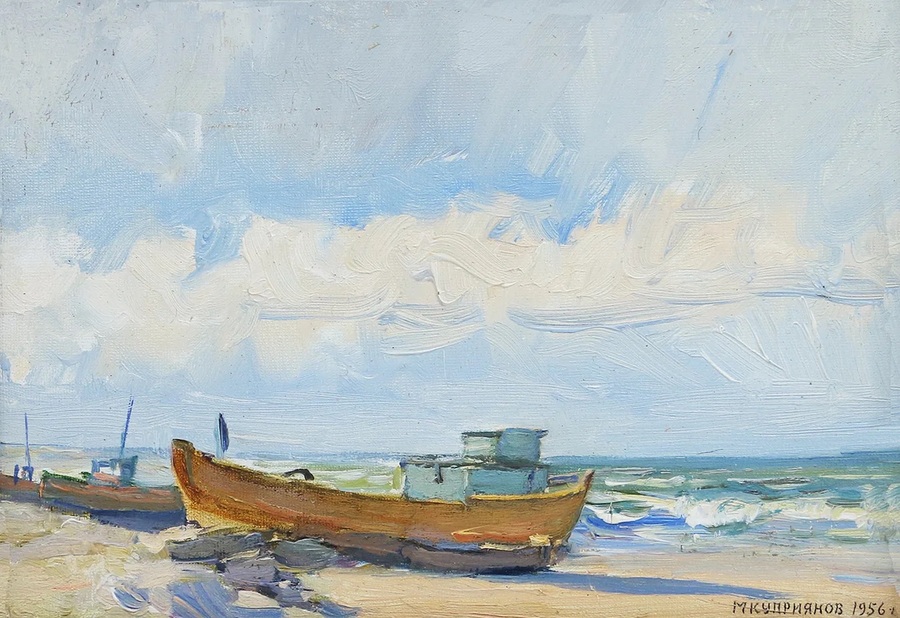
«Genichesk. Fishing Boat» M. Kupriyanov, 1956
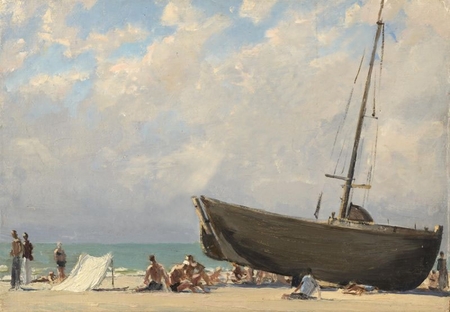
There are cities that enter one’s life by chance, yet it later becomes impossible to imagine life—or even art—without them. For the artist Mikhail Vasilievich Kupriyanov, that place became Genichesk—a quiet, almost provincial town on the Azov Sea. He hadn’t specifically sought it out, but he came once, and realized he could never leave for good.
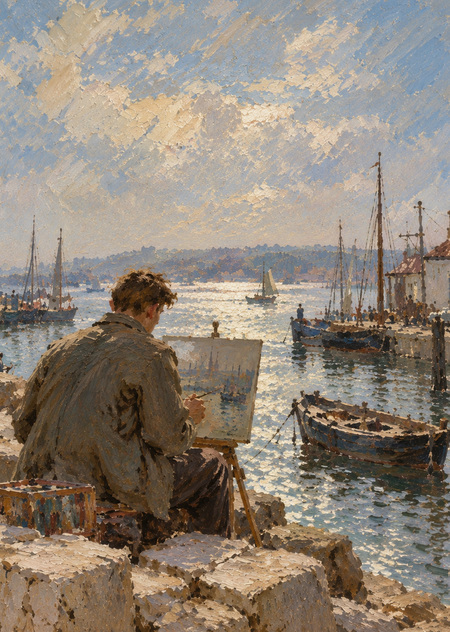
Today, Kupriyanov is primarily known for the «Kukryniksy”—a creative collective he founded with Porfiriy Krylov and Nikolai Sokolov. Their satirical drawings and posters were known across the country. Yet, parallel to this work, Kupriyanov painted landscapes for many years. His paintings captured the mutable states of nature: light on the water, moving clouds, the wind, and the silence of the seashore. It was this side of his work that resonated in Genichesk.
Beginning in the early 1950s, Kupriyanov spent the summer months here every year with his family and close friends. The house at Mira Avenue, 2, where he stayed, became the starting point for countless canvases. The city and its coast gradually transformed into a stable motif, almost a personal diary of the artist. „Genichesk“ (1951, the painting is shown to the left of the text), „Genichesk. Fishing Boat”—behind these titles is not a geographical marker, but a gaze that pauses on what others overlook.
That is the essence of it. Kupriyanov did not paint Genichesk like a postcard—he painted its atmosphere. He was interested in moments easily missed: the evening light, the silhouette of a boat, the wind over the water.
The artist has since passed away. His works are scattered across museums and private collections, and the Genichesk he saw—with its boats, glints of light, and coastal melancholy—still lives on in them. But the paintings are only half the story. The other half is hidden within the walls of the old house on Mira Avenue, in the yellowed photographs, in fragments of memory, in the light sea breeze.
All of this cannot be felt by just flipping through albums or examining reproductions in museums. You can simply come to Genichesk. Find that very house at 2 Mira Avenue. Stand by its walls, breathe the sea air, catch the evening light that Kupriyanov once captured. Watch the boats sway by the shore—and suddenly realize that the paintings do not lie: it is all still here. The house stands, the sea breathes, the twilight thickens just as it did half a century ago. No description can replace that living step upon the ground where the artist left not only canvases but also his vision.
House on Mira Avenue: A Voice from the Past
Egor arrived in Genichesk in early April. He was twenty-five, with a background in art school, a few unsuccessful exhibitions, and zero commissions. Moscow churned out dozens like him: young, with big ambitions, but utterly unneeded. Egor’s paintings were dismissed as «secondary, ” „trite, ” well-executed but lacking a distinct voice. His last show ended particularly badly. One visitor stared at his painting for a long time, then asked: „But what specifically is yours about here?“
Egor had no answer. He left. He fled as far as he could. To Genichesk.
He rented a room in the house at 2 Mira Avenue. The landlady, Anna Petrovna, a gaunt older woman, immediately told him: „Kupriyanov lived here. An artist.“ „I know.“ „Then perhaps this place can help you too.“
Egor smirked. He didn’t believe that a place could help anyone, or that anything could help him at all.
M. Kupriyanov, «Azov Sea,» 1962
The days passed identically: in the morning, he took out his sketchbook, sat on the pier, and began to draw. He tried to replicate what he had seen in Kupriyanov’s work—the light, the water, the boats, the shadows. What came out was gray and flat: the sky looked like it was viewed through cloudy glass, and the water seemed dead. Every time, Egor looked at the finished canvas and felt the same irritation. Why could he see life here, but I can’t? At night, he lay awake, listening to the wind moving through the house, to the creaking of the shutters on the old windows, and suddenly he perceived a quiet rustling—a sound so familiar, as if someone were brushing a brush across a canvas. Was he going mad?
The morning was overcast. A cold wind blew off the sea, and the street was almost deserted. Egor stood by the gate with a cup of lukewarm coffee, watching two men in sharp suits walk around the house.
One held a tape measure and jotted something in a notepad. The other was talking on the phone.
«Do you live here?» he asked, noticing Egor.
«Yes.»
The man put his phone away.
«Then you should start looking for another place.»
«Why?»
«The house is going to be demolished.»
At first, Egor didn’t even grasp the meaning of those words.
«In what sense?»
«The plot has been sold. A new development will go up here. Don’t take it too seriously, young man. Old houses eventually reach the end of their life.»
Egor looked at him.
«Kupriyanov lived here.»
«So what?»
That question sounded unexpected.
«A famous artist, ” Egor clarified.
„So what?“
The man, who turned out to be the head of the local administration named Semyon Petrovich, merely shrugged.
„Art is important to some, but to others, new business is more important.“
Egor clenched his fists, but there was nothing to say; he was nobody here, just as he was everywhere. At that moment, Egor felt for the first time that he had to make a choice. He had a goal: to prevent the house from disappearing. Maybe he could handle this?
Egor returned to the room and collapsed onto the bed. He didn’t know what to do.
A thought struck him suddenly as he glanced at the bookshelf. He rushed to the library, dug through old newspaper issues, found articles about Kupriyanov, read everything that might relate to the house, and made copies.
Then, he went to his neighbors. Most merely shrugged: «It’s an old house, so what?» «Let them build a new one,» «Tourists will come,» «Maybe they’ll turn it into a hotel»… Egor was about to leave when an elderly man called out to him.
«Are you asking about Mikhail?» «Yes.» «I remember him.»
The old man’s name was Nikolai Andreevich. He remained silent for a long time, reminiscing.
«He sometimes came to the shore. Could sit for hours. He hardly spoke to anyone. Then he would return and paint.» «What did he paint?» «What he saw.» «All artists paint what they see,» Egor smirked. «No,» Nikolai Andreevich replied. «He saw things differently than everyone else.»
That phrase lodged in Egor’s mind.
Nikolai Andreevich helped him talk to others. Several people signed a petition. Hope began to flicker. He wrote a detailed letter to the Kherson Regional Museum of Local Lore—complete with facts, names, and copies of articles and the signed petition. He sent the letter. He waited five days for a response. When the envelope arrived, Egor opened it right at the post office. Inside was a dry, official sheet: «Thank you for your inquiry. The house at Mira Avenue, 2, is not listed in the monuments registry. The issue of its demolition falls under the jurisdiction of local authorities.»
Egor clenched the paper in his fist. That was it.
An hour later, he was summoned to Semyon Petrovich. The office was cramped, cluttered with files, and a framed portrait of some director hung on the wall. He himself was seated behind the desk, speaking calmly, almost tenderly, but a chill ran through Egor: «I heard you are collecting signatures and writing letters.» «Yes.» «Why?» «To stop the house from being torn down.» Semyon Petrovich sighed. «Young man, you are an artist. Focus on your paintings.» «What about the house?» «The house is not your property.» «But this place is tied to Kupriyanov’s history.» «History doesn’t bother anyone. But you are already doing it.» Egor remained silent; he had nothing to say. He walked to the shore, sat on the cold stones, and stared at the sea for a long time. The waves rushed in and retreated, as if laughing at him. He felt like nothing—not an artist, but a boy who could do nothing. Egor took out his phone and looked at photos of his paintings. They all seemed identical to him, too proper and cautious. He suddenly realized that all this time, he had been trying to save the house for the same reason he painted his works. He wanted to prove that he deserved to be an artist. He wanted someone to finally say, «You have something.» And if the house could only be saved for that reason—then what? For the first time, Egor wondered if he was fighting for the wrong thing. He returned home, packed his things, and decided to leave.
The power went out in the house at night, and Egor lit a candle. An album with reproductions by Kupriyanov lay on the table, and he opened it almost mechanically. Boats again. Water again. Light again. Then, a quiet, slightly hoarse voice came from behind him:
«You just look, is that it?»
Egor turned around. An old man stood in the doorway, wearing a simple shirt, holding a paintbrush. Through him, the wallpaper was visible, and no shadows could be seen.
«Who—who are you?»
«Mikhail Vasilievich.»
Egor froze.
«You look at my paintings and think there is some secret hidden in them. There is no secret. I simply painted what I saw.»
«Well, I look at the same sea, at the same boats, ” Egor said with a hint of irritation in his voice.
Kupriyanov turned and looked at the canvases.
„You are always trying to paint how I saw this world. But why do you need that?“
„I want to learn how to see.“
„No. You want to learn how to be like me. Those are different things.“
„What if I don’t know how to paint in my own style?“
„Then you have to start, ” Kupriyanov smiled. „Stop trying to imitate and let your heart lead.“
They were silent for several seconds.
„What about the house?“ Egor asked.
„If you want to save it, then save it.“
„I can’t.“
„As long as you think the house must save you—you can’t.“
Egor looked up, but the room was empty. Only a candle and an open window remained. He sat there until morning, gazing at the vacant space. At dawn, he took a new canvas and walked to the shore. He painted like never before—unthinking, with rough, impulsive strokes. He poured his anger, his loneliness, his burning love for that cursed place into the paints.
He photographed the canvas and posted it online. Without any caption and without much hope.
At first, former classmates noticed the post and shared it to their channels. By morning, it had garnered several hundred views. A couple of days later, the photographs spread throughout local communities. One comment seemed particularly significant: «This place cannot be lost.»
People began asking where the paintings were located, and upon learning about the house at 2 Mira Avenue, they started sharing their own stories. Egor realized that something more than just the sharing of photographs had happened. The house, which had seemed insignificant just a week earlier, unexpectedly became the main topic of discussion. Local journalists wrote about it, and then a film crew arrived. Egor gave an interview. He spoke not like a person trying to prove a point, but like an artist who had genuinely perceived the value of that place.
After the story aired, the situation changed. The demolition decision began to be reconsidered; additional checks of documents and materials related to the building’s history emerged. Semyon Petrovich no longer looked so certain. Now, there were people around the house who were not willing to silently watch its disappearance. After some time, it became known that the building would be preserved and would be granted a protective status.
Egor stood on the porch, listening to people discuss what had happened. They congratulated him and thanked him, but the young man did not feel like a hero. He looked at the old walls and thought that it was actually this house that had saved him. If it hadn’t been for the threat of demolition, Egor might still have been trying to see through someone else’s eyes.
Egor received congratulations, had his shoulder patted, and was offered moves to the capital. Yet he stood on the porch, unable to believe anything happening. When it grew dark, Kupriyanov appeared again, as transparent as the mist over the sea. Egor offered a tentative smile.
— What now? Kupriyanov looked at him and replied, «Now you can choose for yourself.»
The ghost vanished, and Egor was left alone in the darkness. Soon, the choice truly presented itself. Galleries, collectors, and journalists began contacting Egor. His work was noticed beyond Henichesk; he was offered exhibitions, publications, and contracts. Not so long ago, he had dreamed of such attention and was certain that it was what would prove his worth as an artist. Now, with the long-awaited recognition finally within reach, Egor unexpectedly felt doubt.
He looked at his new paintings and understood that they had emerged from this place. They held the wind of Henichesk, the sea, the old houses, and that very fear he had tried to hide for so many years. If he left now and started painting what the galleries expected of him, he would lose his own voice again. But if he stayed, he would give up the money and the chance for a fast career.
Egor stood by the window for a long time. On the table lay a contract sent from a Moscow gallery. Not long ago, he couldn’t even dream of something like that. Outside the window, the old house grew dark, and beyond the rooftops, the sea could be heard. — No, — he said to the empty air. — I’m staying.
Not because he feared leaving, and not because he decided to permanently give up a grand life. It was simply that he now understood what he couldn’t before: it is not enough for an artist to be seen by others. First, he must learn to see for himself.