Лик святого и образ личности: эволюция художественных приемов в изображении человека от византии до Джотто
Look at two images: the austere, symmetrical visage of Christ in a 12th-century Byzantine mosaic and the grief-stricken face, imbued with light and shadow, of a weeping woman in a fresco by Giotto from the early 14th century. Less than two centuries separate them, yet visually, they belong to entirely different worlds.
For a long time, this transition was attributed to medieval masters losing the ability to create volume and vivid emotion in their paintings, and to Giotto rediscovering «realism.» However, if you look closely at the details, it becomes clear that the issue wasn’t technical skill. Both the Byzantine icon painter and the Italian Proto-Renaissance master depicted not ordinary people, but saints.
This visual exploration is an attempt to trace how the understanding of sanctity has evolved through the plasticity of the human face. In the close-up views of the monuments listed below, we will see how the conventional «countenance» gradually gains physical weight and character, transforming into a living «image of the individual.»
Concept
Rationale for Topic Selection
Images of saints before the 14th century are not the same as portraits of earthly humans. This theme allows us to trace the shift in religious outlook during the 13th–14th centuries: from a transcendent symbol to an expression of sanctity through earthly emotions, as seen in Giotto di Bondone.
Key Question and Hypothesis
Key Question: How does a change in formal techniques (light, gaze, facial expression) alter the perception of a saintly character? Hypothesis: The shift from the canonical «visage» to the volumetric «face» is not merely the mastery of chiaroscuro, but a new understanding of holiness revealed by Giotto through a living, feeling personality.
Material Selection Principle
This study features 18 monuments from the 12th to the early 14th centuries, tracing the trajectory from Byzantine canons (Neres, Ochrid, Kefalonia) through the Italo-Byzantine school (Cimabue, Duccio) to Giotto (Assisi, Padua).
Rubrication Principle
The research is divided into four chronologically-thematic sections: 1) the geometry and «movement» of the Byzantine face; 2) the softening of the canon and the dialogue of gazes; 3) the application of light and shadow in Giotto; 4) the freedom of perspective and head turn; 5) facial expression and character.
Principle of Source Selection and Analysis
The works of Byzantine scholars (V. N. Lazarev, V. V. Bychkov, G. S. Kolpakova) are compared with studies of the Proto-Renaissance (I. E. Danilov, I. A. Smirnova, J. K. Argan) and supplemented by the history of spirituality (O. S. Voskoboynikov) to explain the semantic reasons for the change in pictorial plasticity.
Navigation
1. Timeless Likeness: Geometry and Chiaroscuro in the Byzantine Canon
2. The Shift in Canon: The Birth of Dialogue in Italo-Byzantine Painting
3. Form and Mass: Analyzing Giotto’s Modeling
4. Breaking the Plane: Perspective and Head Turning
5. Psychology and Character: Mimicry and Personal Identity in Figures
6. Conclusion
7. Bibliography
Timeless Likeness: Geometry and Chiaroscuro in the Byzantine Canon
An analysis of large-scale Byzantine mosaics and frescoes from the 12th century shows that the face here is constructed not according to the laws of anatomy, but according to the rules of symmetry and rhythm. Light does not fall onto the face from the outside; rather, it seems to emanate from within through delicate strokes of white paint layered over the dark underpainting.
Christ Pantocrator (facial fragment). c. 1148. Mosaic. Cefal Church, Sicily
Spas the Uncreated. Second half of the 12th century. Wood, tempera. State Tretyakov Gallery, Moscow
It is particularly striking how the Byzantine master handles tragic narratives. Even in the scene of the «Lamentation» from Neresi, grief does not distort facial features: eyebrows are drawn into a severe graphic arc, and the lips remain tightly closed. The characters' gaze is always directed past the interlocutor, toward eternity. This artistic decision deliberately allows the emotion to «freeze, ” translating it from a mundane plane to a transcendent one.
Lamentation of Christ (fragment: face of the Theotokos). 1164. Fresco. St. Panteleimon’s Church, Nerezi
2. The Shifting Canon: The Birth of Dialogue in Italo-Byzantine Painting
When comparing Byzantine examples with the works of Italian masters from the late 13th century (Cimabue, Giotto, Duccio), it becomes evident how the rigid graphic grid dissolves. Sharp lines rendered in white chalk on the cheeks and forehead give way to smooth tonal transitions, lending the skin a corporeal softness.
But the main visual breakthrough of this stage relates to the gaze. If Chimaibu’s characters still gravitate toward frontal depiction, in the close-ups of Ducho’s «Maestros, ” the pupils shift toward the corners of the eyes—the characters begin to look at each other. An invisible line of tension emerges within the composition. V. N. Lazarev formulated the essence of this shift:
«No Italian master understood the unique spirit of Byzantine painting as subtly as Duccio. Yet, after grasping the foundations of Byzantine aesthetics, he decisively embarked on a path of transcending them, striving to develop a style that increasingly moved away from Greek transcendentalism.»
3. Sculpture and Form: Analysis of Giotto’s Modeling
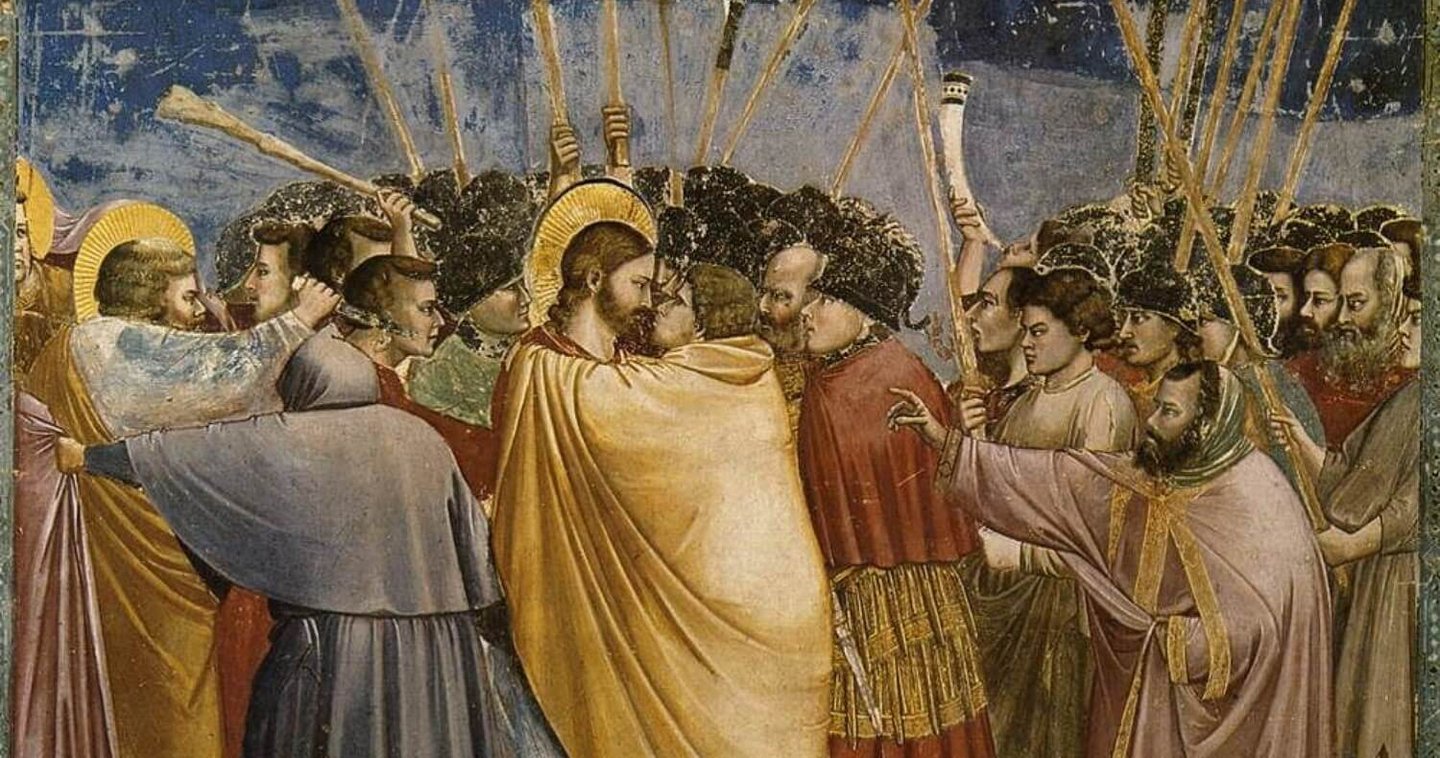
In the frescoes of Giotto di Bondone, there is a radical abandonment of conventional line as the primary means of constructing form. Examining fragments from the frescoes in the Cappella Scrovegni, we see the character’s head first acquire physical weight (J. K. Argan). Giotto shapes the cheeks, nose, and chin with soft chiaroscuro, submitting them to a single light source.
The neck ceases to be a «cylinder» and begins to support the weight of the head. The three-dimensionality here creates believability: it is easier for the viewer to empathize with a character who possesses a similar bodily volume to their own.