Navigation
- The Urban Landscape 1.1. Public Baths 1.2. Monastic Wash Houses 1.3. Myths and Reality of City Streets ———
- Rituals, Body, and the Material World 2.1. Domestic and Hospital Bathing 2.2. Hair Care, Shaving, and Beauty Objects 2.3. Sacred Purity and Religious Ablutions ———
- Textile Hygiene 3.1. Fabric Cleanliness ———
- Disease Prevention 4.1. Illustrations from Medical Treatises 4.2. Pomanders and Air Scenting ———
- Conclusion
- Bibliography
- Image Sources
Concept
In mass culture, the myth of Western Europe in the 13th–15th centuries as a realm of total unsanitary conditions is deeply entrenched. The Middle Ages are often visualized through images of streets and people drowning in filth who fundamentally avoid water. This study aims to deconstruct this stereotype by engaging with the authentic material and visual culture of the Late Middle Ages.
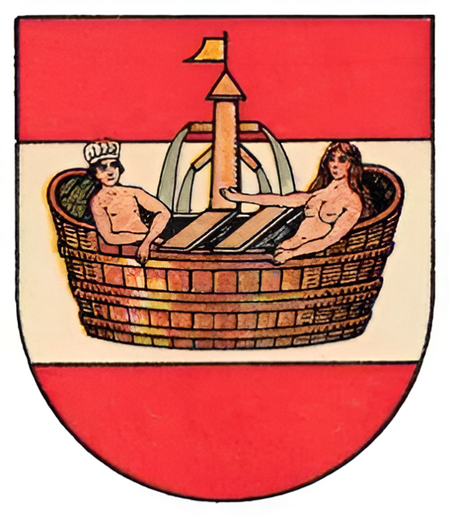
The 13th–15th century period was not chosen arbitrarily: this was a time of flourishing urban self-governance, the complication of domestic rituals, the development of medicine, and the emergence of new standards for representing the human figure in art. Studying hygiene through the lens of visual sources allows us to glimpse the actual daily life of the era. The relevance of this topic lies in the necessity of overcoming historical biases. — Historical coat of arms of Baden bei Wien, Austria, 1480
The basis of the visual narrative is composed of sources created directly in Western Europe during the 13th–15th centuries. The material is selected based on the principles of historical accuracy and representativeness. The following categories are included in the study:
— Book Miniatures: Illustrations from manuscripts and secular chronicles depicting scenes of urban daily life, visits to public baths, and domestic bathing.
— Medical Treatises: Miniatures that illustrate medieval concepts of health, body care, the benefits of fresh air, and water treatments.
— Applied Arts Objects: Preserved artifacts from museum collections.
— Panel Painting and Woodcuts: Works where details of daily life carry both symbolic and realistic weight.
The research is structured as follows:
— The Urban Space: the design of public baths and monastic latrines, as well as a deconstruction of myths surrounding street pollution.
— Rituals, Body, and the Material World: domestic and hospital bathing practices, hair care and shaving, the use of cosmetic items, and religious ablutions.
— Textile Hygiene: fabric care and Late Medieval symbolism.
— Disease Prevention: an analysis of medical treatise illustrations, methods for combating epidemics, and the use of pomanders.
— Conclusion, Bibliography, and Image Sources.
When selecting sources, particular attention was paid to the authority and influence of authors of medieval texts, as well as the normative framework of the era—works recognized in their time or those that significantly impacted culture and daily life. Historical studies, articles, and books dedicated to the culture of everyday life in the Late Middle Ages, textile medicine, and hygiene, which are best suited to achieving the stated goals, will be used for analysis. The textual analysis will focus on their interpretation and their relationship to the artworks, illuminated manuscripts, and material culture items under study.
The core question of my research is how the depiction of hygienic practices differs between official art and everyday culture in Western Europe during the 13th–15th centuries, and to what extent these images align with actual historical facts.
The research hypothesis is based on the assumption that the visual culture of the Late Middle Ages reflects a developed and organized system of body care, whereas the entrenched myth of total unsanitary conditions is the result of later historical distortions. This suggests a need to re-evaluate the perception of daily life and standards of cleanliness in medieval society.
The City Space
1.1. Public Baths
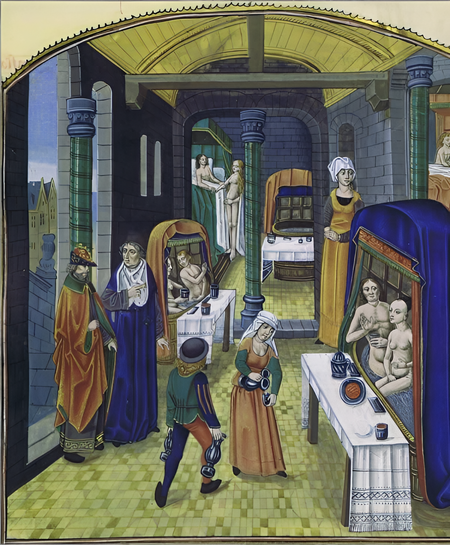
Public baths in the 13th–15th centuries disprove the common myth of complete disregard for hygiene during the Middle Ages. In large cities (such as Paris, Bruges, and Erfurt), their numbers reached dozens. The baths functioned not merely as places for washing, but as key hubs for urban socialization.
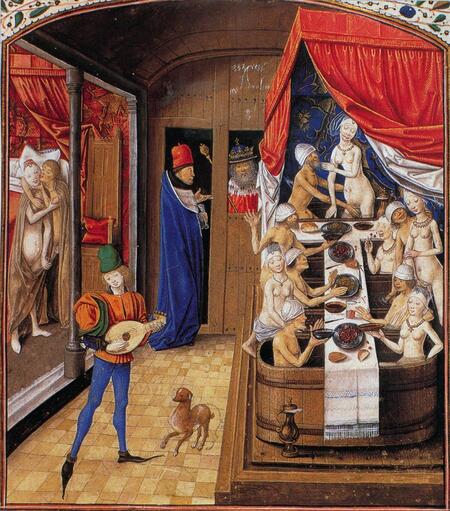
Unknown master—Public Bath (miniature from the manuscript by Valery Maxim, «Memorable Deeds and Sayings»), circa 1470–1475.
Antoine Burgundsky’s Master — Scene in a Public Bath (miniature from the manuscript «Notable Deeds and Sayings»), circa 1470.
Visual sources from this period clearly demonstrate the phenomenon of «communal luxury»: the joint bathing of men and women in large wooden tubs, accompanied by shared meals and music. However, it was this multifunctionality—the blurring of lines between hygiene, gastronomy, and entertainment—that led to baths becoming associated with the spread of syphilis and moral decline by the end of the 15th century, resulting in their mass closure during the Reformation era.
Albrecht Dürer — Men’s Bath, 1496–1497
This large-scale woodcut was published shortly after the decree in 1496 closed the public baths in Dürer’s hometown of Nuremberg, around the time of a syphilis outbreak and a drought.
Therefore, it could be a protest against the decree or perhaps a nostalgic reflection on the idyllic bathing culture of past years.
Albrecht Dürer — Drawing «Women’s Bath,» 1496
The work presents a closed interior viewed from a detailed engineering and procedural perspective: the wood-burning stove with glowing boulders, the water heating tank with faucets, and utilitarian care practices—using a bath whisk for steaming, brushes for exfoliation, and the process of combing hair—are clearly visible.
Anyone who kills another person in the bathhouse must pay a double fine. Anyone who commits theft in the bathhouse exceeding half a mark will save their life by paying forty marks, or face hanging.
The bathhouse was legally equated to «no-man’s-land» spaces, such as a church or one’s own home, where an individual, by shedding their clothes and weapons, became completely defenseless against criminal threats. The strict judicial oversight of safety within the bathing premises demonstrates that city authorities viewed the regular cleansing of citizens not as a marginal whim, but as a critically important, institutionalized element of daily urban life, requiring the highest degree of state protection.
1.2. Monastic Courtyards
Unlike secular cities, medieval monasteries featured intricate water supply systems as early as the 12th–13th centuries. Water was channeled through lead and clay pipes from clean underground sources directly into the monastery courtyards (cloisters).
Unknown artist — Water supply plan of Canterbury Cathedral (from Edwin’s Psalter), circa 1160–1165.
Engraved on the column is the inscription: «When the water supply is insufficient, water can be drawn from the well, and by pouring it into this column, it will supply water to all the institutions.»
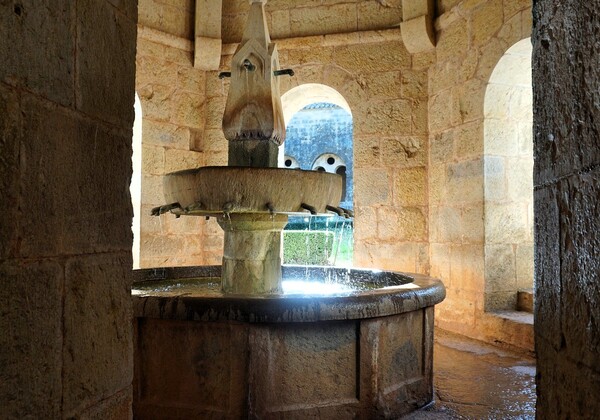
The central hygienic fixture was the lavatorium—a specialized, monumental structure featuring a round or polygonal fountain basin. Handwashing here was not a mere social preference; it was a strict ritual and hygienic mandate. Monks were required to wash their hands several times daily: before every meal in the refectory and before conducting the liturgy. Visual analysis of the floor plans and preserved fountains demonstrates that the level of sanitary engineering in the monasteries was centuries ahead of its time.
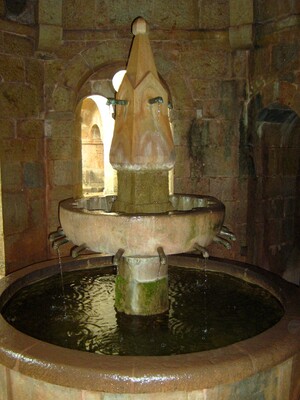
Unknown Master — Fountaine-Lavatoire in the cloister of the Toronne Abbey, late 12th — early 13th century
Unknown master — Cloister (inner courtyard) of the Toronne Abbey, overlooking the lavatory pavilion, late 12th — early 13th century.
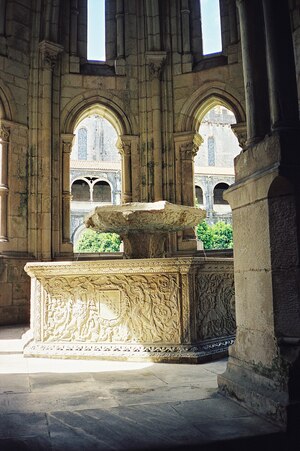
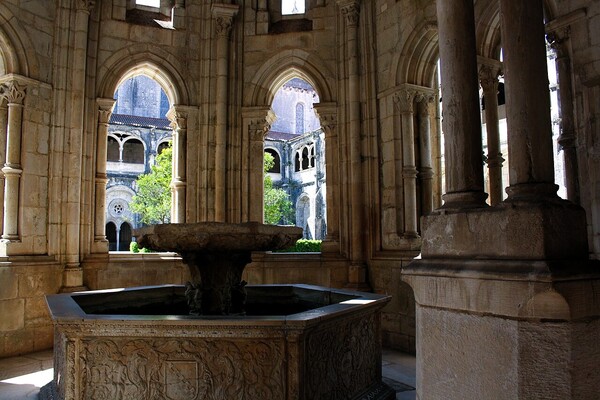
Unknown Master — Gothic Lavatory Pavilion in the Cloister of Silence at Alcobaca Monastery, late 13th—early 14th century
Examples from the Alcobaça Monastery demonstrate that Cistercian monasteries were leaders in hydraulic technologies across Western Europe. Water was not merely supplied to the abbey; it was shaped into a monumental architectural complex. The use of running water in the fountain’s cascading basins emphasized the cyclical nature of ritual purification and the hygienic discipline that was strictly required of hundreds of community members daily.