Concept
I am interested in the visual language of Hieronymus Bosch: multi-figure scenes, strange hybrid creatures, fantastical architecture, and the soft palette of his paintings. Bosch depicted human vices through bodies and monsters. I want to explore how this language can be used to tell stories about contemporary sins that reside on the screen.
The project’s goal is to train Stable Diffusion XL in the style of Bosch and create a series titled «New Sins»: seven vices of the digital age surrounding a central «Eye» that uses a camera lens instead of a pupil. It was important to verify whether the model was adopting the style rather than simply copying paintings, and how it rendered objects not present in the dataset—smartphones, ring lights, and delivery boxes.
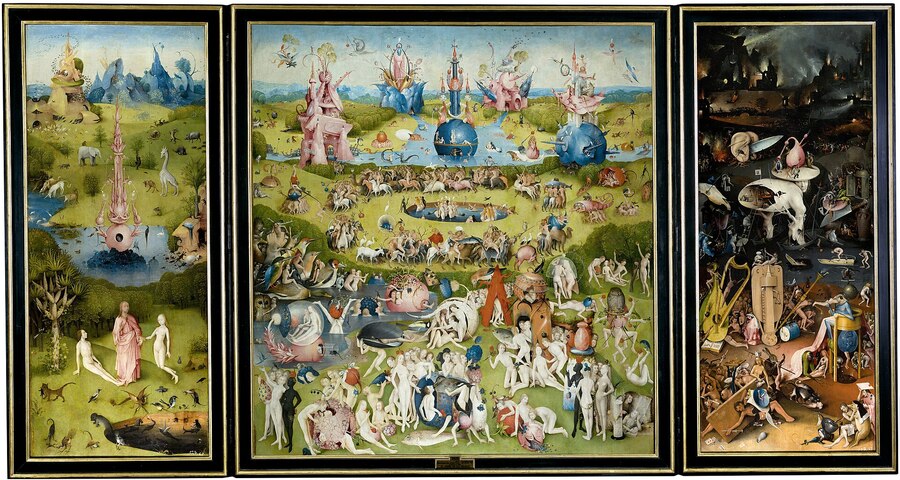
Hieronymus Bosch. «The Garden of Earthly Delights, ” c. 1490–1510. Prado, Madrid
Dataset
The model was trained on 118 square fragments from eight Bosch paintings: «The Garden of Earthly Delights,» «The Haywain,» «The Temptation of Saint Anthony,» «The Last Judgment,» «The Seven Deadly Sins,» «The Ship of Fools,» «Death and the Miser,» and «The Visions of the Afterlife.» Bosch died in 1516, and his works are in the public domain; reproductions were sourced from Wikimedia Commons under a Public Domain license, with the link and license for each file preserved in the sources table.
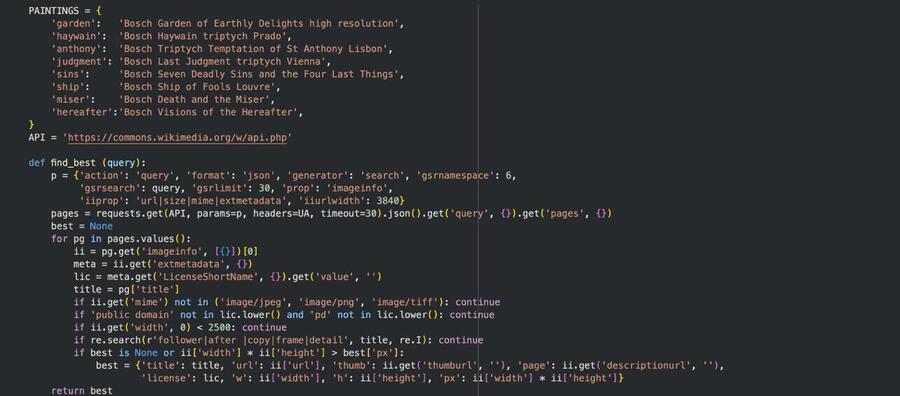
Examples of images used to train the generative model. Source: Wikimedia Commons
To create the dataset, I cropped the paintings into square fragments across three scales: close-up details (faces, creatures, brushstroke texture), medium scenes, and overall shots. All fragments were scaled to 1024×1024 px. Areas with empty backgrounds were automatically filtered out, and I manually removed problematic fragments that contained frames, inscriptions, or varnish cracks. In total, the dataset comprises 118 images.
Dataset excerpts: close-ups, medium shots, and wide shots
Academics
I did not train the model from scratch; rather, I fine-tuned Stable Diffusion XL using LoRA—a small adapter that learns a style and is activated by a trigger word. The training was conducted in Google Colab on a free GPU and took about two hours. Initially, every segment was captioned. The BLIP model described what was depicted in it, and I prepended the phrase «painting in BSCH style.» This allowed the model to associate the content with the caption, while everything that makes the image resemble Bosch (palette, manner, texture) was tied to the word BSCH. The model was trained for 1,000 steps, and I saved an intermediate version every 250 steps. To track how the style emerges, I generated the same base SDXL image using the original model and each saved version.
The base SDXL generates a scene as a modern neon illustration. By 250 steps, it transforms into a painting with an ochre-green landscape and a crowd of creatures, and by 500–750 steps, it dissolves into a grey haze. At 1000 steps, the image clarifies: a high horizon, a blue sky, and pink figures, reminiscent of Hieronymus Bosch’s «Garden of Earthly Delights.» I used this final version for the series.
The basic SDXL draws the scene as a modern neon illustration. By 250 steps, it transforms into a painting with an ochre-green landscape and a crowd of creatures; at 500–750 steps, it dissolves into a gray haze. At 1000 steps, the image clears up: a high horizon, blue sky, and pink figures, reminiscent of the «Garden of Earthly Delights.» This final version is what I chose for the series.
The «New Sins» Series
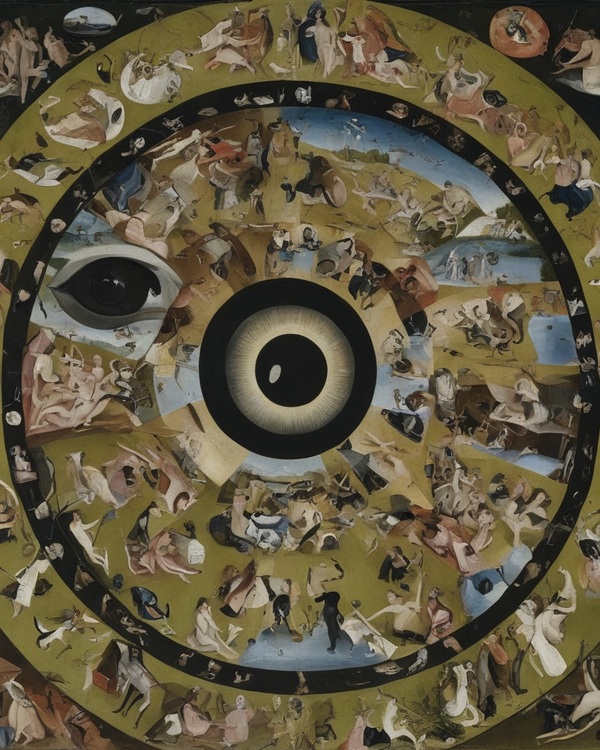
The series is structured around the composition of the «Seven Deadly Sins»: an eye is at the center, surrounded by the seven vices. In this piece, however, the pupil of the eye is a camera lens, and the sins are contemporary.
Eye. Concentric circles converge toward the dark pupil-lens, and hundreds of tiny figures swarm within the rings. Another eye watches from the side—they observe from all sides.
Scroll-gazing. The glutton cannot tear his gaze away from the endless array of fruits and creatures.
Selfiegordinya. Two women in red look at each other through a huge ring; a lamp burns above them. It is impossible to tell who is the reflection, and demons await behind the curtain.
Commentary. A dark throne aflame amidst an endless carnage of bodies. No one knows who is fighting whom, but they cannot stop.
Story envy. A tower of round windows, and in each one, a life of its own. Other people’s windows are always more interesting than your own.
Cashback Obsession. The miser drowns in coins and boxes, clutching yet another to his chest. Above him in the doorway, Death already stands with a spear.
Swipe Dish. A giant strawberry dusted with red hearts, with people reaching for it below. Temptation, broken down into likes.
Prompt Image. A figure in a hoodie is bent over an open book, with scattered sheets around them. Are they writing or sleeping? The work seems to be happening on its own.
For each sin, I wrote a prompt in the language of Bosch iconography: the miser on his deathbed, the demon with the mirror, lovers in glass spheres. A contemporary object replaces one attribute in the scene. Each prompt was generated with four different seeds.
Series Breakdown