Navigation
Introduction and ConceptI. When Objects Form a Face II. When an Image Requires a Shift in Perspective III. When Painting Becomes an Object IV. When Boundaries of Space DisappearComparative SummaryConclusionBibliography
Introduction and Concept
We are accustomed to viewing a painting as a stable image: upon closer inspection, one notices more details, but the scene itself seems to remain unchanged. In European art from the 16th to the 18th centuries, works exist that disrupt this expectation. Objects coalesce into a human face; an elongated form becomes recognizable only when viewed from the side; drawn papers appear real; and the fresco on a vault visually extends the architecture.
This theme was chosen because such works are interesting to compare not only by their execution technique but also by the action they propose to the viewer. This study examines visual deception as an artistic device, rather than as a collection of amusing optical tricks.
The key question is: how did artists of the 16th to 18th centuries use the discrepancy between the visible and the actual to guide the viewer’s perception?
The hypothesis is that the effect of illusion depends on the active participation of the spectator. In a composite portrait, it combines disparate elements into a face; in an anamorphic piece, it alters the viewpoint; before an illusionistic still life, it tests the believability of light and textures; and in a painted interior, it correlates the drawn architecture with the real one. The illusion could function as an allegory of power, an intellectual game, a contemplation on the structure of the painting, or as part of a religious or courtly spectacle.
These mechanisms arose under diverse conditions and coexisted.
The material is limited to works from the Western European artistic tradition of the 16th to the 18th centuries. As primary examples, we have chosen works by Archimboldo, Holbein, the portrait of Edward VI attributed to Scotto, the perspective box by Van Houtstraten, illusionistic still lifes by Dutch masters, and interior frescoes from Perugino to Tiepolo.
Four criteria were used in the selection process: the existence of a reliable museum or scholarly publication; a clear visual technique; the possibility of comparison with another work; and the availability of a sufficiently high-quality image. Photographs of architectural frescoes are selected to show the actual environment alongside the artwork itself.
The structure is built around the evolution of visual experience. It begins with the recognition of a face constructed from objects, then moves to the image’s dependence on the observer’s position, followed by the pictorial imitation of things, and finally, the illusions of an entire architectural space.When working with sources, priority is given to museum catalogs, owners of the works, and scientific publications concerning specific objects. Both general views of the works and magnified fragments are used for analysis. For example, details from the paintings of Archimboldo allow one to examine how individual objects form a human face, while photographs of painted interiors help correlate pictorial elements with actual architecture. Comparisons take into account composition, perspective, light, texture, and the viewer’s position relative to the artwork.
I. When Subjects Converge on the Face
The first group of illusions is related to recognizing a whole within a multitude of parts. In Giuseppe Arcimboldo’s composite portraits, every berry, fish, branch, or book retains its own recognizability, yet simultaneously occupies the space of an eye, a nose, a mouth, or hair. The viewer perceives two orders of image organization—the object-based and the portraiture. This is not a random visual puzzle: the choice of elements can reveal the theme of the allegory and the intended recipient of that allegory.
Giuseppe Arcimboldo. «Summer.» 1563. Kunsthistorisches Museum, Vienna.
In «Summer, ” the head is composed of ripe fruits, stalks, and vegetables. From a distance, the forehead, eye sockets, nose, and lips are discernible; up close, the face dissolves into individual botanical forms. The mouth is particularly striking: the lips are formed by cherries, and the teeth resemble peas. The artist does not conceal objects beneath a mask of human anatomy; rather, they make them simultaneously recognizable objects and features of the face. Thus, the viewer is placed between two modes of reading a single form. The material of the „clothing“ is also important: straw transforms the season into a cohesive figure, not merely a head made of fruit.
Giuseppe Arcimboldo. «Water.» 1566. Kunsthistorisches Museum, Vienna.
In «Water,» fish, mollusks, crustaceans, and other marine creatures replace fruits. The most powerful effect comes from the disproportionate nature of the parts: the artist does not need every animal to be plausibly small or large compared to the others. What matters more is that their silhouettes fill the contour of the face. Pearls and coral simultaneously serve as marine attributes and decorations for the allegorical figure. When compared with «Summer,» it is clear that the method of recognition is repeated, yet the texture, meaning, and emotional nuance change dramatically.
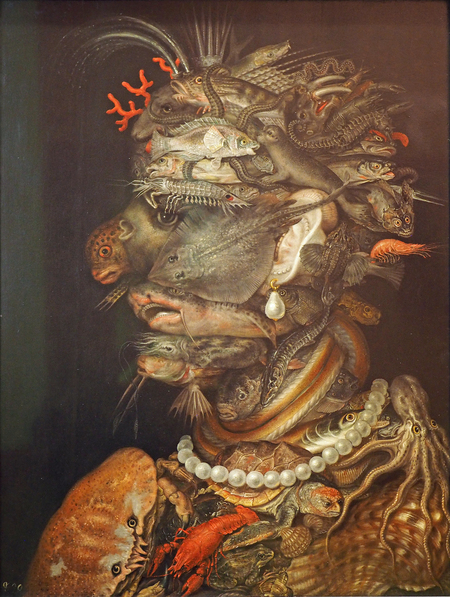
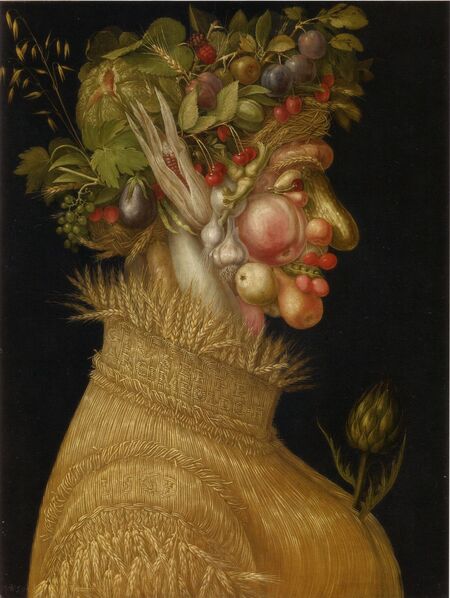
Giuseppe Arcimboldo. «Water.» 1566. Museum of Art History, Vienna. Giuseppe Arcimboldo. «Summer.» 1563. Museum of Art History, Vienna.
In «Summer» and «Water, ” Archimboldo employs the same technique: individual objects coalesce into a recognizable human face. The selection of these objects dictates the content of each painting. Fruits and ears of grain suggest the summer season, while fish and other marine creatures allude to the element of water. In „Fire, ” this principle takes on an added layer of meaning—the depicted objects are connected not only to a natural element but also to the symbolism of power.
Giuseppe Arcimboldo. «Fire.» 1566. Kunsthistorisches Museum, Vienna.
In «Fire, ” the composition is formed from burning logs, candles, a lamp, and metallic objects associated with the harnessing of fire. In the lower section, weapons and details suggestive of military power appear. The Order of the Golden Rune and the Imperial Double-Headed Eagle reference the Habsburg court, for which corresponding allegories were created. We are no longer witnessing merely a game of recognition, but a demonstration of how artistic imagery can connect a natural element with political associations.
Giuseppe Arcimboldo. «Vertumnus.» 1591. Skokloster Castle, Sweden.
In the portrait of Emperor Rudolf II dressed as Vertumnus, vegetables, fruits, and plants cease to be a mere allegorical representation of the season; instead, they become an embodiment of the ruler himself. The image simultaneously demands that the viewer recognize a human face while also perceiving within it a multitude of natural forms. The Skoclostera Museum links this work to the gift presented to the Emperor and the accompanying explanatory poem. In this context, the dual nature of the image aids in discussing authority over the diverse natural world. The visual riddle transforms into a courtly statement.
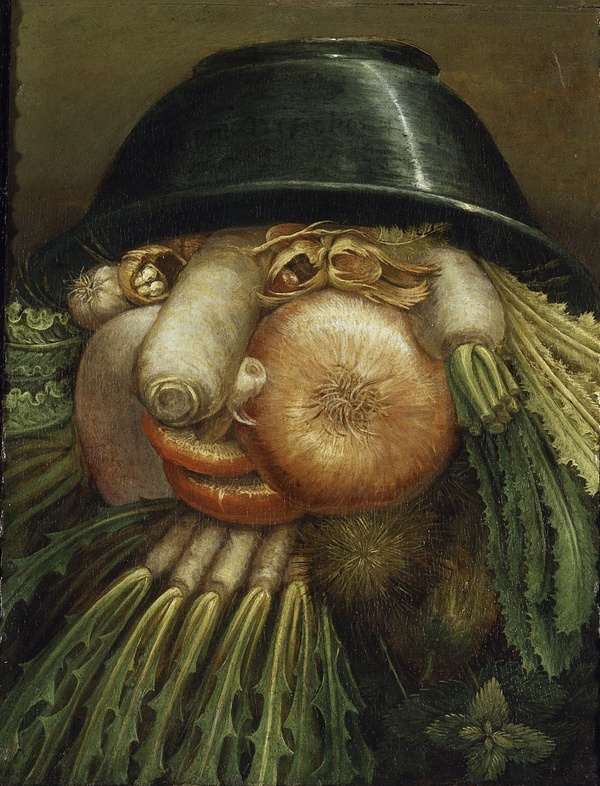
Giuseppe Arcimboldo. «The Gardener.» 1587–1590. Museo Sala Polsoni, Cremona.
«The Gardener» offers a different type of visual transition. In one orientation, the image resembles a still life of vegetables in a dish; after rotation, a human head emerges. The difference from «Summer» is fundamental: here, simply getting close to examine the details is insufficient—you must change the orientation of the entire image. What is seen doesn’t become «more accurate» or «less accurate»; it becomes something else. The viewer realizes that recognition depends on familiar schemata for facial and object positioning.
Оригинал
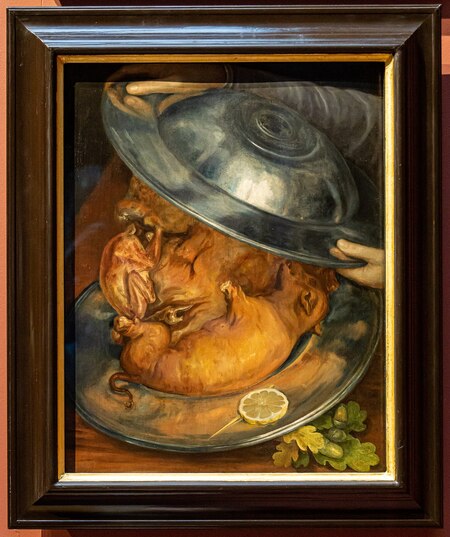
Перевёрнутое изображение
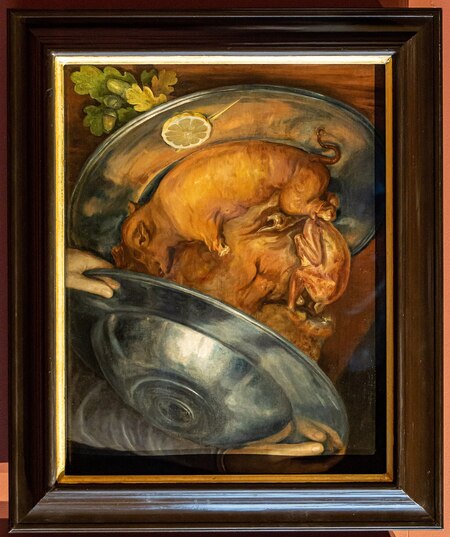
Giuseppe Arcimboldo. «The Cook.» c. 1570. Nationalmuseum, Stockholm.
In «The Cook,» the food presented on the plate transforms into a grotesque human face when rotated 180 degrees. This employs a relative of the «Gardener» technique, but here the link between the depicted object and the person’s profession is particularly evident: the food becomes the «material» for the cook’s portrait.
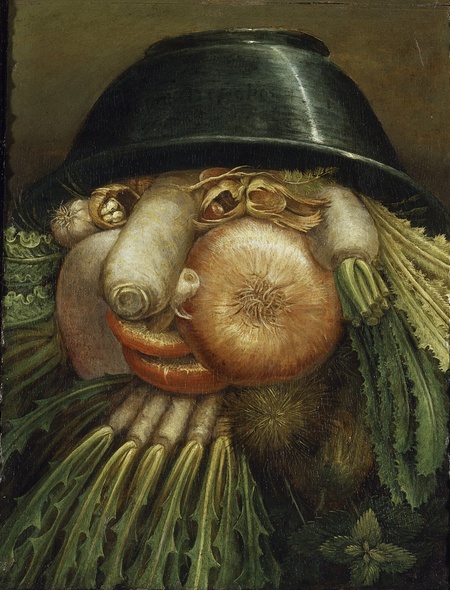
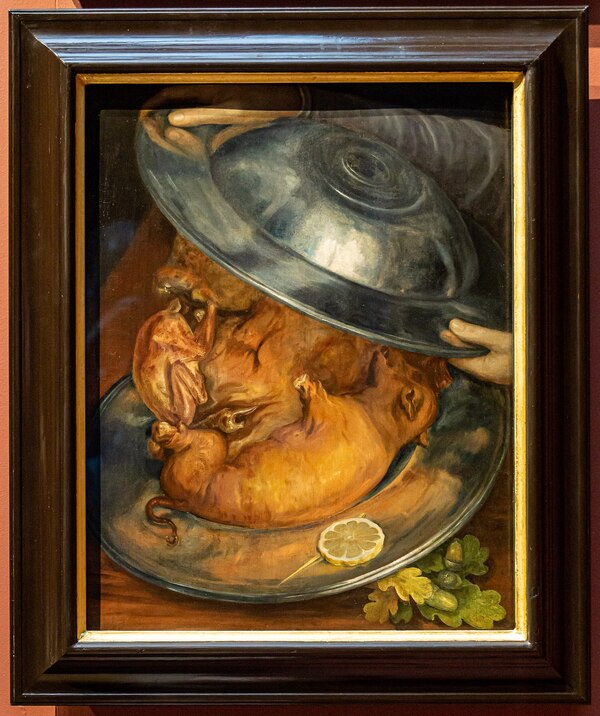
Giuseppe Arcimboldo. «The Gardener.» 1587–1590. Museo Albani, Cremona. Giuseppe Arcimboldo. «The Chef.» c. 1570. Nationalmuseum, Stockholm.
Conclusion I. Recognition is an action, not an inherent property of a thing.
Composite portraits demonstrate that the first impression is not the only valid interpretation. The same form can simultaneously function as a fruit and part of a face, food and a human figure, an image of nature, and an embodiment of a ruler. For Archimboldo, the illusion arises because the viewer recognizes two forms within a single image. However, for an optical trick, the artist is not obliged to construct one image from several. In anamorphosis, recognizability depends instead on the viewer’s position relative to the artwork.
II. When an Image Requires a Change in Perspective
Anamorphosis is an intentionally distorted image that becomes recognizable when viewed from a specific vantage point. In contrast to a composite portrait, it is tied to the viewer’s spatial position. The geometric construction can be calculated for a sideways gaze or for an optical device. This is where the question of controlling the spectator becomes particularly literal: the artist predetermines from where the work must be viewed.
Hans Holbein the Younger. «The Ambassadors.» 1533. National Gallery, London.
Hans Holbein the Younger’s «Ambassadors» features meticulous depictions of two figures, textiles, measuring instruments, and musical instruments. Against the backdrop of such convincing rendering of objects, the elongated shape at the bottom of the painting appears foreign. Viewed from the side, it transforms into a skull. The artist incorporates a disruption of perspective within a composition that typically inspires trust in the depicted space. Because of this, the work compels the viewer to doubt the sufficiency of a frontal gaze.
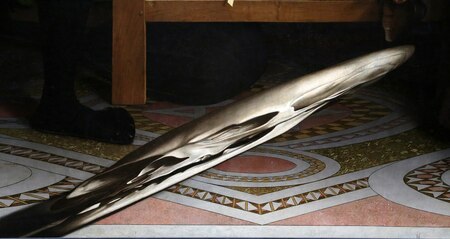
The skull references the theme of mortality, but interpreting it requires physical or mental shifting. This creates a dual effect: from a standard viewpoint, the viewer perceives a worthy and rich subject matter, while simultaneously recognizing a reminder of human finitude. We cannot prove from a single reproduction how each historical viewer engaged with the painting. Nevertheless, the structure of the anamorphism itself makes the change in viewpoint a necessary condition for recognizing the symbol.
Attributed to William Scott. «Edward VI» (anamorphic portrait). 1546. National Portrait Gallery, London.