
Navigation Menu
- Concept
- The Sexualization of the Body in Advertising
- The Formation of Beauty Standards
- Changing Perceptions of Beauty
- Nudity as a Social Statement
- Conclusion
1. Concept
The human body is one of the most recognizable instruments of advertising communication.
Nudity is used to attract attention, create a sexual persona, and shape perceptions of beauty. However, its meaning has expanded over time. Today, the body in advertising can serve not only as an object of desire but also as a means of expressing individuality, freedom, and social ideas. The goal of this study is to trace how the depiction of the nude body in advertising has changed and what meanings it has acquired across different periods—from the sexualization and idealization of appearance to body positivity, bodily diversity, and social commentary.
2. Sexualization of the Body in Advertising
Sexuality has long been utilized by advertising as a means of capturing attention. The image of a nude or partially nude person can provoke an emotional response, shape associations with attractiveness, and amplify interest in the advertised product. In these instances, the depiction of the body often lacks a direct functional connection to the product, becoming an independent means of influencing the viewer.
As a result, people frequently became less participants in the advertising narrative and more the central object. This phenomenon is known as sexual objectification—the portrayal of a person primarily as an object of sexual desire.
One of the most famous examples was the Calvin Klein Jeans campaign from 1980 featuring Brooke Shields. The commercial and print materials were built around the model’s provocative image and suggestive advertising statements. The campaign sparked public criticism and became a subject of discussion regarding the permissible boundaries of sexualization in advertising.
«You want to know what comes between me and my Calvins? Nothing»
Брук Шилдс, 1980
15-year-old Brooke Shields in a Calvin Klein Jeans campaign, 1980
In one of the videos, there was a line suggesting there was nothing between her and her jeans. The ambiguity of the advertisement caused public criticism. Some television networks refused to air the ad, deeming its content excessively provocative.
Sexualization was achieved not through complete nudity, but through a combination of pose, gaze, inflection, and language. The clothing itself was not vulgar; it remained everyday wear. Jeans became a component of an image built around a sexual subtext.
In the early 1990s, Calvin Klein continued to develop its provocative visual aesthetic. The brand’s advertising materials increasingly focused on the human body, the physical form of the models, and the sensual atmosphere of the images.
Mark Wahlberg as Herb Ritts for the Calvin Klein campaign, 1993.
Photographer Bruce Weber created a large-scale advertising series for Calvin Klein, based on black-and-white photographs, nude figures, physical intimacy, and minimal text. In 1992, the brand debuted a famous lingerie campaign featuring Mark Wahlberg, followed later by joint advertising imagery of Wahlberg and Kate Moss.
Mark Wahlberg and Kate Moss in the Calvin Klein 1992 advertising campaign
The body becomes virtually synonymous with the product itself. The underwear is showcased through the model’s physical appeal, and the clothing functions as part of the overall image of sexuality.
Another example of using sexuality as a marketing tool was the Opium perfume campaign by Yves Saint Laurent, featuring model Sophie Dal.
Yves Saint Laurent — Opium, Sophie Dal, 2000.
In the promotional image, the model is depicted nude, wearing high heels, and striking a dramatic pose. The composition is structured to draw the viewer’s attention to the body rather than the perfume bottle itself.
The campaign drew numerous complaints and became the subject of discussions regarding advertising restrictions. Subsequently, the British outdoor advertising campaign was canceled.
In the examined advertising campaigns, sexuality functions as an independent tool for persuasive impact. Provocative poses, exposed areas of the body, sensual gazes, and visual focus on physical attractiveness help forge an emotional connection between the consumer and the product. Sexualization affects not only female representations; the male body also becomes an object of display, although the standards for its attractiveness differ. Over time, the advertising industry solidifies certain ideals regarding desired appearance.
3. Forming Beauty Standards
Advertising doesn’t just reflect existing notions of attractiveness; it actively participates in shaping beauty standards. For decades, advertising campaigns have portrayed a specific body type as desirable—slenderness, youth, smooth skin, and a proportional figure. Through the mass dissemination of the same visual images, these characteristics have become a distinct benchmark of beauty.

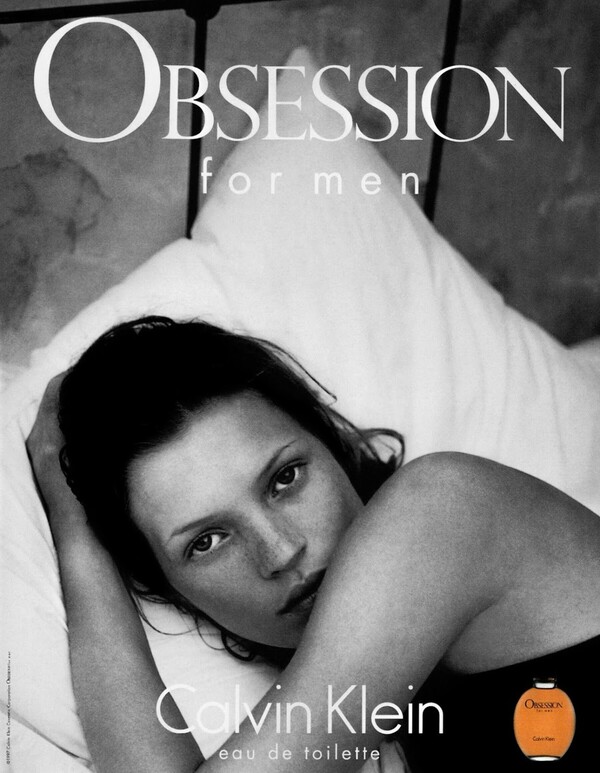
Kate Moss in Calvin Klein Obsession perfume advertisement, photographed by Mario Sorrenti, 1993
This was particularly evident in the fashion industry of the 1990s. Kate Moss became a symbol of this new ideal. Her slender build, fragility, and reserved appearance became part of the era’s aesthetic. Thus, advertising did not merely showcase a model; it cemented a specific look as relevant and desirable.
If Calvin Klein advertisements emphasized the model’s slender physique, the Wonderbra campaign demonstrated a different approach to defining the ideal—highlighting specific proportions. The poster features Eva Herzigova in a black push-up bra. The composition focuses on the model’s chest, and the slogan «Hello Boys» amplifies the provocative nature of the image.
Wonderbra — «Hello guys, ” 1994