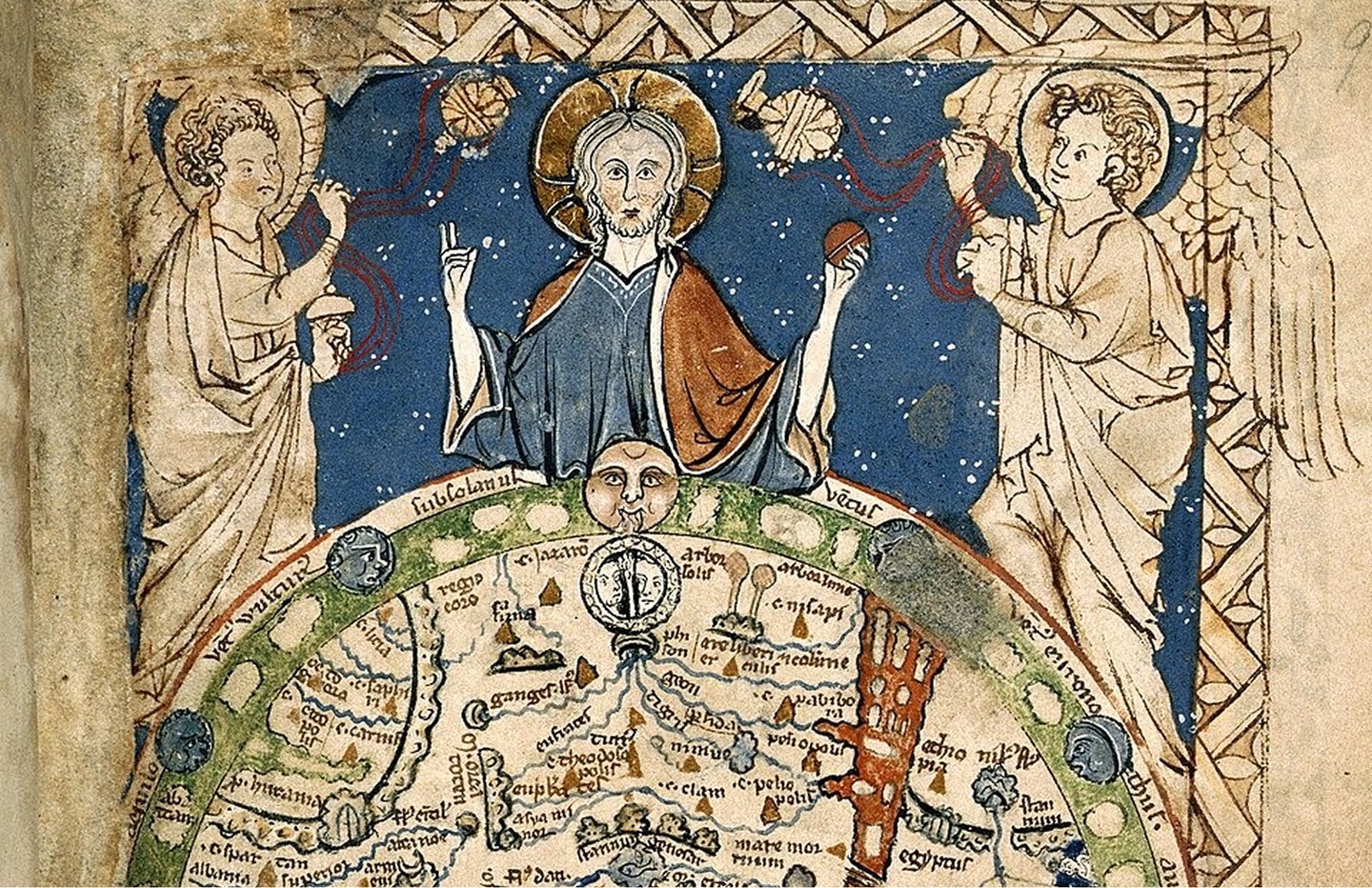
Concept
During the Middle Ages, conceptions of the universe’s structure were shaped by the influence of ancient science and Christian worldviews. These ideas were reflected not only in written works but also in imagery.
Artists created maps, cosmological diagrams, illuminated manuscripts, stained glass, and frescoes to illustrate the placement of Earth and celestial bodies, the boundaries of the world, and the interconnectedness of its parts. To achieve this, they employed geometric schemas, symbolic figures, and the division of space into distinct areas.
A particular area of interest is how these complex cosmological concepts were explained through such visual techniques. In some depictions, the world is enclosed beneath a celestial vault; in others, the Earth is situated at the center of multiple spheres; and in yet others, space is organized around the human figure.
This raises a research question: how did the arrangement of figures, geometric forms, and spatial boundaries help medieval artists explain the structure of the universe?
The research hypothesis is that the selection of composition depended not only on perceptions of the world’s form but also on the image’s purpose—to illustrate the boundaries of the universe, the order of its parts, the movement of celestial bodies, or humanity’s place in creation.
Research Objective: to identify the compositional and pictorial techniques used by artists of the 9th–13th centuries to convey conceptions of the cosmos.
Comparing these works allows us to reveal not only the diversity of medieval cosmological models but also the role of imagery in explaining and transmitting knowledge about the world.
The study includes manuscript miniatures, cosmological and astronomical diagrams, medieval maps, monumental painting, stained glass, and embroidery. The variety of media enables us to trace how similar conceptions of the world were embodied in different artistic forms.
The primary selection criterion was the presence of a visual model of the world within the artwork. It was important that the piece did not merely contain celestial bodies, natural elements, or religious symbols, but rather depicted their arrangement and interrelationships.
The research is based on the visual analysis of the works. Particular attention is paid to composition, geometric forms, the placement of elements, scale, symmetry, direction of gaze, and methods of spatial division. To understand the historical context, we utilize studies in medieval cosmology, the history of cartography, manuscript miniature, and works of art.
The material is organized around four aspects: the form and boundaries of the Universe, celestial bodies and their motion, natural forces and humanity, and the geographical depiction of Earth. Historical information is compared with the characteristics of specific works in order to separate the content of cosmological concepts from the methods of their representation.
Sections
1. Introduction
2. Form and Boundaries of the Universe
3. Celestial Order and the Movement of Heavenly Bodies
4. Elements, Natural Forces, and Humanity within the World System
5. The Terrestrial World: Space and Geographical Order
6. Conclusion
Introduction
In the Middle Ages, humans lacked the ability to view the world from an external perspective. Nevertheless, people were already attempting to understand the structure of the universe—where its boundaries lay and what existed beyond visible space.
Conceptualizations of the cosmos were shaped by the influence of classical science, Christian theology, and natural observation. Different authors proposed their own explanations regarding the shape of the Earth, the arrangement of celestial spheres, and the limits of the universe.
These divergences were reflected in art. Each model demanded a specific visual interpretation, meaning the structure of the cosmos can be explored through the form of the imagery, its composition, and the placement of its elements.
Form and the Boundaries of Existence
In medieval art, there was no single way to depict the universe. It could be represented as space beneath a celestial vault, contained within a circle, or shown as several nested spheres. These variations reflected differing views on the shape of the world and how its parts were arranged.Cosma Indicopleustes proposed a particularly unusual model in his work, «Christian Topography.» His concept of the world’s shape survived in illuminated manuscripts of subsequent centuries.
Unknown master. «The Universe as a Tabernacle.» Miniature from Kosma Indicopleustes’ «Christian Topography.» 9th century.
Kosma rejected the concept of a spherical Earth and proposed a model of the universe based on his own interpretation of Biblical texts.
The miniature depicts the earthly realm within a structure topped by a celestial vault. A large mountain rises at the center, with heavenly bodies illustrated on either side. The upper section of the composition is separated from the earthly domain.
The mountain here is not merely a random landscape element. In Kosma’s model, it participates in explaining the cycle of day and night: the Sun moves around it and is partially obscured by the elevation on part of its journey.
Thus, the image connects the idea of the universe’s shape with an explanation of one of nature’s observable phenomena.
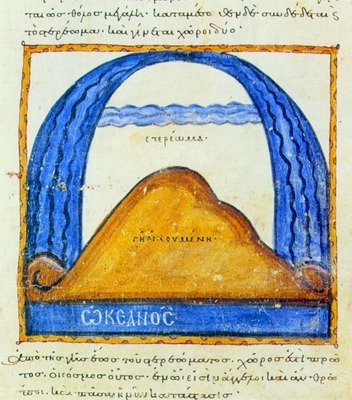
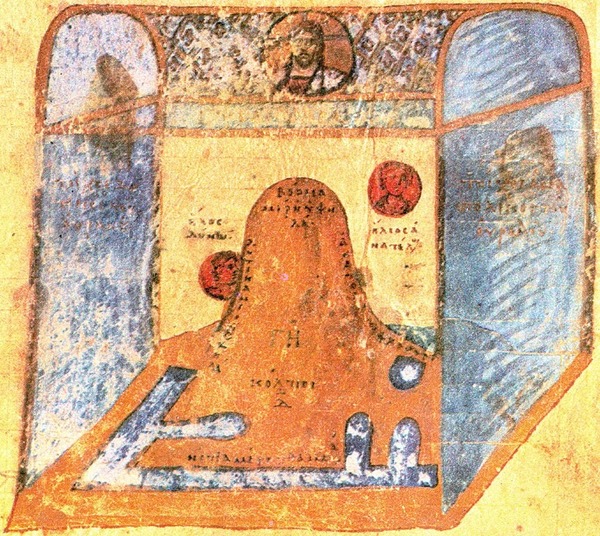
Unknown Master. «Earth-Mountain surrounded by the Ocean.» Miniature from Cosma Indicopleustes’s «Christian Topography» // Unknown Master. «The Universe as a Tent.» Miniature from Cosma Indicopleustes’s «Christian Topography.» 9th century.
In another manuscript of the «Christian Topography, ” the mountain becomes the main element of the composition. It occupies a central position, with a semicircular celestial vault rising above it. Surrounding the mountain’s base are the waters of the Ocean. This structure allows for a clearer view of the arrangement of the earthly part of Cosma’s model.Both miniatures depict a single cosmological system, but they emphasize different aspects. The first integrates the mountain, celestial bodies, and the boundaries of creation. The second focuses on the shape of the Earth’s surface and its placement beneath the celestial vault.Cosma’s depictions were not universally accepted during the Middle Ages. Alongside them, cosmological models based on ancient tradition continued to exist, in which the Earth was considered spherical.
Unknown Master. «Creator God with a Compass.» Moralized Bible. c. 1220–1230.
In the miniature from the Morality Bible, God is depicted holding a compass with which he outlines the boundary of the created world. The universe is represented as a colored circle. Elements of creation are discernible inside it, and the compass itself emphasizes the precision and orderliness of the divine plan. Here, the circle signifies not only the shape of the cosmos but, combined with the figure of the Creator, becomes part of a religious image of world creation. In contrast to the Cosmos model, where the structure of the universe is explained through specific spatial elements, this miniature focuses on the act of creation itself. The geometric form helps convey the idea of the world as a unified and systematically ordered creation. However, the circle was not the only way to denote the integrity of the universe.
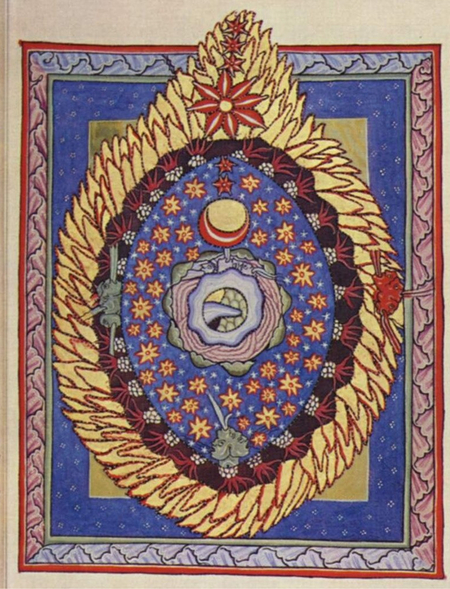
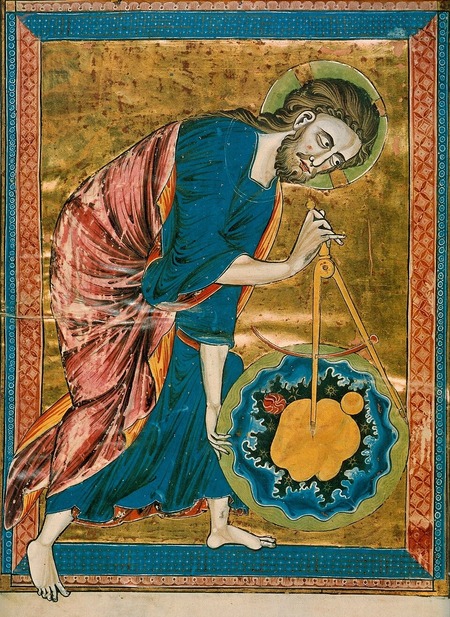
From the vision of Hildegard of Bingen. «Cosmic Egg.» Scivias, I.3, XII century. Copy from the lost Rupert’sberg Codex, 1927–1933. // Unknown Master. «God the Creator with a Compass.» Moralisized Bible. Circa 1220–1230.
In one of Hildegard of Bingen’s visions, the Universe appears in the form of an egg. Inside the elongated oval are various regions of space, including fiery and airy realms, celestial bodies, and a central terrestrial area.The egg shape allows the Universe to be visualized as a single entity, within which several interconnected regions are discernible. Unlike the geometrically perfect circle in the Moralized Bible, the boundaries of the Universe here form an elongated, organic shape. Nevertheless, the internal space remains strictly organized: each area occupies a specific place and is linked to its neighbors.This drive to unify the different components of the world into a single composition can also be seen in works dedicated to the creation of the world.
Unknown Masters. «Tapestry of the Creation of the World» (embroidery). Late 11th — early 12th century.
The embroidery from Girona centers around the figure of Christ, surrounded by scenes of creation. The circular composition is divided into several sectors, each dedicated to a specific part of creation. In contrast to the «Cosmic Egg,» where the regions of the universe are situated within a single shell, the artist employs the principle of division into autonomous fragments. This allows the viewer to examine individual scenes without losing the understanding of their relation to a unified world. The circular composition enables the integration of diverse objectives: designating the totality of creation while simultaneously illustrating the sequence of its emergence. Geometric division of space was also utilized in cosmological diagrams, where the placement of individual parts of the universe was paramount.
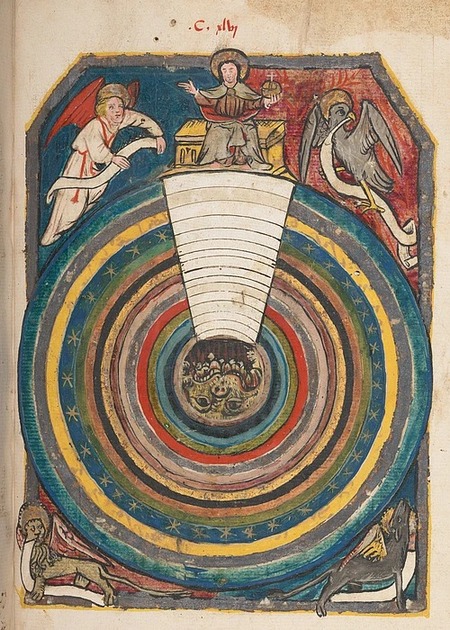
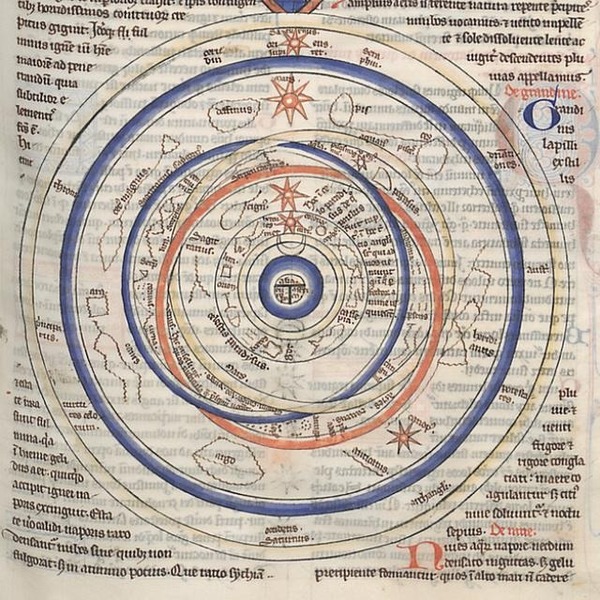
Unknown Master. «The Earth at the Center of the Celestial Spheres.» Hoswein’s «Image of the World» from Metz. 13th century // Unknown Master. «Order of the Celestial Spheres.» Lambert’s «Liber Floridus» from Saint-Omer. 13th century.
In the miniature from the «Image of the World, ” the Earth is situated at the center of several concentric circles. Surrounding it are domains of the four elements, celestial spheres, and other levels of creation. Here, there is no longer a need to illustrate individual scenes or figures to explain every part of the Universe. The arrangement of the circles itself conveys the concept of the world’s structure: the Earth is central, and the other domains successively surround it.
The distinctive feature of this illustration is the merging of the cosmological scheme with religious imagery. A mouth of hell is present at the center, and Christian celestial hierarchies are depicted beyond the heavenly spheres. Thus, the geometric model is integrated into a broader depiction of the Christian cosmos. A similar principle of spatial organization can be found in Lambert of St-Omer’s „Liber Floridus.“
In this diagram, the Earth also occupies a central position, with the elements and planetary spheres arranged around it. However, compared to the previous image, the schema appears more schematic. Geometric divisions and the designations of individual areas take precedence. Unlike the „Image of the World, ” narrative elements are almost absent here. The focus is on the sequence of the spheres and their relative placement.
Both compositions present a geocentric model of the Universe, yet they employ different visual languages. The first unites astronomical concepts with religious iconography, while the second uses geometric structure as its primary mode of explanation. Thus, the circle transforms from a general shape of the Universe into a tool for representing its internal structure.
Medieval depictions of the cosmos varied in form and content, but in every case, the composition helped explain the arrangement of the parts of the universe. The celestial vault defined the world’s boundaries, the circle unified its components, and the concentric spheres indicated their sequence relative to Earth. Thus, the geometric organization of the image became a means of conveying cosmological ideas. However, the structure of the world was determined not only by the placement of its parts but also by the motion of celestial bodies.
Celestial Order and the Motion of Lights
Medieval conceptions of astronomy were largely based on the ancient geocentric model, which held that the Earth was at the center of the universe and celestial bodies revolved around it.However, depicting motion on a static image presented a significant challenge. To address this, artists utilized geometric diagrams, sequences of figures, and symbolic narratives—each element revealing a particular aspect of the celestial order.
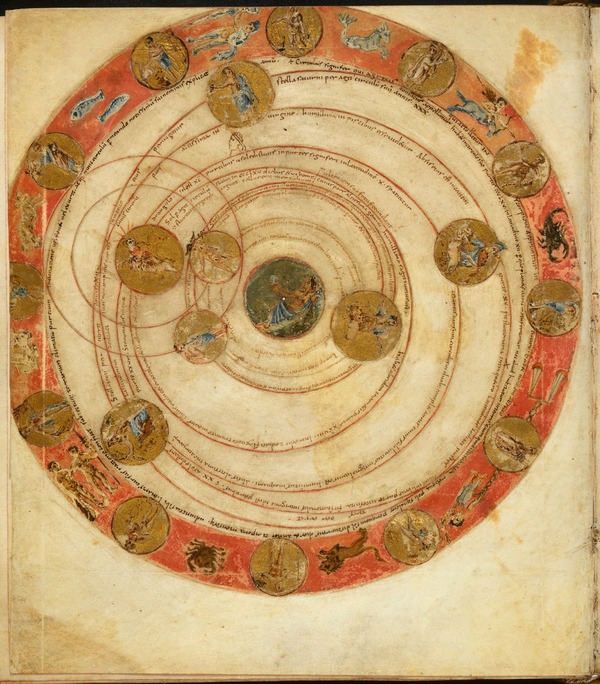
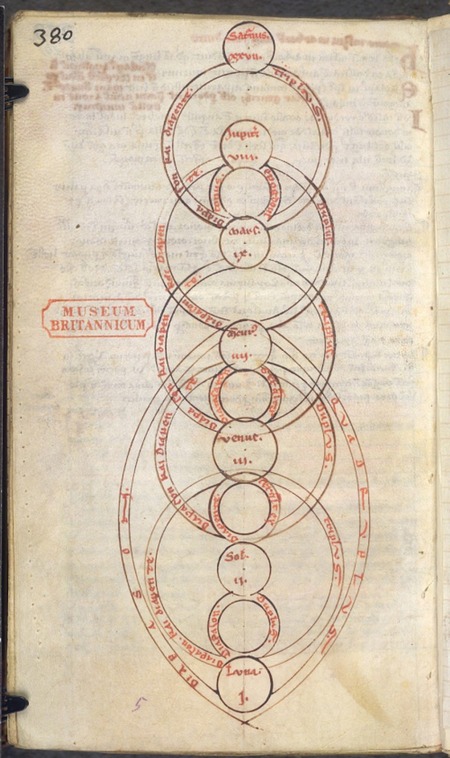
Unknown Master. «Planetary Diagram.» Leiden «Arat.» 9th century // Unknown Master. «Diagram of Planetary Harmony.» 13th century.
In the «Leiden Wheel, ” the planets are situated around a central Earth, and their paths are marked by circles. The outer zodiacal belt defines the boundary of the celestial system.The distinguishing feature of this diagram is that it depicts not only the order of the planets but also their relative positions at a specific moment. The celestial bodies are shown at different points along their paths, allowing the diagram to convey a precise planetary configuration.In the diagram of planetary harmony, the circles are arranged vertically and partially overlap. Each circle corresponds to a specific celestial body. The visualization is based on the concept of the harmony of spheres, which posits that the movements of celestial bodies correspond to musical proportions.Thus, both schematics utilize geometry to explain celestial order, yet they address different objectives. The first illustrates the spatial arrangement of the planets, while the second links their movement to the idea of cosmic harmony.Geometric diagrams were effective for denoting the order of motion, but they failed to convey that motion as an action. A different tradition, inherited from ancient art, was used to represent the Sun and Moon: the celestial bodies were depicted as charioteers managing chariots. This narrative transformed the movement of the luminaries into a tangible action, understandable without recourse to a complex astronomical chart.
Unknown master. «Chariots of the Sun and Moon.» 1120–1135.