Navigator
- Concept
- The Proper Child (1930s–1950s)
- The Child with a Dream (1960s)
- Fears, Play, and the Inner World (1970s)
- The Right to Be Yourself (1980s)
- Conclusion
Concept
Childhood in Soviet culture was never a private family affair. The child was perceived as a future citizen, and therefore everything created for them—from primers to cartoons—served an educational purpose in one way or another. Animation is particularly telling in this regard: unlike live-action cinema, which features a real child actor with their own appearance and character, the image of a child in a cartoon is entirely invented and drawn by adults. Every detail—the character’s height relative to adults, the color of their clothing, their facial expression, their placement in the frame—is the result of the artist’s and director’s choices. Therefore, by examining the drawn child, one can quite accurately determine what society wanted childhood to look like during different periods.
The core of this visual study is to trace how the visual depiction of the child protagonist in Soviet cartoons evolved from the mid-1930s to the mid-1980s, and what these shifts reveal about cultural conceptions of childhood. My focus is not on the plot itself, but on how the child is presented: whether they stand in formation or alone, whether they gaze at an adult from below or on equal footing, whether they occupy the center of the frame or dissolve into the surrounding space, and whether their face is openly expressive or schematically idealized.
The choice of topic stems from the fact that Soviet cartoons remain a part of the childhood of several generations, including my own. However, they are usually rewatched as a collection of favorite stories, without considering the vast difference in how the child is understood between something like «Moidyodyr» and «Masha and the Bear.» It seemed important to examine these familiar frames as historical documents.
The research hypothesis is based on the assumption that the depiction of the child in Soviet animation was not static but gradually shifted from one pole to another. It can be suggested that during the 1930s–1950s, the child was primarily portrayed as an obedient, kind, and socially useful hero who needed guidance or correction, and whose individuality was subservient to the collective or a moral lesson. It is likely that starting in the 1960s, the child’s inner world began to gain prominence: their solitude, fears, dreams, play, friendship, and the right to be different from others. I also suggest that these changes are reflected not only in the plots but also in the visual execution of the films—in the characters' poses and facial expressions, in the color palette, in the composition of the frame, and in how the child relates to adults and to the surrounding environment.
The research material was selected from films by Soyuzmultfilm and the film «New Gulliver» by A. Ptushko, in which the main or one of the main characters is a child. In several instances, I included films where the character is a young animal (a raccoon, a hedgehog, a mammoth calf) because in animation from the 1960s–1980s, such characters often serve the same role as a child and are imbued with distinctly childlike traits. Some of the selection criteria include the film’s recognition and its significance to the history of domestic animation, as well as the presence of a distinct child character in the frame.
The research’s textual sources include books on the history of domestic animation, memoirs and lectures from the directors and artists themselves, reference publications, as well as studies on the history of Soviet childhood. These are necessary primarily for fact-checking and for understanding the context in which the films were created. The films themselves remain the primary source—the frames from which I selected footage during viewing.
The Correct Child (1930s–1950s)
By the mid-1930s, Soviet children’s animation had advanced beyond the simple propaganda images of the 1920s to create full-fledged films, culminating in the establishment of Soyuzmultfilm studio in 1936. Walt Disney’s films served as a stylistic reference for many artists during that time—evident in the rounded forms, vibrant color, and fluid motion. However, the content was distinctly homegrown: nearly every film about a child explored themes of making and correcting mistakes or performing virtuous deeds. In this section, I am interested in how this pedagogical mission is reflected in the visuals—specifically, where the child is positioned, whom they are looking at, and the degree to which they are permitted to express emotion.
A. Ptushko. «New Gulliver.» 1935. Frame from the film: Petya the Giant in the Land of Lilliputians
In the film, a live actor performed alongside puppet characters, making it one of the most renowned experiments in Soviet animation of the 1930s. Pioneer Petya falls asleep over a book and transforms into a giant in his dream. His enormous figure towers over the «backward» world of little people, seemingly embodying the power of the new society. At the beginning of the film, Petya is shown among his squad, dressed just like everyone else. This suggests that the child is large here not because he is growing up or is inherently special, but because he is supported by a collective and an ideology.
M. Tsekhanovsky. «Seven-Petal Flower.» 1948. Frame from the film: Zhenya with a flower
Adaptation of V. Kataev’s short story. Zhenya is bright and colorful, and the color palette in this film is incredibly pure—almost like something from a children’s book. The film was made using the «éclair» technique, where the character movements were drawn over footage of live actors. This allows the girl to move naturally, almost like in live-action cinema. But the more beautiful the imagery, the more apparent it is that the heroine’s desires are empty; she spends magical petals on pretzels, toys, and a flight to the North Pole. Only the last petal, given to the sick boy Vitya, makes her «good.» A child’s worth is measured by how useful they are to someone else.
I. Ivanov-Vano. «Moydodyr.» 1954. Film still: the boy and Moydodyr
A small, messy, and defenseless boy is positioned beneath a washbasin that looms over him, taking up nearly the entire frame. Essentially, Moydodyr substitutes for the adult figure: he scolds, frightens, and demands. The moral echoes Chukovsky’s words directly: «You must, you must wash up / In the mornings and in the evenings.»
V. Polkovnikov, A. Snezhko-Blotskaya. «The Bewitched Boy.» 1955. Film still: Nils on a caterpillar playing a whistle.
A film based on S. Lagerlöf’s fairy tale. At the beginning, Nils is mean and disobedient, and the punishment literally shrinks him in the frame: he becomes tiny, smaller than the goose and even smaller than the animals he previously tormented. It seems to me this is a very accurate visual metaphor for the whole period—a bad child is «small, ” and they can only grow by reforming. In the chosen shot, Nils is already beginning to change: he stands on the goose’s back and plays a flute, leading the mice. His figure is quite minuscule in the vast, dark space of the lake, but this is where he performs an act for the sake of others for the first time, illustrating the path his „redemption“ takes.
L. Atamanov. «The Snow Queen.» 1957. Film still: Gerda in the blizzard
Gerda, in my opinion, is perhaps the most emotional children’s figure of the 1950s. The girl shields herself from the snow with her hand; the wind whips her hair and skirt, and her red dress glows brightly against the black-and-white backdrop of the blizzard. Yet, her feelings serve a noble cause: she goes to save Kai.
A. Snezhko-Blotskaya. «The Tale of the Little Kibalchish.» 1958. Film still: A boy on the stairs looks into the distance.
Screen adaptation of A. Gaidar’s fairy tale. A boy in a uniform stands on the stairs, holding his hand to his forehead, gazing into the distance like a sentinel. The drawing is flat and graphic, with spare colors—red, green, and dark. He has no childish weaknesses; he is neither afraid nor doubtful. I would call this frame the absolute peak of the «proper» child archetype: here, the child is nearly ceasing to be a child and is becoming a symbol.
A Child with a Dream (1960s)
At the turn of the 1950s and 1960s, Soviet animation underwent a noticeable transformation. Artists moved away from the «Disney-esque» roundness, introducing flat graphics, conventionalized color palettes, new themes, and tones. Simultaneously, the portrayal of children began to change. In films from this decade, the child is less often needing correction. More frequently, they desire something, dream about something, or feel lonely while the adults remain oblivious. Here, my focus is primarily on the space surrounding the protagonist and on their gaze.
B. Stepantsev. «Vovka in the Triple Realm.» 1965. Film frame: Vovka and the old woman with the «Do It Yourself» book
Vovka is a slacker, and formally, the film continues the theme of «redemption.» But the tone is different—people are mocking him rather than shaming him. In the shot, Vovka looks bewildered alongside the old woman from a Pushkin fairy tale while looking at a «Do It Yourself» book. The book’s title itself sounds like a mockery of a hero who doesn’t want to do anything himself, and his wide-open eyes look more comical than guilty.
R. Kachanov. «Mittens.» 1967. A scene from the film: a girl by a frozen window
For my research, this is probably the key frame. A little girl stands on a chair by a window covered in frost patterns, looking out at the street where other children are walking dogs. The children themselves are not visible in the frame—there is only the window, the chair, and the small figure—which amplifies the sense of solitude. For the first time in my work, the central element is not an action, but a feeling—loneliness and an unspoken longing. Puppet animation does not allow for detailed facial expressions; the puppet’s face is almost immobile, so everything relies on the turn of her head and the way she reaches toward the windowsill. The cool blue color of the window contrasts with the heroine’s warm dress. Later in the film, a red mitten, standing out against the muted winter palette, transforms into a puppy, and the girl’s imagination becomes reality. The film does not judge her; instead, in the finale, her mother leans down to her daughter and understands her. If you compare this frame to Petya from «Gulliver’s Travels,» the difference is obvious: there, the child is part of a community; here, she is outside of it, and the film is on her side.
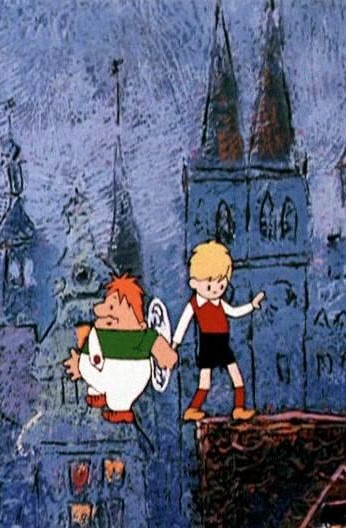
B. Stepanzev. «The Little Lad and Karlson.» 1968. Film frame: The Little Lad and Karlson on the roof