Few artists exhibit such a deep commitment to a specific place. It seems that remove them from their familiar environment—and they lose the ability to create their work. Such is the case with artist Sergei Bakin.
— Николай Суворов о Сергее Бакине. Из каталога ArtIndex, Санкт-Петербург 2016 г.
Выставка
St. Petersburg as a Memory
Вневременное состояние, атмосфера и личная память
Что происходит с образом города, когда он становится частью личной памяти?
Show a different Petersburg—convey it through atmosphere rather than architectural recognition. The city through the eyes of a person who has lived there for most of their life. Personal experiences.
Project Structure
(1) Leningrad Artist Sergey Bakin (2) Relevance (3) Visual Research (4) Exhibition Concept (5) Venue Selection (6) Exhibition Structure (7) Conclusion (8) Image Sources
Leningrad Artist Sergey Bakin
Sergey Bakin is a painter, graphic artist, and fashion designer whose work prominently features urban landscapes, ballet, and the human form.
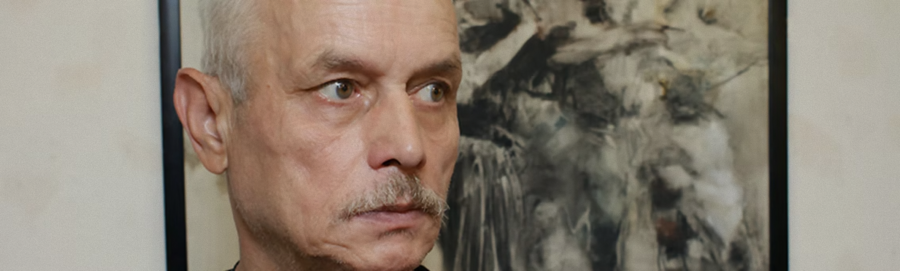
Born in Leningrad in 1957. He graduated from the Secondary Art School at the Academy of Arts, and later from the V. I. Mukina Leningrad Higher Art and Industrial College, specializing in «garment modeling.» For over seven years, the artist worked as a fashion model maker at the Leningrad House of Fashion, after which he devoted himself to painting.
- I landed in the «Industrial Modeling of Women’s Apparel» group, hoping (with the dreams of youth!) to end up in the «Perspective» group later. That group focused solely on creating exhibition collections for display both domestically and internationally. In our group (the industrial one), however, there was no talk of fantasies or «flights of fancy, ” since we were strictly tied to the capabilities (the small scale) of our factories.
— Сергей Бакин, вспоминая о годах работы Ленинградском доме моделей.
«Fatigue.» 80×60. Canvas, oil. 2002.
Visual Study
Атмосфера, свет, размытость и движение в работах Сергея Бакина
(1) Introduction (2) Research Concept (3) Visual Analysis of Works ㅤㅤ(3.1) Ballet: Movement Over Pose ㅤㅤ(3.2) St. Petersburg: The City as State of Mind and Memory ㅤㅤ(3.3) Carnival: Movement, Crowds, and Color ㅤㅤ(3.4) Portrait: Humanity Between Recognizability and Blurring ㅤㅤ(3.5) Fashion: Silhouette, Fabric, and Movement (4) Conclusions (5) Bibliography and Image Sources
Visual Study of Sergey Bakin’s Work
Гипотеза
The atmosphere in Sergei Bakin’s works is created through the interplay of light, color, the character of the brushstroke, and the degree of detail in the image. These elements allow the artist to convey not only the external appearance of a person or space, but also the sensation of movement, the transience of the moment, and an emotional state. However, the same artistic techniques can serve different functions depending on the subject of the work: conveying the plasticity of dance, the variability of urban space, the dynamism of a crowd, or the expressiveness of the human figure.
How does Sergey Bakin use light, blur, and motion to create atmosphere in his works, and how do these techniques manifest across the various thematic directions of his art?
Exhibition Concept
Петербург как воспоминание
St. Petersburg as a Memory, Personal Recollection
To depict a different Petersburg—one conveyed through atmosphere rather than architectural recognizability. The city seen through the eyes of someone who spent the majority of their life there; personal experiences.
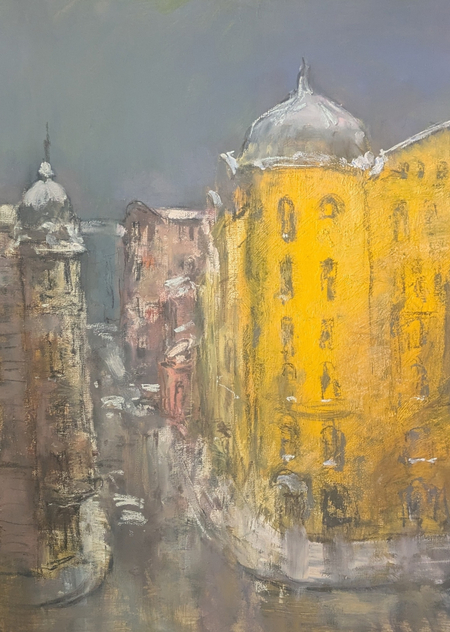
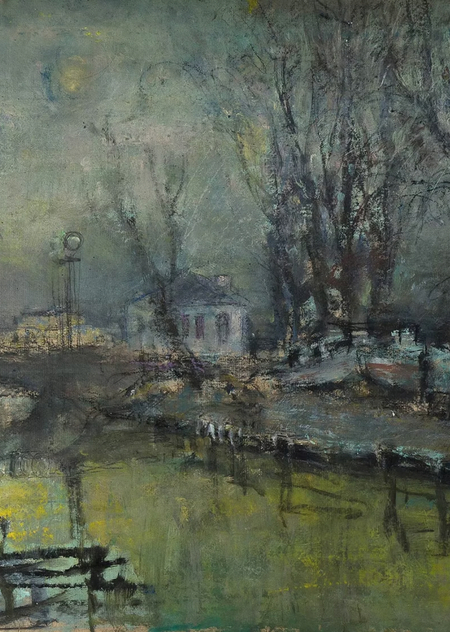
The central theme will explore the image of Petersburg as personal memory. For a person who has lived in a city for most of their life, it gradually ceases to be merely a setting for daily life. Instead, it becomes part of one’s inner world. This is preserved in the humidity of the air, the diffused light, the shades of the sky, the familiar streets, and the courtyards. Memory retains less the precise contours of buildings than the atmosphere of a particular moment—the mood and the feeling with which a person once experienced that space.
How does reality change when we recall it years later? What endures, and what fades? Why do some places remain with us as a feeling of warmth and intimacy, while others take on a shade of melancholy or quiet sadness? The exhibition concept invites us to consider how memory transforms a city, imbuing it with individual meaning and emotional depth.
The exhibition invites viewers to see Petersburg through the eyes of someone for whom the city has become an inalienable part of their biography. Sergey Bakin’s work reflects a long-standing, deeply personal engagement with the urban environment—his experience of life and his observation of the city through its everyday conditions and emotions.
A dialogue arises between the artist’s memory and the viewer’s memory. The same urban image can be perceived differently, acquiring new meanings depending on each person’s own experience. The exhibition will reveal not only which Petersburg the artist sees, but also what city forms in the memory of each of us.
Petersburg can be quiet and contemplative, melancholy and pensive, filled with light, or enveloped in twilight. It can evoke a sense of loneliness, peace, tenderness, or a subtle yearning for something lost.
These diverse moods do not contradict each other; rather, they form a multilayered image of a city that cannot be reduced to a single definition. In Sergey Bakin’s Petersburg, not only the places themselves are important, but also what is connected to them. The city becomes a unique emotional landscape in which the viewer can discover their own memories and experiences.
For visitors to the city, this is an opportunity to experience Petersburg through an artist’s individual perspective—to feel its atmosphere, see its daily life, and connect with the city’s unseen essence.
For Petersburg residents, the exhibition, conversely, can be an encounter with something familiar and deeply known. Recognizable motifs, urban moods, and accustomed spaces will evoke a sense of returning to one’s own past. They remind us that the city in which we live is constantly changing—not only physically, but within all of us. Yet, the memory of it remains just as it is, as do our feelings.
«Petersburg as Memory» is not so much an exhibition about the city as it is about humanity’s capacity to preserve it and its memory within oneself.
Venue Selection
Erarta Museum of Modern Art in St. Petersburg: Several of Bakin’s works are already on permanent display at the museum, and viewers who have seen them will be interested in a deeper exploration of the artist’s work.
Выбором стал их Большой зал на втором этаже.
Erarta offers the right wing of its building for temporary exhibitions, bookings, and events, and also provides assistance with lighting and equipment organization.
The spacious hall is equipped with partitions, which allow us to divide the space into several zones. Furthermore, any lighting, sound, or display equipment can be installed in the hall.
Exhibition Structure
The space is conditionally divided into 4 categories. This is merely a curatorial reading, and it does not limit the interpretations of the work or the mood that the pieces may convey to visitors.
(01) Immersion in the mood of St. Petersburg—early morning and early evening. (02) The versatility of St. Petersburg—vibrancy amidst the gray. (03) Melancholy, coldness. (04) Graphic work, quick sketches, brief memories.
(01) Immersing oneself in the mood of St. Petersburg—specifically, morning and early evening