Definition
Dadaist photomontage is a technique of cutting and reassembling photographs, newspaper clippings, and printed materials into deliberately ragged and shocking compositions that reject traditional artistic integrity. In its time, photomontage became a weapon against bourgeois aesthetics, which had lost its significance in the eyes of the mass audience following terrible political upheavals. Unlike collage (which often employs different types of creative media), photomontage relies exclusively on mechanically reproduced photographic fragments, creating maximally sharp and fragmented narratives
History
This specific type of art emerged in Berlin around 1916 as a protest against World War I and the bourgeois art humiliated by the war. The initial impetus was the mass production of printed images — the Dadaists used them to destroy traditional aesthetics. Through their method, they declared chance, absurdity, and criticism of power. In the 1920s, the technique spread beyond Berlin but faded with the rise of Nazism, which declared Dadaism «degenerate art.» Nevertheless, photomontage strongly influenced Surrealism and 20th-century political graphics
Phenomena That Influenced the Formation of Photomontage
Cubism was the first movement to introduce foreign materials into painting, laying the foundation for collage. Futurist «words-in-freedom» developed the principles of fragmented typography and simultaneity. Machine aesthetics and World War I propaganda posters generated a mass flow of printed images that made appropriation inevitable. At the same time, psychoanalysis revealed the mechanisms of condensation and displacement — unconscious operations that find their reproduction in montage
Georges Braque. Bottle, Glass and Newspaper. 1914
Theorists of the Movement
Photomontage was first declared a «conscious manipulation of reality» in Richard Huelsenbeck’s First German Dada Manifesto (1918 — 1920, published 1920), which demanded that art become a political weapon. Although Tristan Tzara’s Dada Manifesto of 1918 is devoted to Zurich Dada, its principle «I am against systems; the most acceptable system is that of have none on no principle» directly legitimizes the anti-hierarchical logic of cutting and pasting that underlies montage. Meanwhile, the theoretical writings of Raoul Hausmann (e.g., Synthetic Cinema of Painting, 1918) define photomontage as a new visual syntax
Key Artists
Hannah Höch (1889 — 1978)
She explored gender hybridity and the «New Woman». Unlike her colleagues, she worked not only with politics but also with the visual unconscious
Raoul Hausmann (1886 — 1971)
He was co-inventor of photomontage, theorist of optophonetics
John Heartfield (1891 — 1968)
Master of political photomontage, later directing it against Nazism. His real name is Helmut Herzfeld
George Grosz (1893 — 1959)
He used montage to satirize militarism and bureaucracy. In his works, Grosz used glued scraps of government forms and tram tickets
Key Examples
Hannah Höch, Cut with the Kitchen Knife Dada Through the Last Weimar Beer-Belly Cultural Epoch of Germany (1919 — 1920) — a dense political panorama combining the faces of Dada’s opponents, Marxists, sports stars, and Dadaists, literally dissecting Weimar society
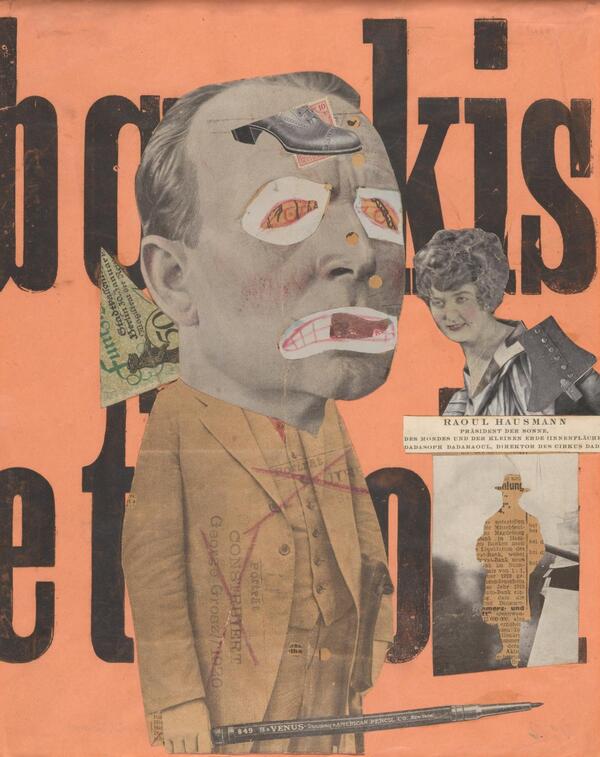
Raoul Hausmann, The Art Critic (1919 — 1920) — an image of a man in a suit with a piggy bank for a head, a postage stamp on his neck, and a coin slot on his chest, satirizing critics as philistine sellouts
John Heartfield, The Meaning of the Hitler Salute (1932) — a later but fundamental work emerging from Dada: a grotesque hand receiving money from behind its back, exposing the corporate underpinnings of fascism
Hannah Höch. Cut with the Kitchen Knife Dada Through the Last Weimar Beer-Belly Cultural Epoch of Germany. 1919 — 1920 and Raoul Hausmann. The Art Critic. 1919 — 1920
Phenomena Influenced by Photomontage
Photomontage has had a significant influence on a range of artistic phenomena: from Surrealist collage and Constructivism with Soviet photomontage to Pop art, and in a broader sense, even on contemporary digital memes and glitch art as means of modern expression
Max Ernst. Clôture. 1967
URL: https://www.norton.org/exhibitions/cut-upcut-out-photomontage-and-collage (accessed: 06.05.2026)
URL: https://www.tate.org.uk (accessed: 06.05.2026)
URL: https://www.moma.org (accessed: 06.05.2026)
Motherwell, R. The Dada Painters and Poets: An Anthology // Harvard University Press / Cambridge, Massachusetts., 1989. p. 413.
URL: https://www.tate.org.uk (accessed: 06.05.2026)
URL: https://www.moma.org (accessed: 06.05.2026)
URL: https://www.theparisreview.org (accessed: 06.05.2026)