Imagine being offered not just a chance to view paintings, but a way to learn how to see differently. The «Desert and Galaxy» exhibition by Viya Celmins—that is precisely the experience: quiet, focused, almost meditative. It is an invitation to slow down in a world where the gaze glides over images at the speed of a social media feed, and to rediscover art as a practice of mindfulness.
«I’m not trying to create a worldview—I’m trying to create a picture of how I see the world.»
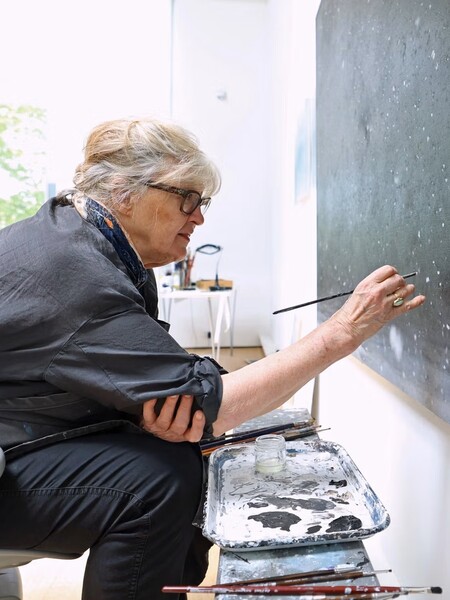

Vija Celmins
The exhibition aims to be a space where the viewer can experience it alongside the artist—slowly, thoughtfully, and genuinely. Welcome to this journey of slowed looking.
INDEX
I. Concept and Curatorial Thesis II. Relevance III. Venue IV. Exhibition Structure and Route V. Room Descriptions and Curatorial Lens V.I. Room 1. «Samples and Catastrophes» (1963–1966) V.II. Room 2. «The First Surface» (1967–1969) V.III. Room 3. «Desert and Galaxy» (1970–1975) V.IV. Room 4. «Fixing the Image in Memory» (1976–1982) V.V. Room 5. «The Web» (1983–1989) V.VI. Room 6. «Night Sky» (1990–2001) V.VII. Room 7. «Snow» (2002–2024) VI. Conclusion
Image List Bibliography
I. Concept and Curatorial Thesis
The curatorial lens of this exhibition is built around the phenomenon of «slow looking» as a key methodology of Vie Celmins—a practice where the act of intense observation itself becomes the content of the work. Her art is not an illustration of reality nor an attempt to create a recognizable narrative; rather, it is a meticulous translation of the visible onto a graphic surface where traditional perspective systematically dissolves, yielding to rhythm, repetition, and texture.
For Celminsh, monochrome functions not as a limitation, but as a tool for concentration: it strips away superfluous color information from perception, compelling the viewer to register the most subtle tonal gradations, micro-relief, and the density of the line. This is a way of seeing where attention shifts from «what is depicted» to «how it was made”—moving from focusing on the narrative to uncovering the surface and its internal logic.
«Desert and Galaxy» function here as two semantic poles of vision, demonstrating the artist’s unique ability to hold the extremely proximate and the infinitely distant within a single artistic field. On one hand—grains of sand, the finest threads of a spiderweb, barely perceptible cracks in stone: microscopic optics that demand almost tactile attention from the viewer. On the other—stars, nebulae, snowfall: cosmic scales where the image emerges from myriad small points and voids. These poles are unified by a single language of monochrome and repetition: whether it is the rhythmic pattern of sand grains or a scattering of stars, the image by Tselminsh becomes not a copy of the subject, but a memory of it—a trace of perception, fixed by the effort of the gaze.
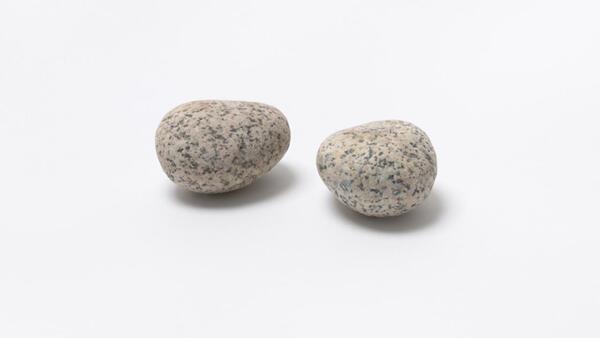
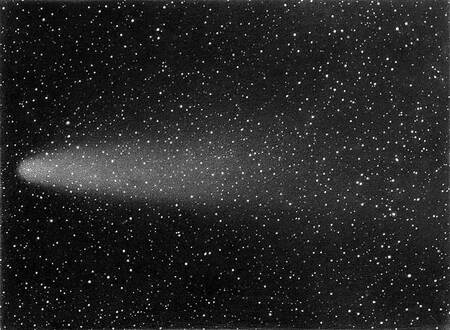
1. Vija Celmins, Two Stones 1977/2014–16 One found object and one constructed object: alkyd oil on bronze 2. Vija Celmins, «Untitled #13», 1996 Charcoal on paper, 17 × 22 inches.
In this exhibition, we trace the evolution of this method as a progressive movement from objecthood to non-objectivity—from recognizable forms to images where the surface itself becomes the primary content. The exhibition’s journey mirrors the artist’s physical path: from early still lifes featuring everyday objects (where the object still retains its «materiality») to the extremely «empty» imagery of deserts, night skies, cobwebs, and snow (where perspective vanishes, leaving only rhythm and texture). Each room documents another stage of this transition—moving from documenting catastrophe and the material world to exploring surface, from detailed drawing to meditative fields of stars and snowflakes.
This route allows the viewer not just to see the works in chronological order, but to experience with the artist the process of «slowing down”—learning to notice subtle tonal shifts, to distinguish graphite layers, and to read the pauses between lines. This is the core objective of curatorial vision: to transform the exhibition into a practice of mindfulness, where every piece is an invitation to pause, look closely, and witness how form emerges from minute repetitions and rhythms—a form capable of capturing the transient.
II. Relevance
In this era of accelerated visual consumption, Tselminsch’s practice offers an alternative lens: attention to detail, the tactility of surface, and monochrome as a method of concentration. For the Russian viewer, this is a rare opportunity to see the full range of her techniques—including complex prints—and to understand how minimalism and repetition become a language.
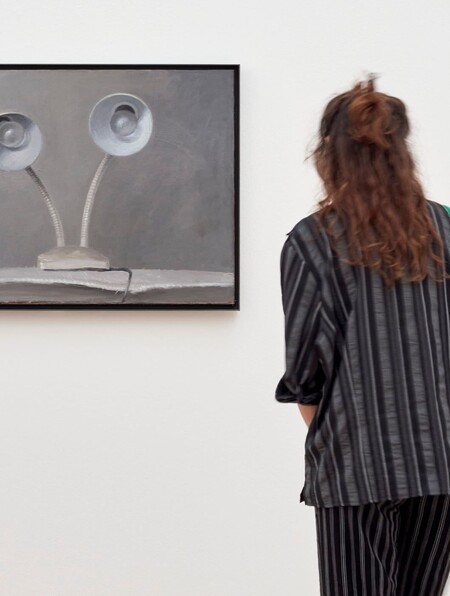
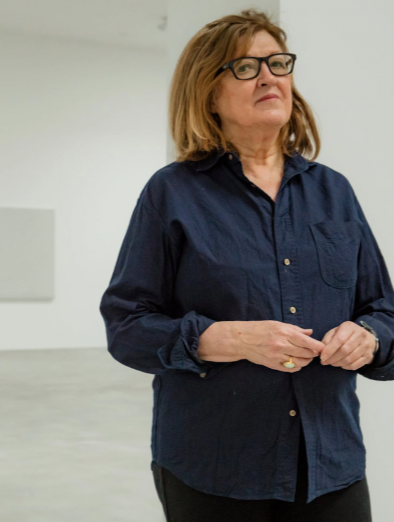
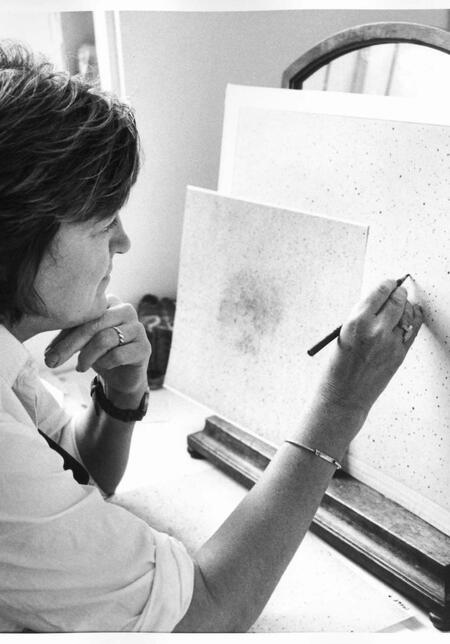
Vija Celmins and her art
The exhibition is embedded within the international context of the modernist tradition of observation and abstraction, as well as within the local museum discourse: its proximity to 19th–20th-century art allows for a dialogue with the history of sight and representation.
III. Platform
The Pushkin State Museum of Art, Gallery of Arts of Europe and America of the 19th–20th Centuries, meets all exhibition requirements:
1. International Optics. The gallery systemically showcases international art and excels at navigating transnational contexts.
2. Atmosphere. The architecture and exhibition layout of the venue allow for the necessary quiet and concentration needed to perceive monochrome graphics.
3. Technical Expertise. The venue has experience working with delicate monochrome surfaces, controlling lighting, humidity, and microclimate.
4. Historical Context. Proximity to 19th–20th-century art allows for a dialogue with the modernist tradition of observation and abstraction.
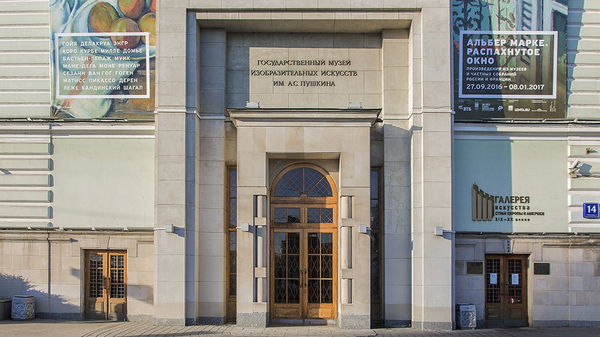
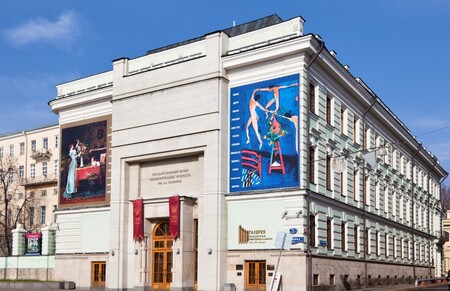
Pushkin State Museum of Art, Gallery of Art of Europe and America of the 19th–20th Centuries
IV. Exhibition Structure and Visitor Flow
Chronology (1963–2024), arranged across seven rooms on the gallery’s ground floor. The route involves a continuous progression from the representational to the non-representational—from painting to graphic art, from the «object» to the «surface.»
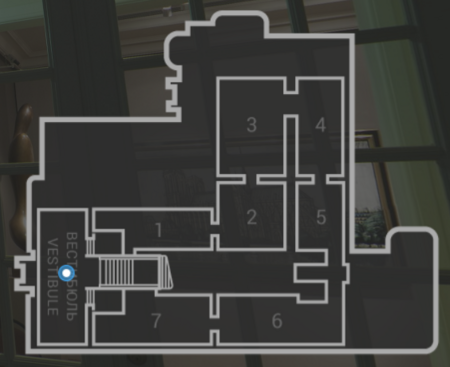
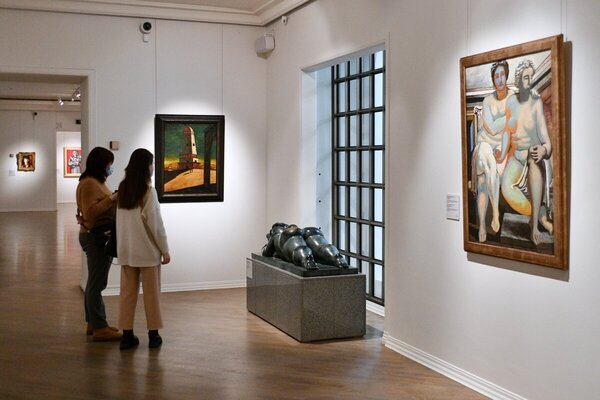
First-floor space of the Pushkin State Museum of Fine Arts, Gallery of Art of Europe and America of the 19th–20th Centuries
Audience Impact:
The artist’s physical journey through space: from recognizable objects to forms where perspective dissolves, leaving only surface and rhythm.
V. Studio Descriptions and Curatorial Perspective
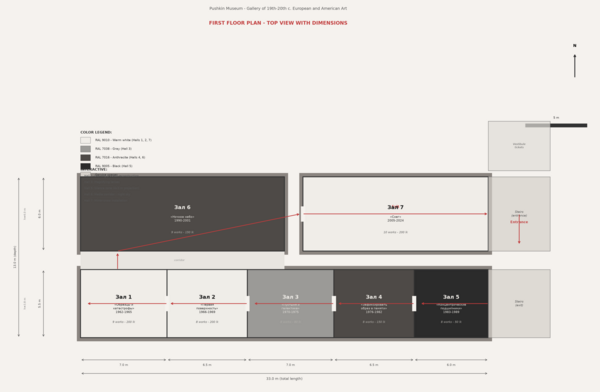
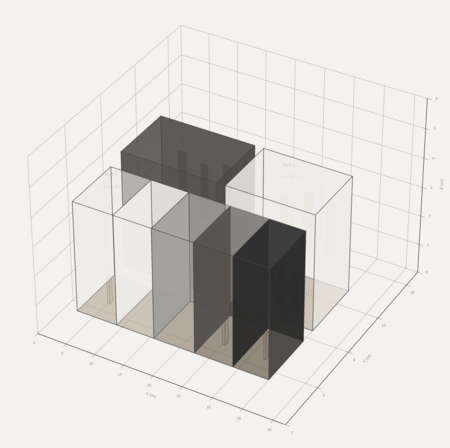
Exhibition Plans for «Desert and Galaxy»
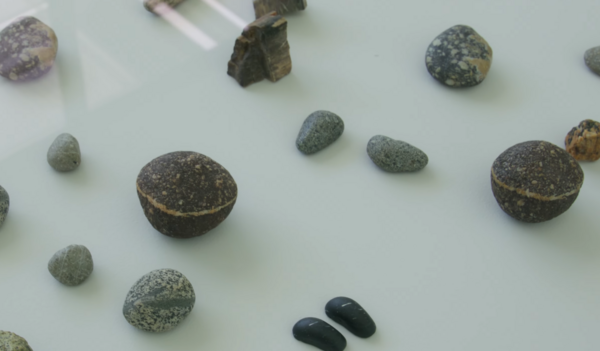
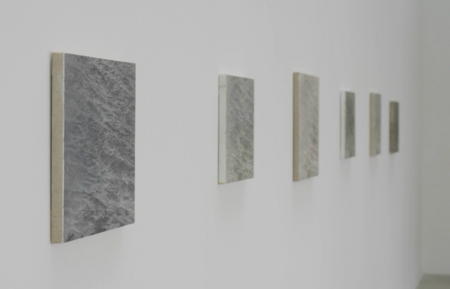
Exhibition Hall Details for Yi Celminsh
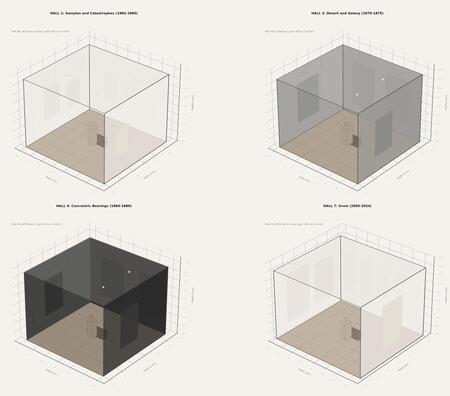
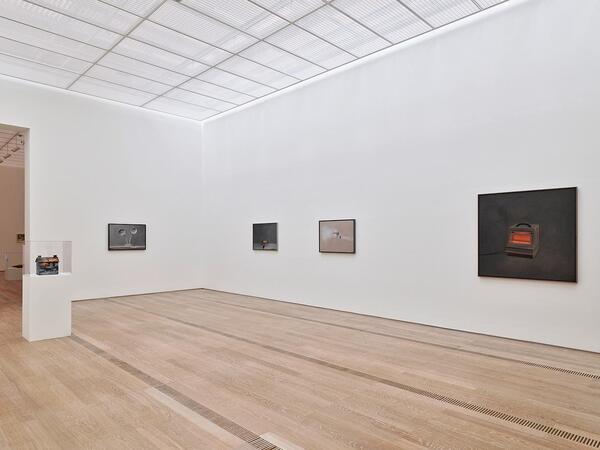
Plans and visualizations for the exhibition «Desert and Galaxy»