Navigator:
Concept Political Ideas and Overcoming Alienation Experimental Theatre and Direct Address Expanding the Boundaries of Cinema and Surrealism Conclusion
Suji Terayama remains one of the most enigmatic and underrated figures in Japanese cinema. His radical, experimental approach to filmmaking and his tendency to engage directly with the audience undoubtedly present a compelling field for discussion and analysis, which served as the motivation for this study.
Terayama’s work, renowned for its avant-garde and experimental nature, often challenges traditional narrative structures and audience expectations. By addressing the viewers directly, his films create a unique level of interaction that moves beyond conventional storytelling. This study will illustrate how Terayama utilizes this technique and its impact on viewer perception and the interpretation of his films.
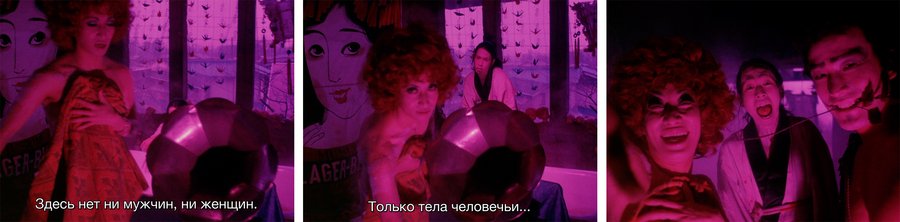
Stop Reading, Let’s Take to the Streets! (1971) | Suji Terayama
Breaking the fourth wall can disrupt the expected narrative flow and pull the viewer out of their immersion.
Terayama masterfully handles this «approach, ” as if questioning, if there are four walls, why not try striking every single one?
In Russian-language literature, „breaking the fourth wall“ is most often referred to as a „device“ or „technique, ” but Terayama repeatedly employs it as an „approach“ around which the rest of the film’s structure is formed.
The central question of this paper is: How does the technique of breaking the fourth wall, as used by Shuji Terayama, influence audience perception, and what are its specific characteristics?
Terayama’s sequential breaking of the fourth wall serves to create a metafiction that engages the audience in a critical dialogue about the nature of reality, fiction, and the role of cinema. It is suggested that this technique is intended to raise the viewer’s awareness of film as an art form and to provoke deeper contemplation on the presented themes.
The question of what the fourth wall is, in itself, is quite complex. Breaking the fourth wall can serve a variety of purposes. In a general sense, it is an unspoken barrier separating the real world from the cinematic world, enclosing it within itself (though the term can certainly be applied to other forms of visual art).
However, we can attempt to provide a more specific answer by engaging with Terayama’s lived context. First and foremost, he was a playwright, director, and intellectual who was intimately familiar with Western cinema and research trends.
Furthermore, Terayama held a multifaceted, radical political stance; he was a Marxist and shared the skepticism of many Japanese people regarding industrialization and technological progress.
Several assumptions follow from these facts.
Political Ideas and the Overcoming of Alienation
First, from this, one can surmise that Terayama’s creative work resonates with or is inspired by Jean-Luc Godard’s experiments aimed at breaking the fourth wall, as well as the endeavors of certain Marxist directors who sought to pull the viewer out of a comfortable position of «experiencing pleasure» (Malvi, 1975).
Stop Reading, Let’s Take to the Streets! (1971) | Shuji Terayama
This is also supported by the fact that some films directly address the issue of horizontal cinema and spectator passivity (the introduction and finale of «Throw Reading, Let’s Go Out»).
Stop reading, we’re heading out to the streets! (1971) | Shuji Terayama
The character’s address to the audience serves as an indicator of some internal flux. Simultaneously, at the film’s end, the character suddenly transforms into an actor who addresses us, along with all the members of the production crew.
To us, this is still the main protagonist, yet by dissecting himself into parts, the actor speaks about his distaste for cinema and, more broadly, about gathering in the streets to sharpen the revolutionary situation.
It is also interesting that the actor represents the key members of the production project, which is then followed by «horizontal titles"—in the most literal sense. These scroll horizontally, showcasing the people who participated in the film’s creation.
Stop Reading, Let’s Hit the Streets! (1971) | Shuji Terayama
The protagonist’s introduction at the beginning of the film occurs after a minute-long break featuring a black screen and faint ambient sounds. Addressing the audience, the hero does not specifically frame the narrative in which he will play the central role. He speaks about himself, leading us to believe he is speaking as the film’s character. However, in the finale, we hear a similar address from him to us, but this time distinctly from the perspective of an actor.
While watching, it is impossible to definitively ascertain the exact nature of the relationship between these two addresses. Perhaps this represents some dialectical shift within the revolutionary figure (the hero in a state of transition $\rightarrow$ the hero before the change $\rightarrow$ the actor speaking about the sensation of being part of the hero’s lived life and the necessity of political action).
On the other hand, this film blurs numerous boundaries between cinema, reality, and the viewer. The fusion of the boy from a disadvantaged family with the actor facing a difficult fate can be seen as coherent. It may simply be another step toward social solidarity.
Throw Away the Books, Let’s Take to the Streets! (1971) | Shuji Terayama
Experimental Theater and Direct Address
Secondly, Terayama’s dramatic experience involves a heightened focus on audience engagement or what Tom Brown (2012) terms «direct address.» While these addresses are a common theatrical practice, Terayama’s approach defies easy categorization as conventional.
Stop Reading, Let’s Take to the Streets! (1971) | Shuji Terayama
The plays he authored formed the basis for many of his early films, actively incorporating not just «direct address, ” but also „direct involvement.“ Audiences were frequently invited to participate in various scenes of experimental theater, a practice that was highly unusual for the late 1960s.
Pastoral. Dying in the Countryside (1974) | Shuji Terayama
Throw the Books, Let’s Take to the Streets! (1971) | Shoji Terayama
An interesting example in this context is Terayama’s latest film, «Goodbye, Ark,» where the director very slowly builds emotional tension, which culminates in a highly tragic crescendo in one of the film’s final scenes. Ultimately, the director seems to multiply the emotions by shifting the direct gaze toward the audience, addressing their fragility.
Farewell, Ark (1984) | Tetsuya Terayama
This scene takes on a special context when we learn about Terayama’s unique relationship with the village and the city, and that this is the director’s posthumous film—his final statement.
Expanding the Boundaries of Cinema and Surrealism
Thirdly, Terayama sought to experience cinema as both a technology and a tool. His intention was not limited to a specific practical goal, but resided in the experience and the experiment of expanding the perception of familiar cinematic elements. This is further evidenced by the fact that he experimented with virtually every aspect of cinema—narration, sound, color, editing, and more.
Terayama pushed the capabilities of cinema to their maximum to construct surreal worlds and investigate the surreal nature of film and its constituent elements.
Interview transition — film in «Throw Reading, Let’s Go to the Streets!» (1971) | Shuji Terayama
This is illustrated by a documentary-style interview that cuts back into the film («Stop Reading, Let’s Go Out») or by a large volume of archival photographs and footage edited into the film.
Chronicle from «Fruits of Passion» (1981) | Shuji Terayama