What does «release.arch» do?

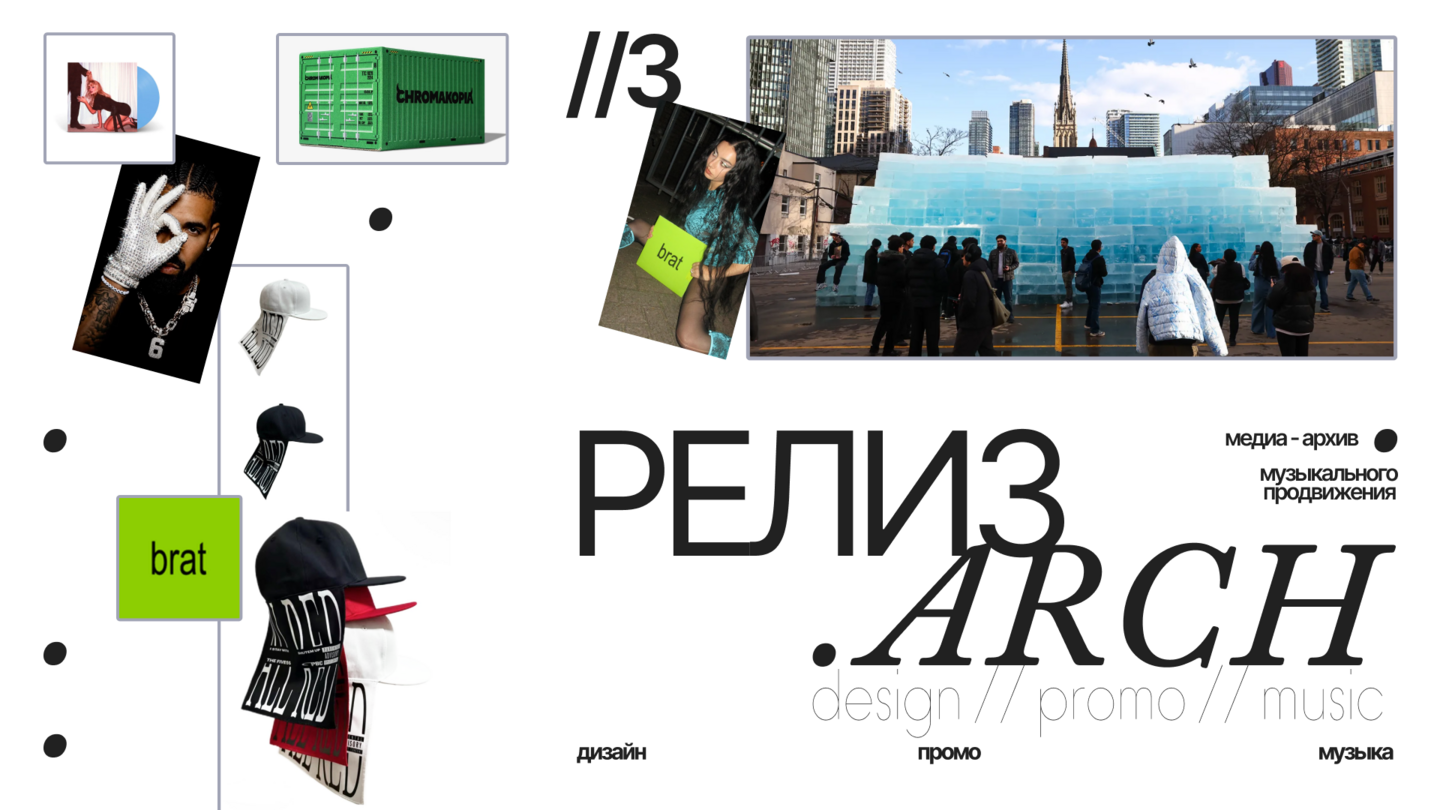
«release.arch» is a media archive dedicated to the visual and marketing strategies of music releases. The project investigates how an artist builds their visual identity, what media they utilize, how those elements interconnect, and how design becomes integral to music promotion.
At the heart of each piece is a specific release campaign, which analyzes album art, typography, photography, posters, merchandise, collaborations, outdoor advertising, snippets, venue design, and other communication elements. For every component, the goal is not only to show what it looks like but also to explain who created it, where and when it was used, and what specific objective it served.
«release.arch» explores the question, «how does this work as part of artist promotion?» and why it’s cool.
«release.arch» investigates not a singular design object, but the system of promoting a single release—integrating the musical aspect, marketing, and visual elements—thus becoming an archive of how music takes on a visual form and how that form is disseminated.
The project examines campaigns of various scales, transforming them into a practical tool for designers, musicians, and managers—allowing them to understand the solutions implemented, the problems they solved, and what can be applied to their own projects.
2// Future Media Themes
Media focus extends beyond music to encompass its visual promotion. From this, it follows:
{1} Segment Media focusing on music marketing and visual communications.{2} Niche Topic The visual system of a music release and its promotion methods in the music market: through album art, identity, typography, photography and video, merchandise, posters, outdoor advertising, digital platforms, collaborations, and special activations.
The primary thematic focus is case studies from the last 10–20 years, when music promotion became especially intertwined with the digital environment, social media, and comprehensive visual campaigns.
At the same time, «relys.arch» also examines historical methods of promoting musicians and releases to track how the tools, media, and logic of communicating with the audience have evolved.
3// Competitive Analysis Criteria
Seven criteria are used to analyze competitors in the presentation:
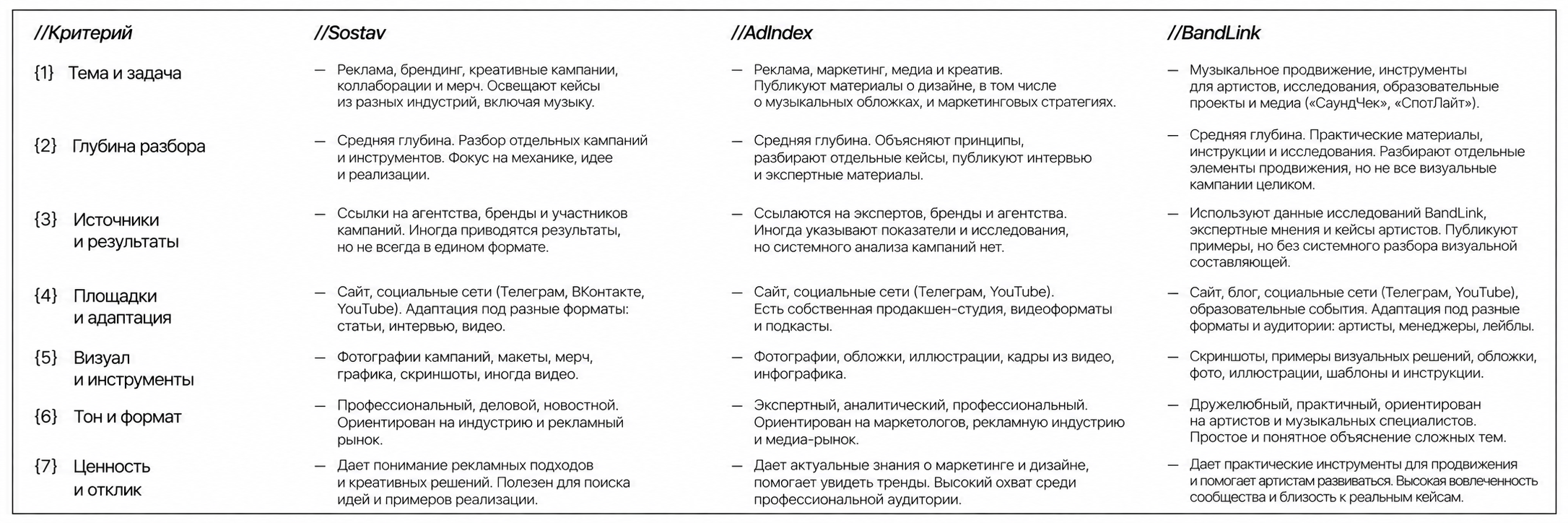
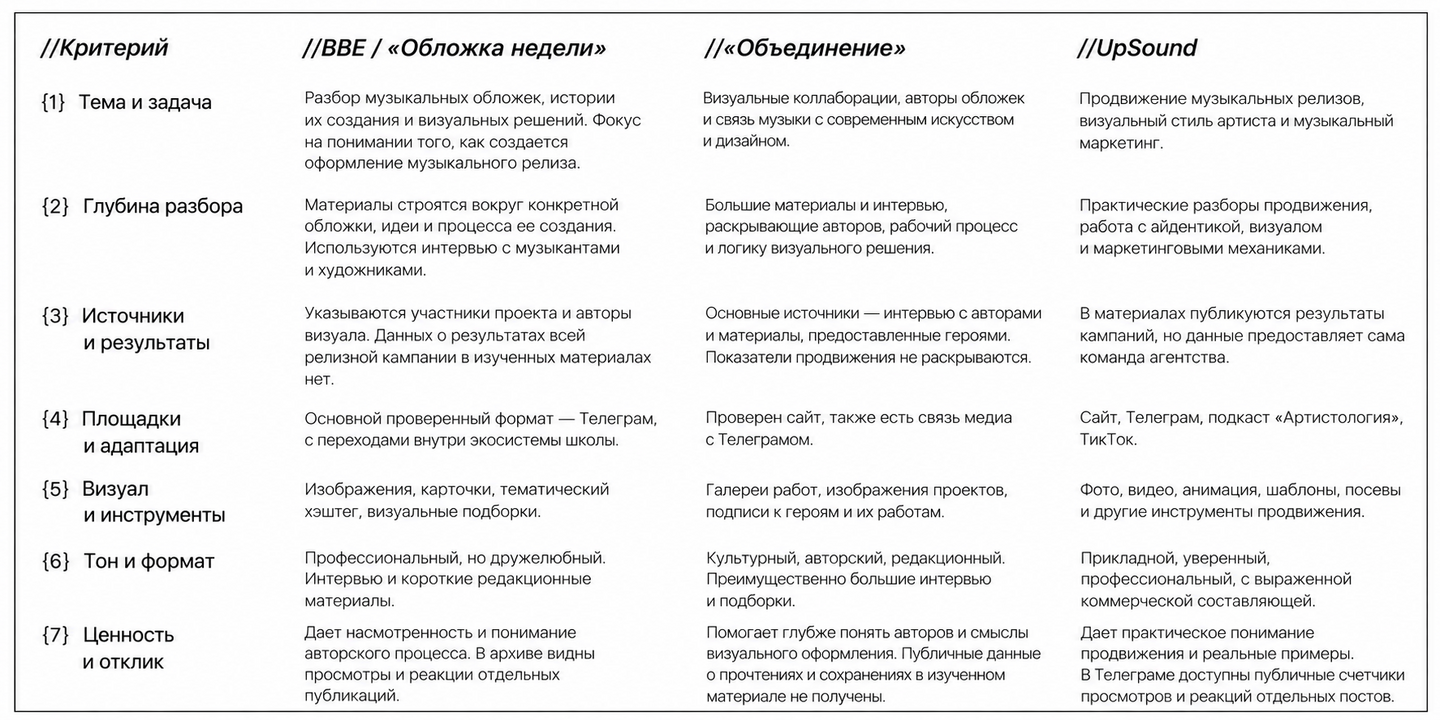
{1} Theme and Objective How closely the project relates to the theme of music visualization and release promotion.{2} Depth of Analysis Does the analysis cover only the visuals, or also the objective, process, media, and campaign sequence.{3} Sources and Outcomes Are the authors, origin of materials, publication period, and data sources specified?{4} Platforms and Adaptation On which platforms is the content released, and how is one piece of material adapted for different channels.{5} Visuals and Tools What formats are utilized: images, galleries, video, motion graphics, short clips, segments, highlights, and other tools.{6} Tone and Format What approach is used: authorial, educational, critical, or commercial.{7} Value and Response What benefit does the audience gain, can the material be reused, and what reactions are available to it.
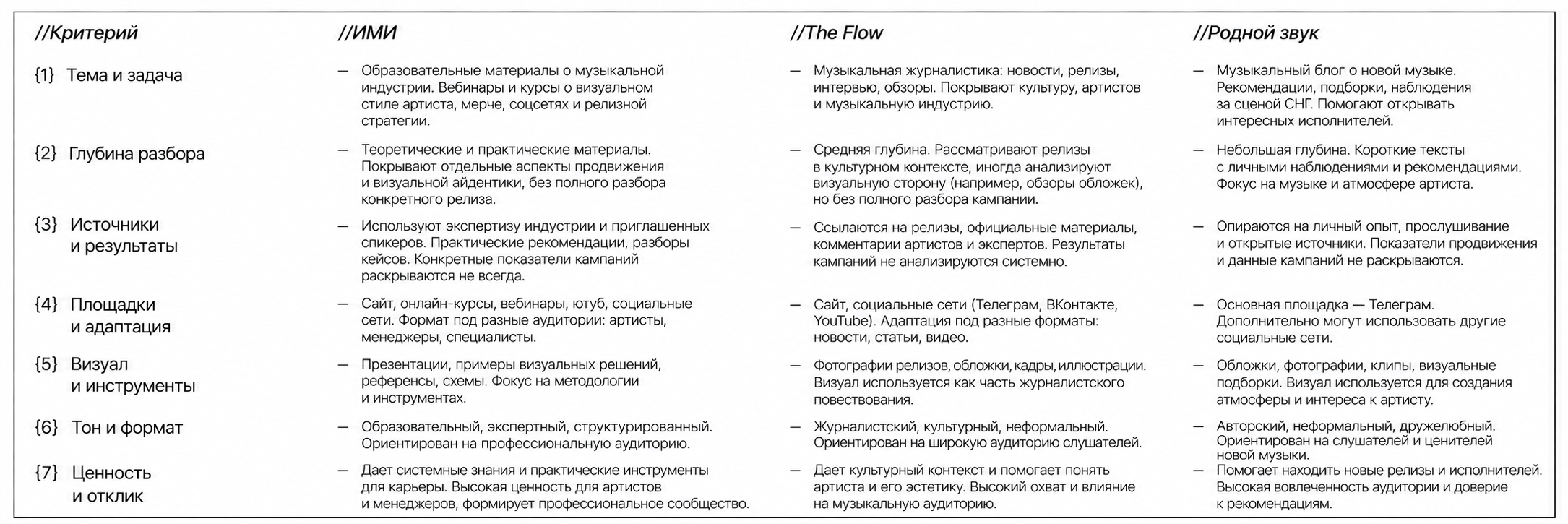
direct // indirect // potential
Competitive analysis shows that the topic of visual music promotion is already present in the market, but it is scattered across various media types without a unified system.
The characteristics I have identified and will use in my own project are:
From media about design, we take note of the creators and the visual creation process; from agency case studies, we adopt the structure: «challenge—solution—result»; from educational and industry projects, we incorporate clear explanations of mechanics; and from music media, we utilize easy entry points through the artist, the release, and the cultural context.
«rелиз.arch» can occupy a space between design media, music journalism, and marketing case studies, creating a unified format for analysis.
4// Distribution Channels
{1} Telegram — the primary channel The project’s main platform: comprehensive case breakdowns, visual cards, links to sources, and a pinned index of case studies.{2} Thematic Outreach Posts in channels focusing on music, design, and the music industry featuring a brief visual summary that links to the full material.{3} Recommendations from Key Figures and Case Authors Disseminating publications through musicians, designers, art directors, and other participants involved in the analyzed campaigns.{4} Short Videos A short clip reveals one technique or an interesting fact from a case study and directs the user to the full breakdown. When researching suitable formats, short videos on social media were considered.{6} Website Archive — Next Phase Following the Telegram launch, the project will expand into a dedicated database where materials can be searched by artist, release, format, and mechanic.{7} Podcast — Media Expansion Interviews with members of release teams will drive the audience toward related visual dossiers and the project archive.
5// Target Audience
«relys.arch» has four core audience segments that differ based on the objective a person approaches the media with. At its inception, «relys.arch» was an informational B2C product: the audience reads the media based on their own needs, including professional ones. Corporate services and the B2B direction are not included in the pilot. All four segments are currently working hypotheses and require further validation through interviews and content testing.
Designer
Anya24 years old, works with indie projects, lives in Yekaterinburg. The age and geography are only provided here as an example of someone starting their career who often works remotely.Situation Anya needs to present an artist with a cover concept and explain how that visual idea will develop across announcements, merchandise, and other media.Problem She collects references and images from various sources but often doesn’t know who created them, what context they were used in, or what problem they were intended to solve.Behavior She opens short articles during breaks, saves a case study she likes, and returns to it later when compiling a brief or preparing a presentation for the artist.What «relis.arch» provides A full breakdown of a campaign, including its creators, media, and an explanation of the visual logic. This material can be used not only as a reference but also as an argument in her own work.JTBD When I am developing a visual concept, I want to find a dissected music case study to support my decision when presenting it to the artist.Value Criterion After reading, Anya can explain in her own words why the chosen solution works, while still having links to the sources and information about the creators.
Independent Artist
Misha22 years old, self-releasing music in Kazan. For this segment, age and location are less important than his role, his stage in the project, and his limited resources.Situation Misha plans to release a single in a month and is trying to determine what is realistically needed for promotion: one cover art piece, a short track snippet, or a small promotional asset.Problem He doesn’t know which elements are truly necessary for a launch and which only make sense with the resources of a large team.Behavior He reads the channel in the evening on his phone, forwards useful materials to his designer, and returns to a concise list of solutions when planning a release.What he gains An analysis of the requirements, scope of work, and a minimum viable approach. That is, not just a beautiful example, but an understanding of what can be achieved with a limited budget and a small team.Jobs to Be Done When I am preparing an independent release, I want to understand the components of the visual campaign so I can allocate my efforts and give my team an achievable task.Value Criterion After reading, Misha can identify the essential assets for the launch and avoid overly complex mechanics that don’t match his scale or resources.
Artist Manager
Katya29 years old, works with an independent pop project in Moscow and remote contractors. For this segment, responsibility for deadlines, team coordination, and task distribution are crucial.Situation Katya needs to coordinate the release promotion, gather visual materials, and map out the journey from publication to streaming play.Problem It is difficult to compare metrics from other case studies: reach, clicks, plays, and other metrics are often mixed, making it hard to determine exactly what worked.Behavior She reads the material via a work link, quickly finds the necessary medium, saves the scheme, and uses it when discussing the campaign with her team.What She Gains A campaign timeline, the roles of participants, the tasks for each medium, and metrics specifying the period and source.JTBD When I discuss a campaign with my team, I want to see the path from the visual to the action so that I can agree on the mechanics and the method of evaluating the results.Value Criterion After reading, Katya can articulate the goal of each medium and predetermine what data needs to be collected after the launch.
attentive listener
Dasha
21 years old, interested in the Russian indie and pop music scene, lives in Novosibirsk. For this segment, cultural interest and the habit of sharing music discoveries are important.
Situation
Dasha saw an unusual album cover by an artist she knows and wants to understand how it relates to the music, photography, merchandise, and the overall aesthetic of the release.
Problem
She is unfamiliar with professional terminology, and isolated images without context do not help her grasp the concept or the campaign’s logic.
Behavior
She arrives via referral, reads a brief introduction, looks at the images, and shares an interesting fact or material with friends.
What She Gains
A simple explanation of the visual codes, the artist’s background story, and links to the music.
Jobs to Be Done (JTBD)
When I become interested in an artist’s image, I want to understand its details to better grasp the release and share it with others.
Utility Criterion
After reading, Dasha can explain the connection between multiple media types and share the material without needing to retell it.
6// Unique Selling Proposition
«release.arch» {1} Deconstructing a Music Release in Detail From album art, branding, and merchandise to out-of-home advertising, digital promotion, special mechanics, and campaign results.
{2} Showing Not Just What Was Done, But How It Worked Each case study includes the creators, the audience, the launch sequence, platforms, and data sources—without mixing facts and interpretations.
{3} Turning a Case Study into a Working Tool Every analysis concludes with a specific tactic, the conditions for its application, and an understanding of what can be adapted for your own release.
«release.arch» — a media archive that analyzes music releases as complete visual and marketing campaigns, transforming every case study into an applicable tool for one’s own promotion.