
Данный проект является учебной работой студента Школы дизайна или исследовательской работой преподавателя Школы дизайна. Данный проект не является коммерческим и служит образовательным целям
Проект принимает участие в конкурсе

How Riot announces, explains and ships changes across League of Legends, Teamfight Tactics, 2XKO and Riftbound.

A single-brand communication analysis of Riot Games, focused on how the studio communicates game updates and new-product launches. The study reads Riot’s update communication through the Dialogic Theory of Public Relations and the Diffusion of Innovations, across four products: League of Legends, Teamfight Tactics, 2XKO and Riftbound.

Rubricator

  1. The brand and its four products.
  2. Target audience.
  3. Update communication channels.
  4. Theoretical framework: Dialogic Theory and Diffusion of Innovations.
  5. Analysis I — the developer–player dialogue (Dialogic Theory).
  6. Analysis II — rolling out updates and launches (Diffusion of Innovations).
  7. Conclusion and recommendations.
  8. Bibliography and image sources.

The brand and its four products
Исходный размер 1920x1340

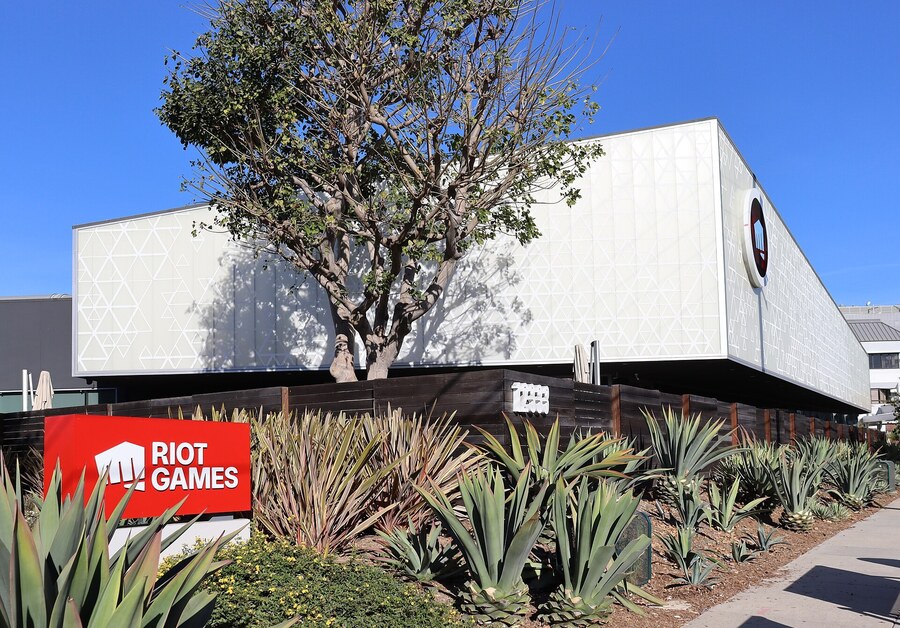
Riot Games headquarters, Los Angeles.

Riot Games is a developer and publisher founded in 2006 and built around the value it calls «Player Focus». For a communication study the interesting object is the studio’s update communication rather than any single game: Riot operates live services that must announce, explain and justify a constant stream of changes to keep players engaged.

This places the studio close to what Grunig (1992) calls a two-way symmetrical model of communication, in which an organisation adjusts to its publics as much as it tries to persuade them — an unusual stance for a commercial game developer, and the reason its communication rewards analysis.

Исходный размер 1320x1180

Author diagram: Riot’s four products and their release cadences, 2026

This study follows four products on deliberately different cadences. League of Legends, the flagship MOBA, ships balance patches roughly every two weeks. Teamfight Tactics, the auto-battler, refreshes through seasonal «Sets» (Set 17, «Space Gods», launched in April 2026). 2XKO, a 2v2 tag fighter, moved through closed beta and PC early access in 2025 to a full console launch and Season 1 on 20 January 2026.

Riftbound, a physical League of Legends trading card game, released its first set «Origins» in China in August 2025 and in English globally on 31 October 2025. One studio, four very different release rhythms — and a shared communication playbook.

This study treats that shared playbook as a single object and asks how Riot announces, explains and justifies change while sustaining player trust. As a creative-industries firm whose value lives in long-running live services (Hesmondhalgh, 2019), Riot cannot rely on a one-off launch message and must communicate continuously. The analysis applies two complementary frameworks — the Dialogic Theory of Public Relations, for the developer–player relationship, and the Diffusion of Innovations, for the staged rollout of updates and new products — to Riot’s patch notes, developer blogs, public test servers, launch cinematics and the region-by-region release of Riftbound.

Target audience

Исходный размер 1920x1280

League of Legends World Championship 2015 (knockout-stage reveal on the main stage).

Riot’s audience is competitive, highly engaged players who treat their game as an ongoing practice rather than a finished purchase. They read patch notes, watch developer videos, test changes on public servers and argue about balance on Reddit and social media. For this audience an «update» is a change to the rules of a game they are personally invested in rather than a marketing message, which places them closer to participants in a participatory culture than to a passive audience (Jenkins, 2006).

Update communication channels

Исходный размер 1320x1180

Author diagram: Riot’s update communication channels as a loop, 2026.

Riot communicates updates through a recurring sequence of channels: roadmaps and teasers that announce what is coming; patch notes and «/dev» blog posts that explain it; public test servers (PBE) and betas that let players try it; the live patch or launch itself; and social media, Reddit and hotfixes that close the loop by listening. The same loop is reused across all four products, scaled to each one’s cadence.

Исходный размер 1320x1180

Author reconstruction of a Teamfight Tactics patch-notes screen, 2026.

Patch notes are the backbone channel. Every change is itemised — a buff, a nerf, a bug fix, a system change — and, crucially, each is accompanied by a stated reason. Transparency is the default: players are told not only what changed but why, which turns a routine maintenance document into an act of relationship management.

Исходный размер 1320x1180

Author reconstruction of a «/dev» developer blog post, 2026.

The «/dev» blog posts go further, written in a first-person developer voice addressed directly to players. They typically acknowledge a concern players have raised, show the data the team examined, and explain both what will change and what will deliberately not change. This format makes the studio’s reasoning visible and frames updates as a conversation rather than a decree.

Theoretical framework

Исходный размер 1320x1180

Author diagram of the Dialogic Theory of Public Relations (after Kent and Taylor, 1998).

The first lens is the Dialogic Theory of Public Relations. Kent and Taylor (1998, 2002) argue that organisations build trust by communicating with publics in genuinely two-way ways, and they describe dialogue through principles such as mutuality, propinquity, empathy, risk and commitment. Riot’s update communication is unusually rich in exactly these features, which makes the theory a close fit.

Исходный размер 1690x1174

Innovation-adoption curve, from innovators through the early and late majority to laggards.

The second lens is the Diffusion of Innovations. Rogers (1962/2003) describes how a new idea or product spreads through a population in stages — from innovators and early adopters to the early and late majority and finally laggards. Each Riot update or launch is an innovation that has to be introduced and adopted, and Riot’s staged rollouts map onto this curve almost literally.

The two theories address different questions. Dialogic Theory explains the ongoing relationship through which updates are communicated and contested; Diffusion of Innovations explains the staged mechanics by which a specific change or new product is introduced and taken up. Together they cover both the relationship and the rollout.

Analysis I — The developer–player dialogue

Исходный размер 1920x1280

Fans gathered outside the arena at the 2015 League of Legends World Championship — the public Riot must stay accessible to.

Mutuality and propinquity. Kent and Taylor (1998) describe mutuality as a recognition that organisation and public are inextricably linked, and propinquity as being accessible and present. Riot scores highly on both: players co-shape patches through feedback, and developers are reachable in the spaces players already use — public Reddit replies, social posts and the PBE test server — so the studio is present at the moment changes are discussed.

Empathy. Dialogic empathy means an atmosphere of support and a willingness to acknowledge the other’s position. Riot’s «/dev» posts routinely open by restating a player concern in the players' own terms before presenting a change, signalling that the complaint was heard. The first-person developer voice is itself an empathic device: it personalises the studio and invites response rather than closing the topic.

Исходный размер 1320x1180

Author reconstruction of a 2XKO developer drop during launch season, 2026.

Risk. Dialogue requires vulnerability — sharing information without controlling how it is used (Kent and Taylor, 2002). Riot accepts this routinely: it publishes forward-looking roadmaps it may miss, runs open betas and early access where unfinished products are judged publicly, and admits balance mistakes in writing. 2XKO’s long public beta-to-launch path is a clear example of communicating from a position of exposure rather than control.

Commitment. Commitment measures how far an organisation invests in dialogue over time. Riot’s itemised, reasoned patch notes — produced on a relentless cadence across every product — are a standing demonstration of that investment: the studio commits, patch after patch, to explaining itself.

Micro-conclusion. Across the five principles Riot is strongly dialogic in its update communication, but unevenly: dialogue is richest around balance and design, where feedback is invited, and thinner around commercial decisions such as monetisation, where changes are more often announced than discussed. The relationship is genuine but selective.

Analysis II — Rolling out updates and launches

Исходный размер 1920x1281

Fans arriving at the 2015 League of Legends World Championship — Riot stages a launch as a mass event.

Riot stages adoption deliberately. The public test environment (PBE) functions as a channel for innovators and early adopters, who try changes before the majority and feed problems back. A new Teamfight Tactics Set such as «SpaceGods» is then communicated as a seasonal relaunch event, a coordinated reveal that moves the early-adopter excitement of PBE out to the whole player base on a predictable schedule (Rogers, 1962/2003).

Исходный размер 1320x1180

Author reconstruction of Riftbound’s staggered regional launch timeline, 2026.

Riftbound shows the same curve across geography. Its first set «Origins» was seeded in China in August 2025 and then released in English globally on 31 October 2025, with Riot signalling a move to simultaneous worldwide sets thereafter.

Communicating a staggered, region-by-region rollout lets early markets act as innovators whose reception de-risks the wider launch: each territory that adopts «Origins» is, in diffusion terms, an earlier segment whose response shapes how the next wave is announced — diffusion managed deliberately rather than left to chance.

Исходный размер 1920x1280

A caster on the League of Legends World Championship broadcast, 2015.

Launches are wrapped in spectacle. Big updates and new seasons are carried by broadcast events — world championships, dev showcases and launch streams — that dramatise the change before any patch note is read, supplying the emotional pull that carries the early majority across the gap from «aware» to «playing». 2XKO followed the classic technology-adoption path — closed beta, PC early access, then full console launch with Season 1 in January 2026 — communicating each stage as a distinct invitation to a wider circle of players (Moore, 1991).

Исходный размер 1920x896

Riots World Arena, 2018

Micro-conclusion. Riot does not release updates all at once; it sequences them along the adoption curve and communicates each stage to a widening audience. The staging is itself a message — it tells players that change is tested, deliberate and shared — which is why the rollout mechanics and the dialogic relationship reinforce one another.

Conclusion and recommendations

Riot’s update communication can be read as one repeatable loop — announce, explain, test, ship, listen — applied across four products on different cadences. Through the lens of Dialogic Theory the loop is a relationship: itemised patch notes, «/dev» posts and public developer replies satisfy mutuality, propinquity, empathy, risk and commitment, making players feel like participants in design rather than recipients of decisions. Through the lens of Diffusion of Innovations the same loop is a rollout: PBE, betas, staged set launches and Riftbound’s region-by-region release move each change along the adoption curve, using early adopters to de-risk the wider audience.

Исходный размер 1320x1180

Author diagram: Riot’s two-way update-communication loop, 2026.

Recommendations. First, Riot should extend its strong design-side dialogue to commercial changes: monetisation and systemic economy updates are where transparency is thinnest and player trust is most easily lost — a classic crisis-communication exposure (Coombs, 2019) — so the «/dev» explanatory format should be applied there too. Second, with four products on different cadences, the studio risks update fatigue and inconsistent voice; a shared communication framework with product-specific tone would keep the loop legible. Third, for new launches such as Riftbound and 2XKO, Riot should make the staged rollout explicit to players — naming each adoption stage — so that staggered access reads as care rather than exclusion.

A direction for further study: how Riot’s update-communication loop performs in physical media, where Riftbound cannot be hotfixed and the «listen» step has a much slower feedback cycle than in live digital games.

Библиография
1.

Coombs, W. T. Ongoing Crisis Communication: Planning, Managing, and Responding / W. T. Coombs. — 5th ed. — Thousand Oaks, CA: Sage, 2019. — 256 p. — ISBN 978-1-5443-3195-9. — Текст: непосредственный.

2.

Excellence in Public Relations and Communication Management / ed. by J. E. Grunig. — Hillsdale, NJ: Lawrence Erlbaum, 1992. — 666 p. — ISBN 978-0-8058-0226-9. — Текст: непосредственный.

3.

Hesmondhalgh, D. The Cultural Industries / D. Hesmondhalgh. — 4th ed. — London: Sage, 2019. — 540 p. — ISBN 978-1-5264-2409-9. — Текст: непосредственный.

4.

Jenkins, H. Convergence Culture: Where Old and New Media Collide / H. Jenkins. — New York: New York University Press, 2006. — 336 p. — ISBN 978-0-8147-4281-5. — Текст: непосредственный.

5.

Kent, M. L. Building Dialogic Relationships Through the World Wide Web / M. L. Kent, M. Taylor. — Текст: непосредственный // Public Relations Review. — 1998. — Vol. 24, No. 3. — P. 321–334.

6.

Kent, M. L. Toward a Dialogic Theory of Public Relations / M. L. Kent, M. Taylor. — Текст: непосредственный // Public Relations Review. — 2002. — Vol. 28, No. 1. — P. 21–37.

7.

Moore, G. A. Crossing the Chasm: Marketing and Selling High-Tech Products to Mainstream Customers / G. A. Moore. — New York: HarperBusiness, 1991. — 227 p. — ISBN 978-0-88730-519-1. — Текст: непосредственный.

8.

Rogers, E. M. Diffusion of Innovations / E. M. Rogers. — 5th ed. — New York: Free Press, 2003. — 551 p. — ISBN 978-0-7432-2209-9. — Текст: непосредственный.

9.

2XKO // Wikipedia: the free encyclopedia. — URL: https://en.wikipedia.org/wiki/2XKO (дата обращения: 12.06.2026). — Текст: электронный.

10.

2XKO launches January 20, 2026 // Gematsu. — 2025. — URL: https://www.gematsu.com/2025/12/2xko-launches-january-20-2026 (дата обращения: 12.06.2026). — Текст: электронный.

11.

Riftbound // Wikipedia: the free encyclopedia. — URL: https://en.wikipedia.org/wiki/Riftbound (дата обращения: 12.06.2026). — Текст: электронный.

12.

League of Legends Riftbound October 31st Global Release // Esports Insider. — 2025. — URL: https://esportsinsider.com/2025/07/league-of-legends-riftbound-october-31st-global-release (дата обращения: 12.06.2026). — Текст: электронный.

13.

TFT Patch Schedule 2026 // Esports.gg. — URL: https://esports.gg/news/teamfight-tactics/tft-patch-schedule-2026/ (дата обращения: 12.06.2026). — Текст: электронный.

Источники изображений
1.

Cover: Geometric Neon Lights: photograph / Michael Gaylard. — CC BY 4.0. — Изображение: электронное // Wikimedia Commons. — URL: https://commons.wikimedia.org/wiki/File:Geometric_Neon_Lights_(55258736886).jpg (дата обращения: 13.06.2026).

2.

Riot Games headquarters, 12333 Olympic Boulevard, Los Angeles: photograph / Coolcaesar. — CC BY 4.0. — Изображение: электронное // Wikimedia Commons. — URL: https://commons.wikimedia.org/wiki/File:12333_Olympic_Boulevard.jpg (дата обращения: 13.06.2026).

3.

2015 League of Legends World Championship, main stage: photograph / Bruce Liu. — CC BY-SA 3.0. — Изображение: электронное // Wikimedia Commons. — URL: https://commons.wikimedia.org/wiki/File:2015_League_of_Legends_World_Championship_group_stage_(124787031).jpg (дата обращения: 13.06.2026).

4.

2015 League of Legends World Championship, broadcast caster: photograph / Bruce Liu. — CC BY-SA 3.0. — Изображение: электронное // Wikimedia Commons. — URL: https://commons.wikimedia.org/wiki/Category:2015_League_of_Legends_World_Championship_group_stage (дата обращения: 13.06.2026).

5.

2015 League of Legends World Championship, fans outside the arena: photograph / Bruce Liu. — CC BY-SA 3.0. — Изображение: электронное // Wikimedia Commons. — URL: https://commons.wikimedia.org/wiki/Category:2015_League_of_Legends_World_Championship_group_stage (дата обращения: 13.06.2026).

6.

2015 League of Legends World Championship, fans arriving: photograph / Bruce Liu. — CC BY-SA 3.0. — Изображение: электронное // Wikimedia Commons. — URL: https://commons.wikimedia.org/wiki/Category:2015_League_of_Legends_World_Championship_group_stage (дата обращения: 13.06.2026).

7.

League of Legends World Championship Final 2018: photograph / Richard Ye. — CC BY 2.0. — Изображение: электронное // Wikimedia Commons. — URL: https://commons.wikimedia.org/wiki/File:League_of_Legends_World_Championship_Finals_2018.jpg (дата обращения: 13.06.2026).

8.

Traditional Innovation Adoption Model (after Rogers): diagram / Seb.von.st-sund. — CC BY-SA 4.0. — Изображение: электронное // Wikimedia Commons. — URL: https://commons.wikimedia.org/wiki/File:Traditional_Innovation_Adoption_Model.png (дата обращения: 13.06.2026).

Мы используем файлы cookies для улучшения работы сайта и большего удобства его использования. Более подробную информац...
Показать больше