Concept
Theme: «The Role of Ornament in the Transformation of Visual Perception of Space in the Decorative Arts of Khorezm in the XII–XIV Centuries.»
This topic was not chosen arbitrarily—the geometric ornamentation of Khwarazm from the 12th–14th centuries not only proved the supreme level of skill of Khwarazmian masters but also defined the look of the «stellar» style of all later Central Asian architecture. Prior to the Mongol invasion, Khwarazm was a powerful state—the Khwarazm Shahs’ empire (1)—with developed agriculture, crafts, and trade. Important trade routes, including sections of the Great Silk Road, passed through Khwarazm. In the 13th century, medieval Khwarazm suffered two catastrophes: the Mongol devastation in 1221 destroyed the Khwarazm Shahs’ capital along with its artisans, and after Timur’s invasion in 1388, only ruins remained of the city. However, as a member of the Golden Horde, Khwarazm experienced an artistic renaissance.
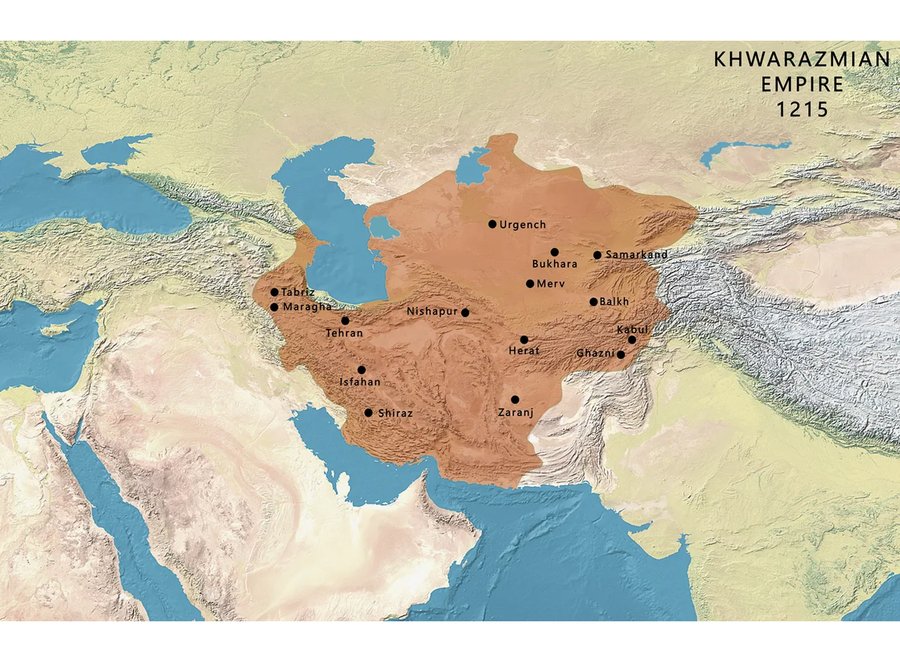
(1) Khorezm Map from the Early 13th Century
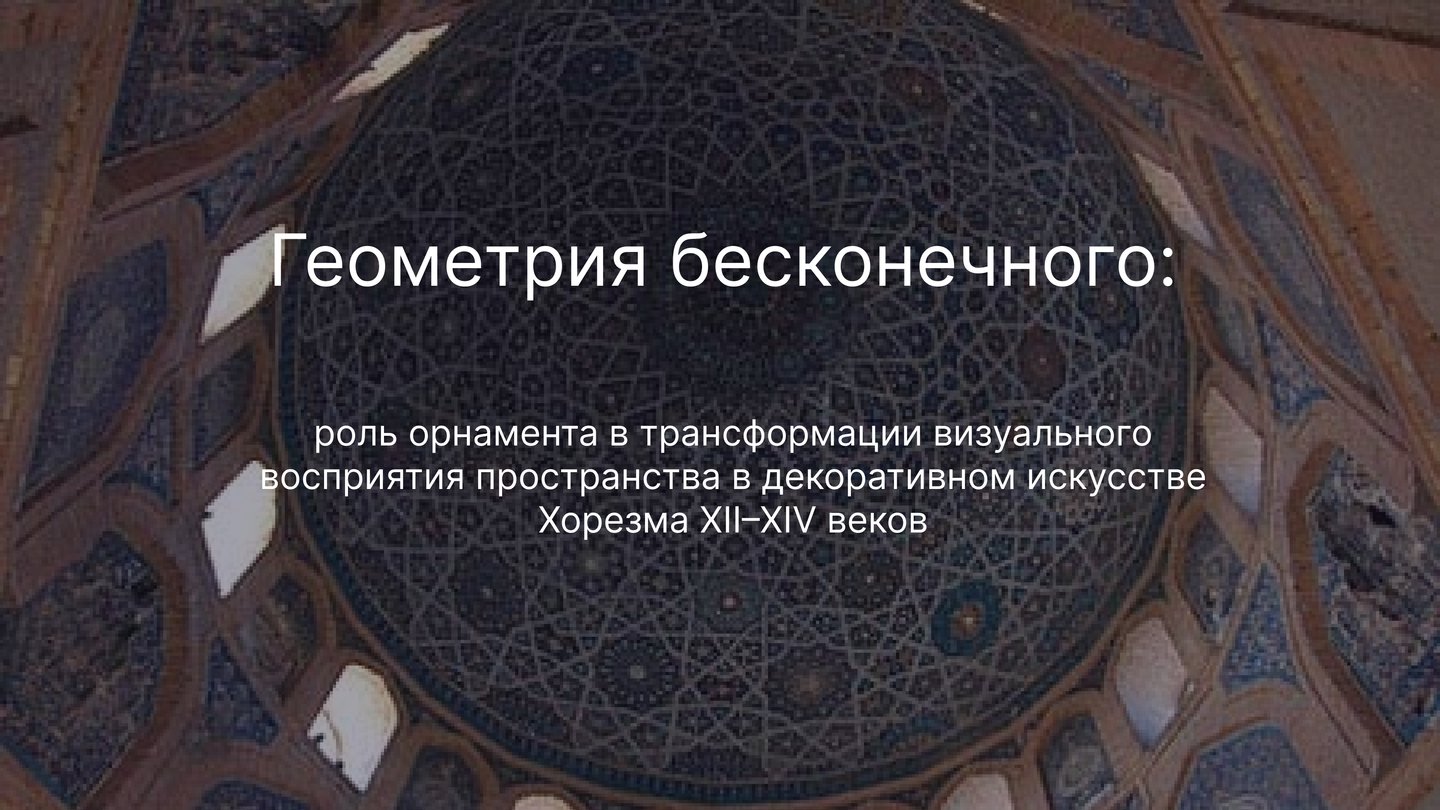
The diverse decorative techniques found in the Khorezm mausoleums (4) in Kunya-Urgench (2)—which, along with other monuments of the ancient city, are included in the UNESCO World Heritage list—allow us to gauge the supreme technical knowledge of the decorators of that era. It is this ancient city that can reveal to us the secrets of creating illusory infinity. For instance, the Turabek-Khanym mausoleum (3) (second half of the 14th century) is crowned with a dome where stars and polyhedrons create the illusion of an endless cosmos, reminiscent of the program code of a deterministic universe. It is breathtaking. In this structure, ceramic mosaic was first employed in Central Asian architecture, and the dome’s ceiling «resembles a bottomless sphere of sky dotted with bright luminaries shimmering against a blue background» [3].
(2) The ancient city of Kunya-Uurgench, 12th–14th centuries.
(3) Mausoleum of Tyurabek Khanum, Kunya-Urgench, 14th century
(4) Mausoleum of Il-Arslan, Kunya-Urzgench city, 12th century
Material Selection Principle
The subjects of the visual study are those decorative elements where the effect of spatial illusion reaches its maximum: the mosaic dome of the Tyurabek-Khanym mausoleum, the corrugated drums of the Tekesh and Il-Arslan mausoleums, and the minaret of Kutlug-Timur with its delicate brick geometric patterns.
Structuring Principle
The research structure is divided into chapters according to the following principle: We first analyze general information regarding patterns and ornaments utilized in Islamic culture. We then examine the girih pattern in detail as the primary technique in Khorezmian ornament. Next, using the Turabek-Khanym Mausoleum—the chief architectural monument of Khorezm—as an example, we investigate the decorative methods that create spatial illusion. The third chapter is devoted to other techniques that enable a volumetric perception. Finally, we discuss the relevance of visual boundless scope and spatial volume in contemporary design and draw conclusions.
The bibliography presents a list of informational sources upon which this research is based. This list includes articles, official websites, documents, and books necessary for preparing this study.
Question
So, how do the geometric elements of the Khorezm ornament from the 12th–14th centuries transform a limited surface into infinite space?
Hypothesis
The Illusion of Space = The Master’s Precision Mathematical Calculation + A Collection of Artistic Techniques.
Such techniques include: radial composition, radiating from the center and forcing the viewer to perceive a «bulge» in the design; changes in rapport that prevent a complete apprehension of the pattern, making it appear to extend beyond visible boundaries; interlacing elements that dissolve the boundaries between background and figures; and real architectural depths—muqarnas, niches, and ribs.Chapter 1. How Patterns are Built
Before discussing the illusion, one must understand the mechanism of creating patterns according to Islamic canons, which rely on form and order.
«The decor of the period under study is divided into botanical, geometric, epigraphic, and zoomorphic forms» [1] (5).
(5) Four Types of Ornament in Khorezm Glazed Ceramics
Let’s examine the types of ornamentation (5).The top row—canonical types. On the left: vegetal ornamentation, succeeding the tradition from the Islamic world. On the right: geometric designs—braiding, diamond chains, circular medallions, and the six-pointed star made from hexagons. It is the «diamond chain» and the «peacock eye» that will become motifs copied by Golden Horde potters from those of Urgench.The bottom row—epigraphy and zoomorphism. On the left: a repeating stylized inscription, analogous to the Kufic bands of Midzakhan. On the right: zoomorphic themes, which became more widespread in the 13th–14th centuries than ever before, due to the arrival of the Golden Horde.However, when we speak specifically about Khorezmian ornamentation, it is the Girih that became its «calling card.»
Girih (from the Persian word «knot») is a system of geometric ornamentation built upon straight line segments that form six-pointed, eight-pointed, ten-pointed, and twelve-pointed stars, separated by polygons and ribbons.
Girih — the mathematics of Islamic patterns.
The Girih star is a figure with rays radiating from the center. The interlacing ribbons force the eye to move continuously along the lines, finding no point of rest. The same lattice structure of the design generates «sharp, ” „medium, ” and „obtuse“ variations of the pattern—depending on the angle of the star’s rays (6), (7). This is where the secret to spatial illusion is hidden.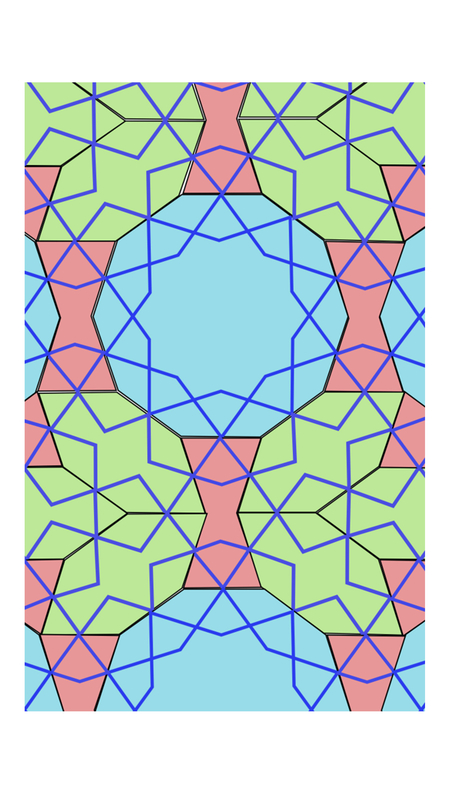
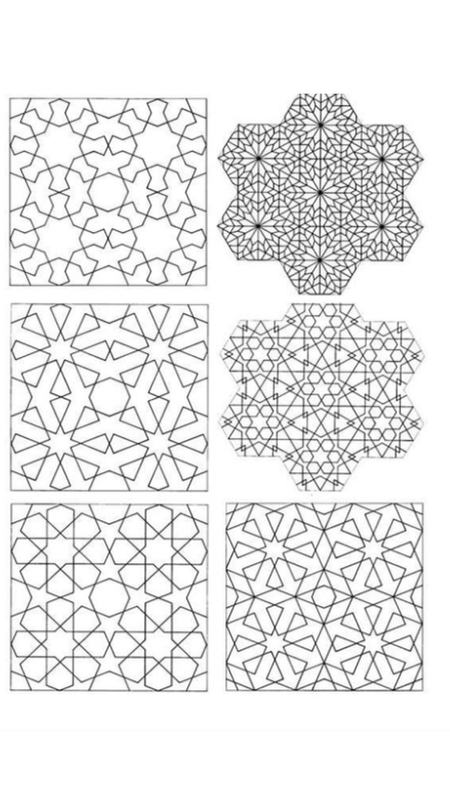
(6), (7) Gyrikh’s diagrams
How Gyrich «works» in Khorezm
Khorasan geometry on pottery includes six-pointed stars with scrolls, rhomboid chains, «peacock eyes, ” and onion-shaped medallions, all interwoven from excavations at Mizdakhana and Shemakhal. In architecture, the most striking example of the use of girih is the mosaic grid of the Turebak Khanum mausoleum dome.
Chapter 2. The Turyabek-Khan Dome-Sky
Historical Overview
Turebek Khanum’s Mausoleum is the principal structure of the Golden Horde’s Gurganj. The mausoleum is named after the daughter of Uzbek Khan and the wife of the governor of Khwarezm, Kutlug Timur, and it was constructed in the second half of the 14th century.
UNESCO recognizes it as the largest and most sophisticated monument in terms of spatial composition from Kunya-Urgench. The mausoleum’s interior features a spatial composition crowned with a dome adorned with stunning geometric color patterns.
Researchers note that the mosaic, «in such abundance and perfect technique, ” appears in Central Asian architecture for the first time and rivals Samarkand’s mosaics [7] of the Timurid era—although the Khwarezmian palette is richer.
It is believed that in 1388, Timur brought the best Khwarezmian masters to Samarkand—meaning that the technology first tested on the dome of Turebek Khanum’s Mausoleum became a model of the „stellar“ style for all subsequent Central Asian architecture.