Categories
► Concept► Semantic Functions of the Gold Background:
- The gold background as a method for organizing space.
- The gold background creates a sense of the sacred image.
- The gold background as a symbol of power.
- Gold as a means of creating light.► Conclusion
Concept
In classical European painting, the background helps us understand where the main figures are located: indoors, outdoors, or in a specific space. In Early Byzantine art of the 5th–6th centuries, the gold background functions differently. It has the capacity to alter our entire conception of the space in which the depicted figures exist. Mosaic ensembles from the Italian city of Ravenna are particularly compelling.
In the early 5th century, mosaic art in Ravenna still maintained the ancient tradition of depicting the sky as dark blue and placing figures within a terrestrial landscape. However, by the middle of the 6th century, the background began to be depicted in gold, and the space transitioned into a framework that shaped the perception of the sanctuary.
How does the golden background alter the perception of space, characters, and the meaning of the image in Ravenna mosaics from the 5th–6th centuries?
In my visual research, I examine the functions of the gold background: it transforms space, participates in creating a sense of the sacred, forms the visual hierarchy of people, and helps illuminate the church.
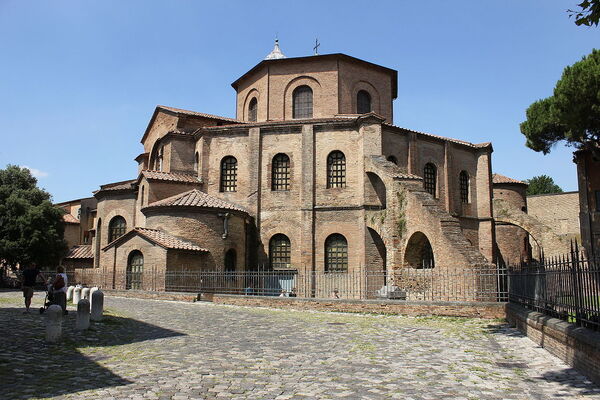
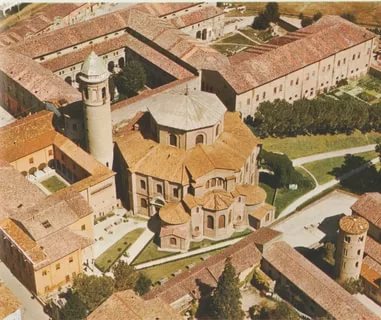
Historic Center of Ravenna, Italy. San Vitale Basilica, circa 547 AD.
During the V and VI centuries, Ravenna served as the capital of the Western Roman Empire. After its fall, the city became the center of Odoacer’s kingdom, and later the Ostrogoths ruled Ravenna under Theodoric. These shifts in political and religious aspects were reflected in the city’s appearance. The city’s mosaics preserve traditions from various cultural eras.
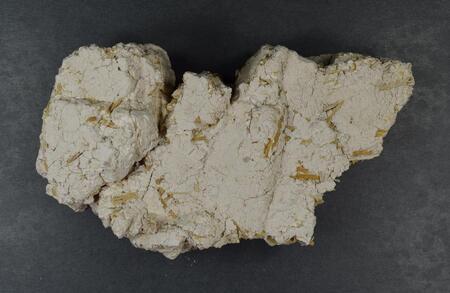
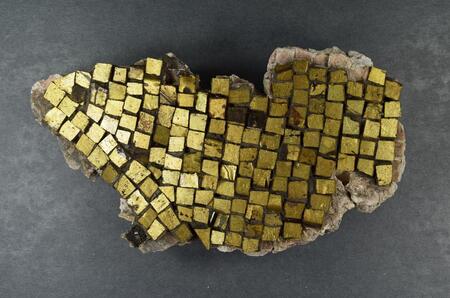
Fragment of a mosaic surface. Ravenna, Italy, 5th–6th Century.
The mosaic is constructed from small glass elements—tesserae. Each tessera is positioned at a different angle, which creates a sense of dynamism and movement in the piece as the lighting changes.
Semantic functions of the gold background: 1. The gold background as a means of organizing space. 2. The gold background creates a sense of the sacred image. 3. The gold background as a symbol of power. 4. Gold as a means of creating light.
Golden backgrounds as a method of spatial organization
Mausoleum of Gallus Placidia, Ravenna, circa 425–450 AD. Vault mosaic.
The mosaic is dominated by a rich blue background speckled with stars. At the center of the composition is a golden cross, symmetrically surrounded by stars. The cross symbolizes the sacrifice of Christian faith, while the stars represent heavenly angels. The golden color of the stars indicates that the cross is the source toward which they are directed. The mosaic evokes a sense of eternity in the viewer.
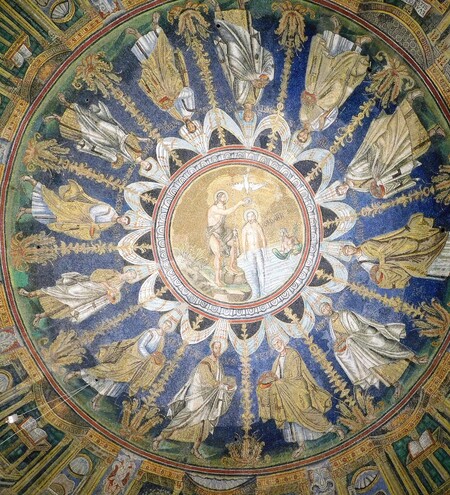
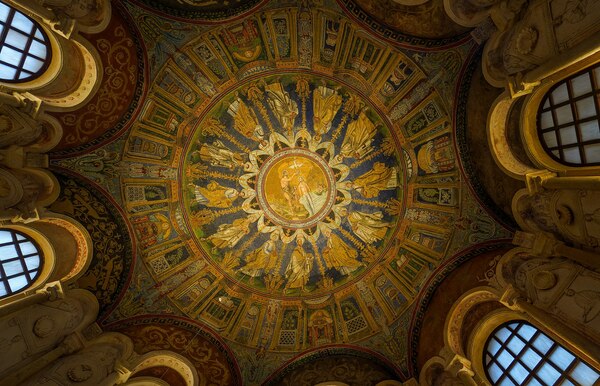
Domed mosaic of the Neo-Nicene Baptistery, Ravenna, 5th century
The dome’s composition is divided into several concentric zones. The central image of the Baptism of Christ is surrounded by a procession of apostles moving against a blue background accented with decorative elements. The gold background emphasizes that the central image is the culmination of the event.
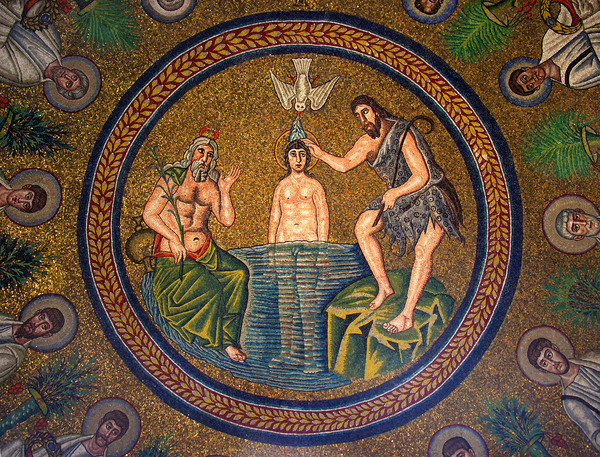
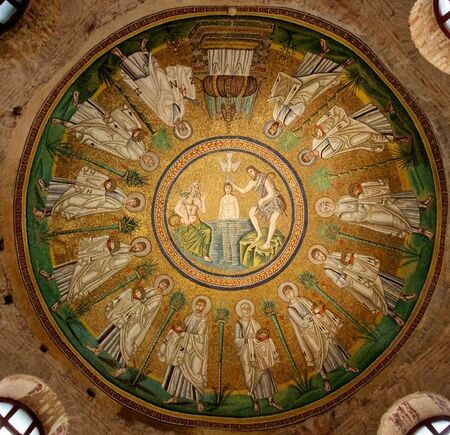
Arian Baptistery, Ravenna, late 5th—early 6th century. Dome mosaic depicting the Baptism of Christ.
Unlike the Neonian Baptistery, the composition of the Arian Baptistery dome utilizes the element of a gold background as a crucial device for organizing its details. The central scene is surrounded by a procession of apostles to emphasize the circular composition. The golden field of this mosaic unifies the center and the surroundings, lending the image a sense of completeness. This allows the viewer to focus on the figures and the ritual event.
If in earlier mosaics celestial space was still conveyed through recognizable natural imagery, in later mosaics gold increasingly replaced a specific environment and transformed into a symbol of the divine world. Instead of landscape, architecture, and perspective, the viewer sees an abstract, otherworldly space, which grants the event a sacred character.
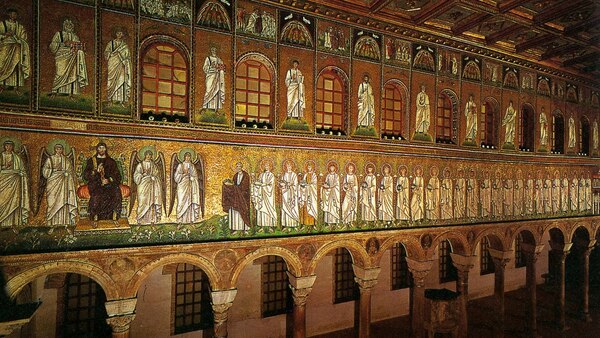
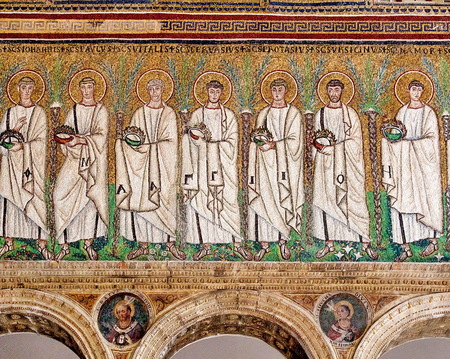
Procession of Saints Martyrs. Basilica of Sant’Apollinare Nuovo, 6th century.
Procession of Holy Martyrs to the Mother of God with Child. St. Apollinaris Novus, 6th century.
The figures are arranged in an extended processional composition against a continuous golden background. This creates a rhythm that directs the viewer’s gaze toward the walls. The absence of a realistic background gives the impression that the procession is taking place in the space of eternity.
2. The gold background evokes a sense of sacred imagery
Christ in Majesty. Basilica of San Vitale, c. 547.
At the center of the apse composition, Christ is depicted seated on a celestial sphere. A nimbus encircles his head, merging with the golden background. Christ offers a martyr’s crown to Saint Vitaly. On the other side, Bishop Ecclesius presents a model of a church. The figures are set against the golden field. At the bottom of the composition, there is a blooming meadow, but it does not form a landscape. The golden background encloses the sacred figures, emphasizing the world’s belonging to the divine sphere.
The blue sphere, on which Christ is enthroned, stands out against the surrounding gold surface. The color contrast between the blue and gold separates the elements of the image, while the golden field serves as the overall environment. The sphere beneath Christ also has a gold outline, contributing to the formation of the image of divine power.
Apse of the Basilica of Sant’Apollinare-in-Classe, 6th century. Mosaic of the Transfiguration of Christ.
In this composition, the gold color does not occupy the entire background space. The lower section of the apse is organized as a conceptual green paradise landscape featuring plants, trees, birds, and sheep, with Saint Apollinary depicted in a prayerful posture at its center. Above this, there is a blue zone adorned with a precious cross and golden stars. The combination of natural motifs, gold elements, and celestial symbolism creates a sacred space where gold interacts with the landscape.
The Lamb of God in the mosaic decoration of the Basilica of San Vitale, 6th century