
Concept
The court attire of the Russian Empire in the 19th and early 20th centuries presents an interesting example of the fusion between European fashion and national tradition. At first glance, the ceremonial gowns of empresses, grand duchesses, and court ladies resemble the European ballgowns of their era: corseted bodices, voluminous skirts, open shoulders, long trains, and luxurious fabrics. However, upon closer examination, it becomes clear that these dresses possessed a distinct visual language that differentiated the Russian Imperial Court from other European courts.
The starting point of the research begins in 1834, when Emperor Nicholas I approved a description of women’s court attire for formal occasions. The costume acquired a regulated form, and its color, material, embellishments, and individual details became dependent on the woman’s rank at court. The official look incorporated elements referencing traditional Russian costume: long, draped sleeves reminiscent of 17th-century clothing, headwear inspired by the kokoshnik, and gold and silver embroidery. Nevertheless, the overall silhouette continued to evolve within the framework of European fashion.
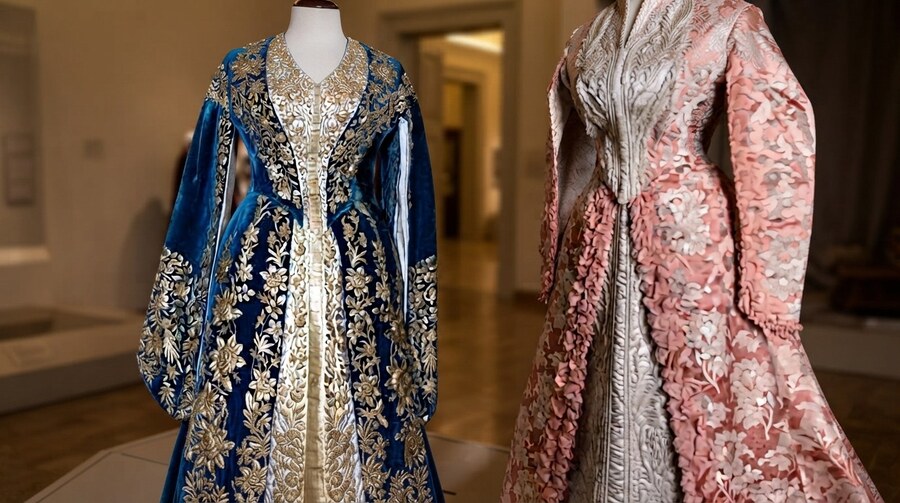
Women’s Gowns. 1834.
The relevance of this topic to me lies in the opportunity to examine clothing not merely as a reflection of the fashion of a particular era, but also as a tool for shaping a national identity. It is particularly fascinating that the Russian style in court dress did not signify a complete return to traditional folk attire. Rather, it involved a reinterpretation: individual forms, ornaments, and details were transplanted into an entirely different social sphere, creating a ceremonial image that aligned with the imperial court’s conception of Russian identity.
Primary Research Objective — to trace how the European silhouette merged with elements of Russian national costume and how this combination evolved during the period of 1834–1917. To achieve this, we will examine portraits of empresses and grand duchesses, depictions of court ladies, photographs of ceremonial events, surviving garments, and museum collections. Particular attention will be given to comparing pictorial representations with actual costume pieces: this will allow us to observe not only the artistic image but also the construction, materials, and finishing details.
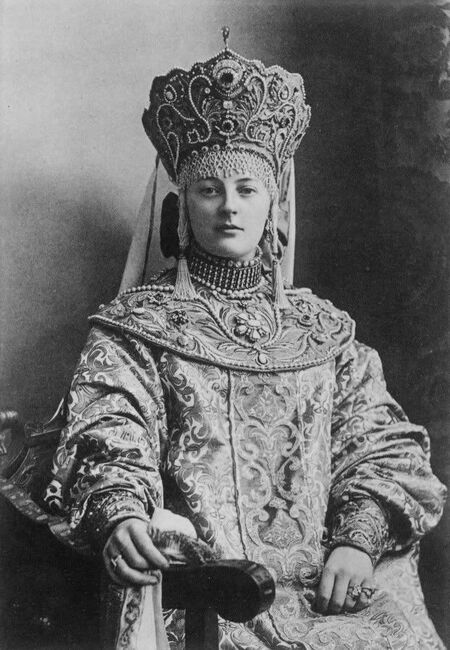
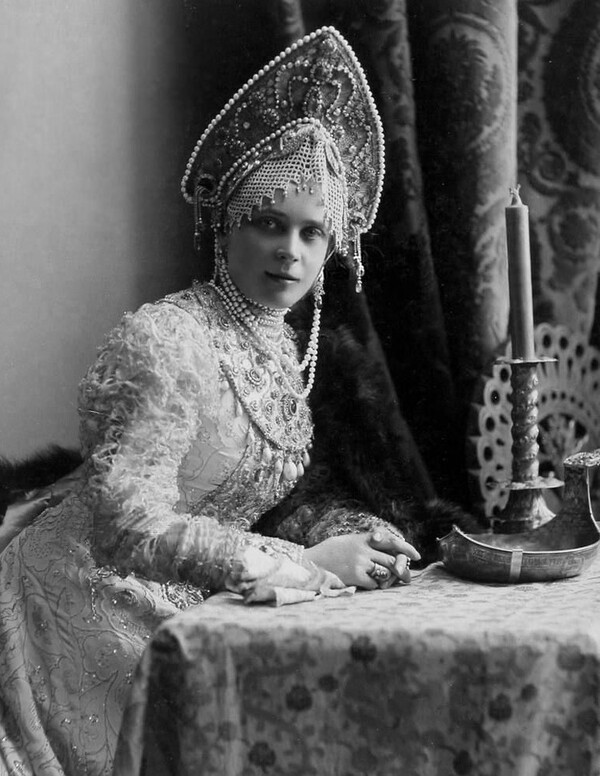
A photograph of Princess Elizaveta Dmitrievna Zu Sain-Wittgenstein, known as Nabokova, in a lavish gown at a ball in the Winter Palace in 1903. A photograph of Countess Zinavida Nikolaevna Yusupova in a splendid attire of a 17th-century noblewoman at a ball in the Winter Palace in 1903.
The visual study is grounded in thematic classification. First, the formation of court dress and its relationship to European fashion is examined. Next, attention shifts to national elements: the kokoshnik, the character of the sleeves, gold embroidery, ornaments, and decorative materials. A separate section is dedicated to costume as an indicator of court standing, as variations in color, embellishment, and train length could convey the wearer’s status. The concluding part focuses on the early twentieth century and the imperial court’s turn toward historical images of pre-Petrine Rus', particularly the 1903 costume ball.
The visual material will be selected not only based on the date of creation but also on the presence of specific details that help reveal the central theme. For example, to compare European and Russian silhouettes, images of gowns from the same period will be used; for analyzing the kokoshnik, portraits clearly showing the headwear’s shape will be used; and to study the court hierarchy, images of women of various ranks will be used. This approach will allow us not merely to narrate the history of costume sequentially, but to compare its elements and identify underlying patterns.
My Hypothesis is that the Russian court costume developed as a unique visual system where the European form served as a foundation for reinterpreting national tradition. The kokoshnik, decorative motifs, gold embroidery, and historical details did not simply embellish the dress; they created a recognizable image of the imperial court. Furthermore, the costume served several functions simultaneously: aesthetic, ceremonial, and status-related. Through it, a woman’s social standing, her affiliation with the court environment, and the empire’s concept of its own cultural identity were demonstrated.
Thus, the research aims to demonstrate court costume not as a fixed historical form, but as a dynamic confluence of fashion, national symbolism, and social status.
Navigation
- Concept
On February 27, 1834 (March 11, New Style), Emperor Nicholas I approved the document «Description of Ladies’ Outfits for Attending the Court on Formal Occasions.» It established not just general guidelines for the appearance of court ladies, but specific requirements concerning the construction, materials, color, and decorative design of the gown.
The document specifically emphasized that the gown design must be uniform for all women attending the imperial court: «As for the design of the dresses, they must all follow the same pattern, as shown in the drawing.»
This requirement extended even to ladies who did not hold court titles but visited the court. They could choose the color and adornment of their dresses, but they were obligated to adhere to the established silhouette and avoid patterns reserved for court ranks. Thus, the regulation served two functions: establishing a unified visual identity for the courtly setting and denoting each woman’s status within it.
The court dress consisted of a velvet top garment with an open bodice, a deep décolletage, long hanging sleeves, and a train. The top garment split from the waist at the front, revealing a white underskirt. The main headwear was a kokoshnik or a pokoynik with a white veil; unmarried girls wore a band with a veil.
The costume combined a European silhouette with elements of traditional Russian attire. The fitted bodice and voluminous skirt followed European fashion, while the kokoshnik, hanging sleeves, and the character of the top garment referenced Russian costume. Researcher Maria Nesterova calls it a «Frenchified sarafan.»
Album of samples of court ladies' outfits, approved by decree of Emperor Nicholas I in 1834.
The color and trim of a gown depended directly on the woman’s rank at court. For example, the Empress’s ladies-in-waiting wore crimson velvet with gold embroidery, while the grand duchesses' ladies-in-waiting wore the same color but with silver trim. Green velvet was designated for the statsdams and chambermaids, and light blue for the grand princesses' ladies-in-waiting.
Portrait of Empress Alexandra Feodorovna in Russian court dress. A. Malyukov, 1836.
The portrait of Empress Alexandra Feodorovna clearly shows the characteristic details of the new courtly style: the red headdress, the white veil, the golden gown, and decorative trim. The Empress’s appearance demonstrates how national elements were incorporated into a European-style formal costume.
«View of the White (Coat of Arms) Hall in the Winter Palace.» 3. A. I. Ladurner. 1838.
A. I. Ladurner’s painting depicts not just formal attire, but the court hierarchy in real space. The women are dressed according to a unified 1834 regulation, yet differences in velvet color and embroidery allow them to be visually segmented by their standing at court. Kokoshniks, veils, and long trains create a uniformly ceremonial appearance, and the arrangement of the figures in the ballroom emphasizes their connection to the imperial family’s ceremonial life. The painting clearly illustrates how court dress simultaneously unified the women while signifying distinctions among them.
The European Silhouette and the Russian Image
The court dress did not reject European fashion; rather, it adapted it to Russian court traditions. The fashionable proportions of the dress—a fitted bodice and a long skirt—were maintained, but the familiar silhouette was complemented by the kokoshnik, a train, and decorative embroidery. It was these national details that made the costume distinct from European evening wear.
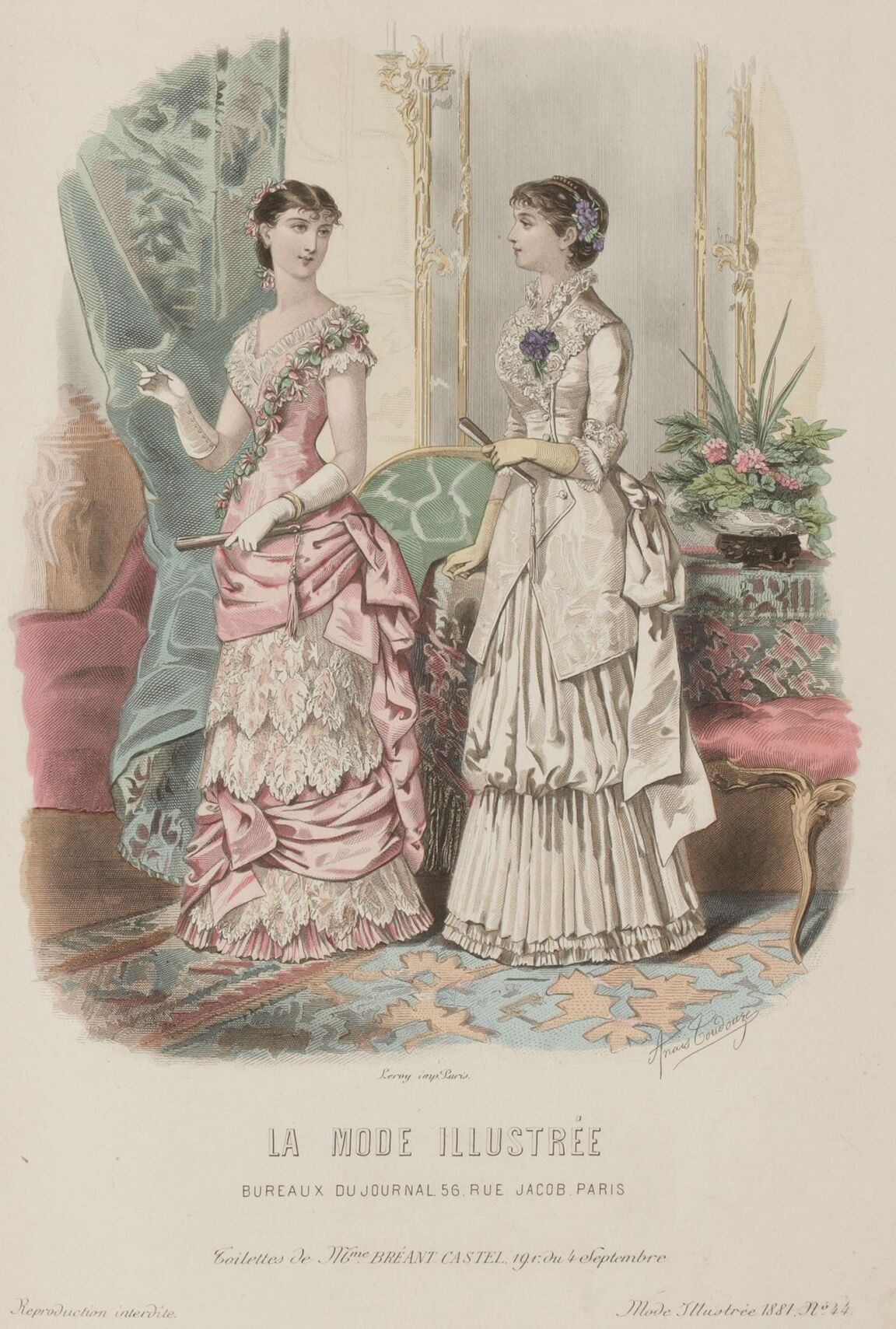
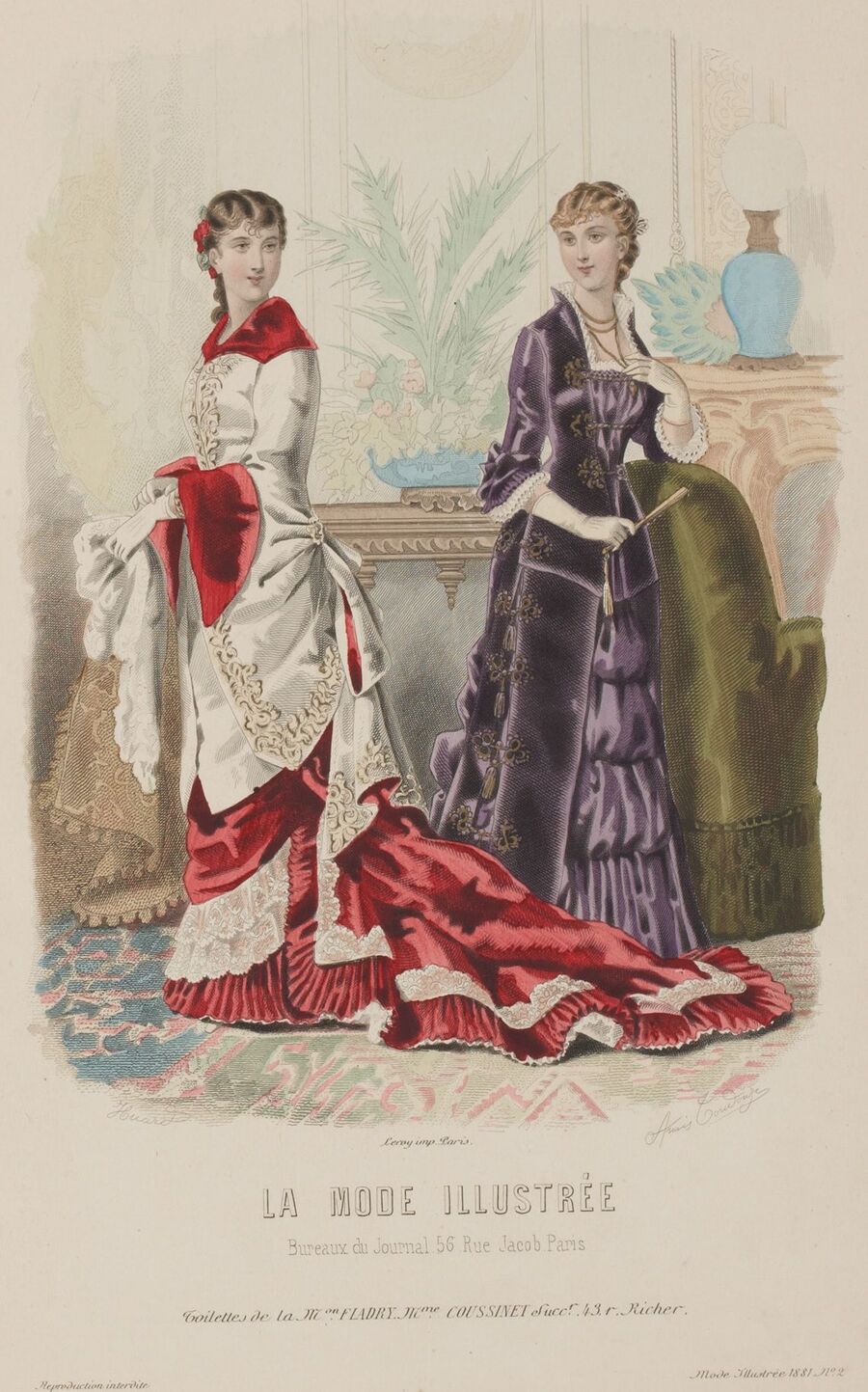
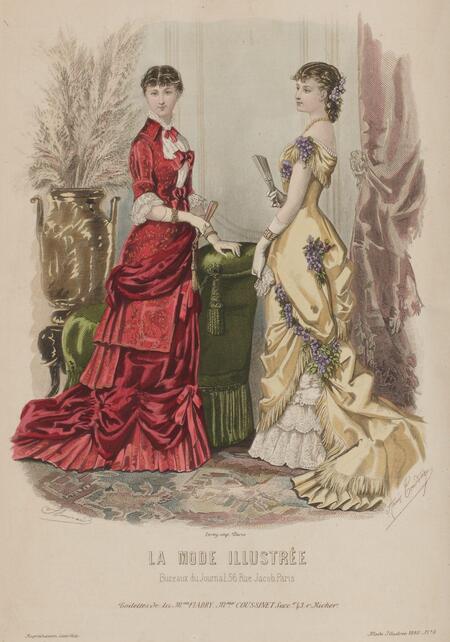
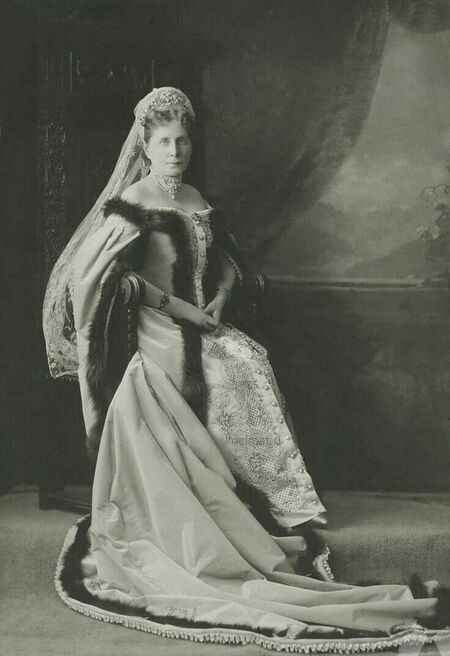
European women’s fashion, 1880. La Mode Illustrée. Grand Duchess Maria Pavlovna in Russian court attire, 1880s. Photographer unknown.
The comparison shows that European fashion set the overall silhouette, but court dress adhered to a different visual principle. Instead of a contemporary European headdress, the kokoshnik was used, and instead of standard trimmings, rich embroidery and elements referencing Russian historical costume were employed. Furthermore, the national image was created not by copying folk attire, but by reinterpreting it for the imperial court.
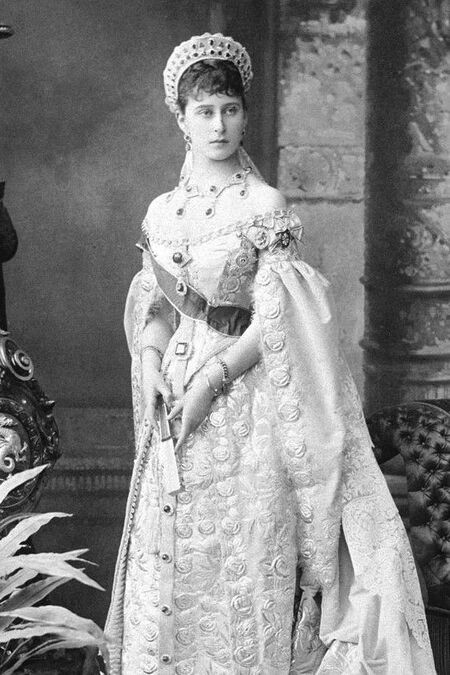
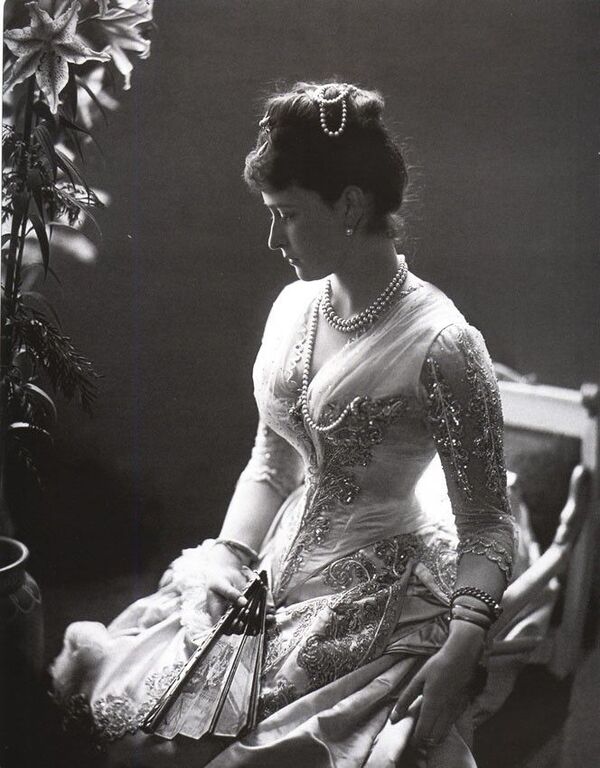
Grand Duchess Elizabeth Feodorovna, 1885.
In Elizaveta Fyodorovna’s photographs, it is particularly evident that the Russian courtly image was not merely a costume, but an integral part of the imperial family’s representation. The long train, ribbon, and ceremonial ornaments underscore the solemnity of the attire, while the headpiece ties it to national tradition. The European form here serves as the foundation for creating a distinct imperial persona.
The Russian court style emerged at the intersection of European fashion and national tradition. Its distinctiveness lay not in opposing the West, but in transforming the European silhouette into a recognizable symbol of the Russian Empire.