Introduction
The Russian style of the early 20th century emerged from artists' engagement with national cultural heritage—folk costumes, ornament, icon painting, prints (lubok), and decorative and applied arts.
Sergei Diaghilev’s «Ballets Russes» played a pivotal role in its dissemination, uniting painting, music, choreography, scenography, and costume. The works of Alexander Benois, Nikolai Rerikh, Mikhail Larionov, and Natalia Goncharova demonstrated various approaches to interpreting Russian culture—from historical stylization to avant-garde experimentation.
Theatrical costume became the link between fine art and fashion. Its silhouettes, color palettes, ornaments, and textures transcended the stage and influenced the evolution of European fashion design.
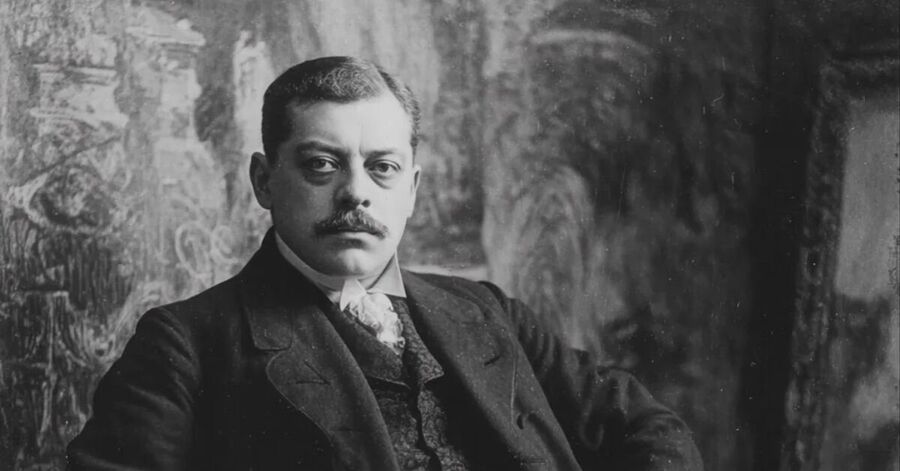
Sergey Dyagelev
The goal of this study is to trace the transformation of Russian artistic heritage—from painting and theatrical costume to fashion.
Research objectives include: — Examining the artistic characteristics of four artists' work. — Analyzing their contributions to the «Ballets Russes.» — Identifying characteristic elements of the Russian style in costume design. — Tracing the influence of theatrical art on European fashion. — Considering the interpretation of national motifs in clothing design.
This work employs a visual-analytical approach, based on the study of paintings, costume and set sketches, archival photographs, and fashion collections.
Concept
The core of this research is the concept of the Russian style as a multifaceted artistic phenomenon. Through the work of Alexander Benois, Nikolai Rerikh, Mikhail Larionov, and Natalia Goncharova, various methods of interpreting national culture are revealed—ranging from folk life and ancient rituals to avant-garde painting and theatrical design.
«The Ballets Russes» serves as the nexus for these directions, and theatrical costume acts as the space where artistic ideas take material form.
The study demonstrates how Russian cultural heritage has transformed into a source of new solutions for global art and fashion.
Navigation
- Introduction
- Concept
- Topic Index
- Petrushka and A. Benois
- Nikolai Rerikh
- Mikhail Larionov
- Natalia Goncharova
- From Painting to Fashion
- Conclusion
«Petrushka» and Alexandre Benois
Alexandre Benois. Sketch of the puppet theater square set design
Historical Context
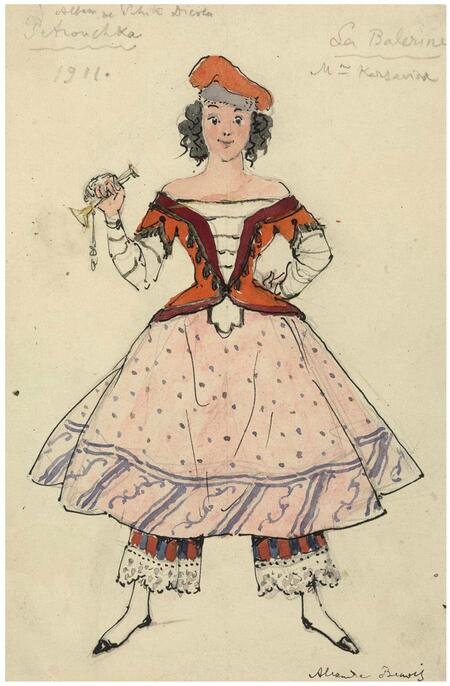
«Petrushka» is a four-act ballet created for Sergei Diaghilev’s Ballets Russes company. The premiere took place on June 13, 1911, at the Théâtre des Champs-Élysées in Paris. The production was developed by composer Igor Stravinsky, artist and screenwriter Alexander Benois, and choreographer Mikhail Fokine. The principal roles were performed by Vaslav Nijinsky (Petrushka), Tamara Karsavina (Ballerina), and Alexander Orlov (Arab).The ballet is set in St. Petersburg in 1830 during the Maslenitsa folk festival. The events unfold in Admiralteysky Square, where a public celebration takes place, complete with street stalls, fair performances, street performers, merchants, and a festive crowd.The choice of the historical period was crucial for Alexander Benois. The artist drew upon the image of St. Petersburg in the first half of the 19th century, which was tied to his own childhood memories of Maslenitsa festivities. In his recollections, he noted the distinct appeal of the street stalls and the fair atmosphere.
Ballet Plot
The narrative centers on three puppets brought to life by the enigmatic Magician: Petrushka, the Ballerina, and Aram. Petrushka possesses human emotions and falls in love with the Ballerina, but she favors Aram. As a result of this romantic conflict, Aram kills Petrushka. In the finale, his ghost appears above the puppet theater, demonstrating that even after physical death, the protagonist retains his will and individuality.
The plot merges elements of folk puppet theater with a drama about human emotion, loneliness, and lack of freedom. The contrast between the puppets' mechanical movements and their internal experiences becomes the crucial artistic principle of the production.
Alexander Benois: An Appeal to Folk Culture
Alexander Benois (1870–1960)
Artist, art historian, critic, and one of the founders of the «Mir Iskusstva» art group. His work is connected to an interest in historical culture, theater, architecture, and decorative arts.
Alexandre Benois at work
In working on «Petrushka,» Benoit did not turn to an abstract notion of Russian national style, but rather to the specific urban culture of the 19th century. The sources for creating the sets and costumes included:
— Folk toys and traditional Petrushka dolls. — Lubochnye pictures and popular printed images. — Lithographic albums depicting scenes of St. Petersburg and urban life. — Fashion magazines and historical images of 19th-century costume. — Fairground circuses, theatrical performances, and Maslenitsa celebrations.
Lubok painting. «Russian Frolic of Maslenitsa»
These materials enabled the artist to reconstruct not only the external appearance of historic St. Petersburg but also the visual atmosphere of a traditional folk celebration.
Scenography: The Image of Maslenitsa Petersburg
Alexander Benois. Sketch for the Circus Square set design
One of the main features of the production was the creation of a large-scale image of a city fair on stage. Benoit structured the stage space as an independent artistic composition, in which architecture, trade pavilions, a festive crowd, and theatrical performances formed a single whole.
Alexandre Benois. Sketch of the Petrushka Room Set Design
The ballet consists of four scenes: — First scene. A Maslenitsa celebration in Admiraltseyskaya Square. Market pavilions, trade rows, street performers, and a festive crowd. — Second scene. Petrushka’s room. A confined space that emphasizes the hero’s solitude and lack of freedom. — Third scene. Arap’s room. A contrasting, richly decorated space that reveals the character of the character. — Fourth scene. The return to the fairground, where Petrushka dies and his ghost appears.
Alexander Benois. Sketch for the Arpa room set design.
The opening and closing images frame the performance: the action begins and ends amidst a festive crowd. However, beneath the surface gaiety, the tragic story of the main character gradually unfolds.
Visual analysis of the set design:
— The multi-figure composition evokes the feeling of a vibrant urban environment. — The architecture of the fair booths and trade pavilions forms the recognizable image of a folk festival. — The variety of characters and details allows the scene to be perceived as an independent genre painting. — The combination of historical urban motifs and theatrical convention transforms 19th-century St. Petersburg into an artistic backdrop.
The contrast between the open square and the enclosed rooms of the puppets is also significant. The fairground is filled with movement and social interaction, while the characters' rooms become spaces of isolation.
Costume as a Characterization Tool
In «Petrushka, ” the costume serves not only a decorative function but also helps to reveal the character of each individual. Benoit uses differences in silhouette, color, ornament, and clothing details to emphasize the contrast between the characters.