«The land on which people walk is not for sale.»
The traditional attire of North American indigenous peoples is often depicted in a single image: suede, fringe, and headdresses made of eagle feathers. However, behind this monolithic representation stand hundreds of diverse nations with distinct environments, histories, and relationships with their neighbors. This theme was chosen because costume allows us to see how a culture responds to external pressures—what it chooses to adopt from others and what it maintains as inviolable. For comparison, three groups of nations are selected, arranged geographically from south to north: the Apache of the Southwest, the Iroquois of the Northeast, and the Cree of the Subarctic and Plains. The initial hypothesis is as follows: the Apache resisted the longest and should be the most «closed off»; the Iroquois engaged actively in trade and diplomacy; and the Cree were the most open, resulting in a blended culture.
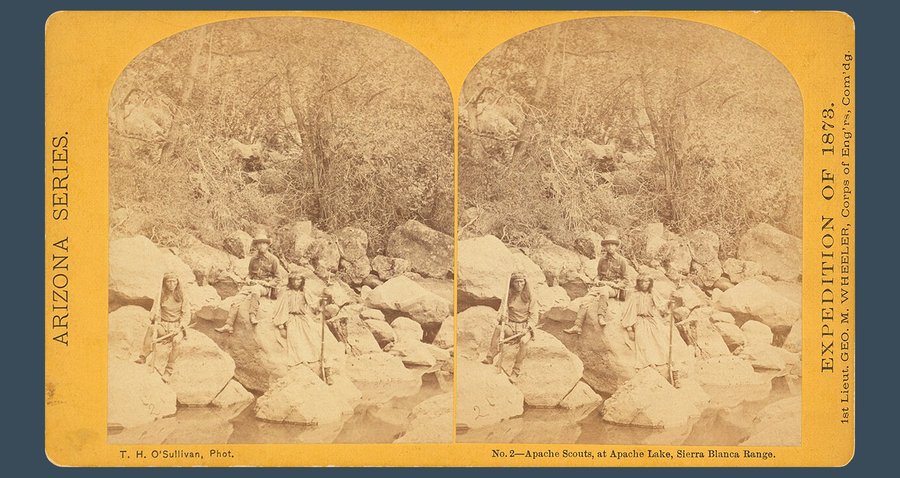
Timothy O’Sullivan. Apache Scouts at Apache Lake, Sierra Blanca Mountains. 1873
In this work, cultural code refers to the persistent characteristics by which a costume is recognized as «belonging»: the cut, the ornamentation, significant materials and colors, and the ceremonial function of the item. The key question is: what exactly does a people retain when they change the material of their clothing, and does this depend on how open they are to the outside world? The hypothesis is that all three peoples borrowed materials (fabric, glass beads, metal), and the code was preserved in how the foreign material conformed to their system, irrespective of the material’s purity. The strategies employed, however, differed. The Apache adopted materials for daily wear while safeguarding their ceremonial items. The Iroquois transformed trade materials into their own language of signs. The Cree created a hybrid form common to themselves, mixed populations, and Northern Europeans. The axis of «closedness—openness» in this work is tested, not assumed beforehand.
The text uses the term «Indians,» which is accepted in Russian scientific literature, including in the Great Russian Encyclopedia. The names «Apache, ” „Iroquois, ” and „Cree“ were given to these peoples by their neighbors and by Europeans; according to the Great Russian Encyclopedia, the word „Iroquois“ is Algonquian and meant „snakes,“ i.e., enemies. The self-designations are provided upon first mention: Nde for the Apache, Hodenosunee for the Iroquois, and Nehiyawak for the Plains Cree. Each of these three names encompasses several peoples, so specific groups were chosen: Chiricahua and Western Apache, Seneca and Mohawk, James Bay Cree, and Plains Cree. The majority of the work covers the period from before European contact through the early generations of contact, with the final section focusing on the changes of the late 19th century—the formation of the „Indian“ figure in stage productions, film, and modern representation. A caveat regarding the material is necessary here. Clothing made of hides and plant fibers is scarcely preserved, and there are no images created by the peoples themselves prior to contact. Therefore, the pre-contact costume is reconstructed based on three types of evidence: early European drawings, the oldest items held in museums, and remnants of former techniques visible in later costumes (suede, porcupine quills, shells). The period of „early contact“ varies among the three peoples: for the Iroquois, it is the 17th–18th centuries; for the Cree, the time after 1670; and for the Apache, it lasts until 1886. The selection of images follows this logic: first, items and techniques dating to the pre-contact era, then early representations, and finally, items that show trade materials.
The sections on the three peoples are structured identically to ensure a fair comparison: environment and raw materials, early evidence, what arrived through trade, and what was preserved. This is followed by a comparative overview and a section covering the period after the 1880s. Textual sources include articles from the Great Russian Encyclopedia, the Canadian Encyclopedia, descriptions of museum artifacts (Royal Ontario Museum, Art Museum, Huntington Library), and materials from the educational centers of the peoples themselves (Fort Sill Apache Nation, Six Nations Polytechnic Institute). Museum descriptions were used for details about objects, encyclopedias for dates and population figures, and community materials to understand how the peoples themselves interpret their attire. Early drawings and photographs are examined critically—their creators were soldiers, missionaries, traders, or, as Edward Curtis documented, captured Indigenous people as a «dying race, ” which inherently influenced what ended up in the frame.
The Peoples of the Americas
Cultural Domains of Native Peoples of North America according to A. Kreber’s classification. Map: Nikater, 2019
The Apache belong to the Southwest, the Iroquois to the Northeast, the Cree to the Subarctic and partially to the Plains. Each people lives within its natural zone, so the differences in costume cannot be attributed solely to the character of the people—first, they are dictated by the reindeer, bison, caribou, and climate.
Apache: Suede ceremonial attire and woven daily clothing
The Apache speak Athabaskan languages and are divided into several nations; here we examine the Chiricahua and Western Apache. Until the mid-19th century, women wore dresses made of deer deerskin, and men wore loincloths in the summer and deerskin shirts with leggings in the winter. High moccasin-boots served as footwear. The deerskin was typically dyed yellow using mineral pigments. There are few images of the Apache before the mid-19th century, and the visual record begins in the 1850s. For the Apache, the period of «early contact» extends until 1886, when the last group of Chiricahua, led by Geronimo, surrendered.
Apache Lipan. Drawing. 1857
Military cap. Chiricahua. 1880s. Peabody Museum, Harvard University Beaded moccasins. Chiricahua. c. 1890. National Museum of the American Indian (on display at the Oklahoma History Center)
1
1