Navigation: • Concept • Introduction • PART I. The Video Game Language: The Logic of the Work • PART II. The Manga and Anime Language: How Emotions Are Conveyed • Conclusion
Concept
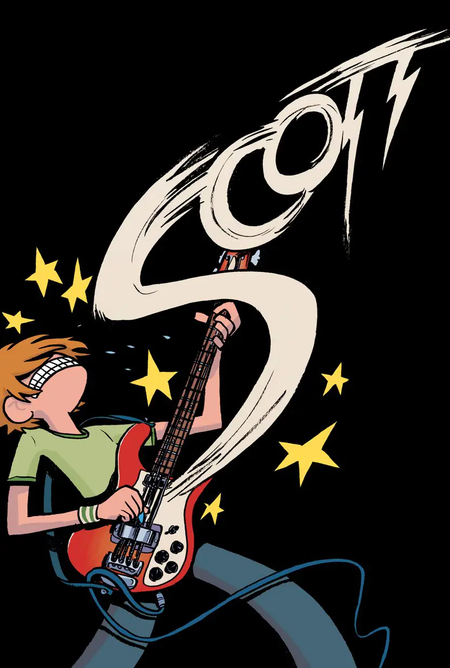
«Scott Pilgrim» was created by Canadian author and artist Bryan Lee O’Malley. The six-volume series was published by Oni Press from 2004 to 2010. The story is set in Toronto. Scott, a 23-year-old, plays bass in the band Sex Bob-omb, carelessly spending his youth without a job, and dates the seventeen-year-old student, Nive. Later, he falls for Ramona Flowers and, to date her, must defeat her seven «evil exes.» The book grew out of fan culture: O’Malley grew up on manga, anime, and video games, so the comic looks like a fusion of North American indie aesthetics and Japanese visual tradition. It became a cultural phenomenon, leading to an Edgar Wright film (2010) and an animated series.
I chose this topic because it is highly relevant to our generation today. Our generation grew up immersed in video games and anime. This language is simple and immediately understandable, allowing us to discuss serious themes with a wide audience—such as infantilism, avoidance of responsibility, and prolonged youthfulness. The comic «Scott Pilgrim» does exactly this: it takes familiar tropes and uses them as a way to tell the story of a person unwilling to grow up. For me, it’s also significant that many readers can see themselves in Scott. He is neither a villain nor a perfect hero, but an ordinary person who postpones difficult conversations, hopes everything will resolve itself somehow, and prefers to believe the problem isn’t within him. The reader journeys through a coming-of-age experience alongside the protagonist. My research includes scenes where stylistic techniques relate to the character’s conflict with reality—meaning his actions, feelings, or sense of responsibility. These are instances where Scott Pilgrim’s reality is augmented through gaming mechanics or tropes derived from Japanese graphic culture.
The research is divided into two parts: «The Language of Manga and Anime,» which reveals the characters' emotions through the comic, and «The Language of Video Games,» which is used to build the work’s logic. Within each section, the subsections proceed chronologically to show how the technique evolves alongside the plot. The research concludes with a short chapter on how the comic deconstructs game logic. Primary source: the comic itself (the color edition), including author’s afterwords and commentary. Secondary sources: comic theory, studies of manga and anime, and game theory and developmental psychology.
How does the visual language of manga and video games in «Scott Pilgrim» portray the character’s emotional immaturity?
ключевой вопрос исследования
In Scott Pilgrim, video game mechanics and manga visual language are employed not just as stylistic devices, but as a means to narrate the story of an emotionally immature person. Scott perceives life as a game where problems can be solved by defeating an opponent, earning a reward, and advancing to the next level. However, as the plot unfolds, it becomes clear that growing up requires taking responsibility for one’s own actions, rather than conquering others.
гипотеза исследования
Introduction
To understand what I am seeking through game mechanics and manga tropes, one must first define the character. Scott Pilgrim is an emotionally immature person who avoids responsibility. His infantilism manifests in several ways. He thinks about himself and his desires, not about other people. Scott rarely wonders how those around him—Nives, Wallace, the band members, Ramona—are feeling. His needs always come first. Furthermore, he lives off others; for example, he shares an apartment and a bed with Wallace and doesn’t work. For him, relationships are a way to gain emotions, not a commitment. He starts dating seventeen-year-old Nives, then gets involved with Ramona and lacks the courage to break up, avoiding conversation and stalling. When he does break up, he quickly forgets the pain he has caused the other person.
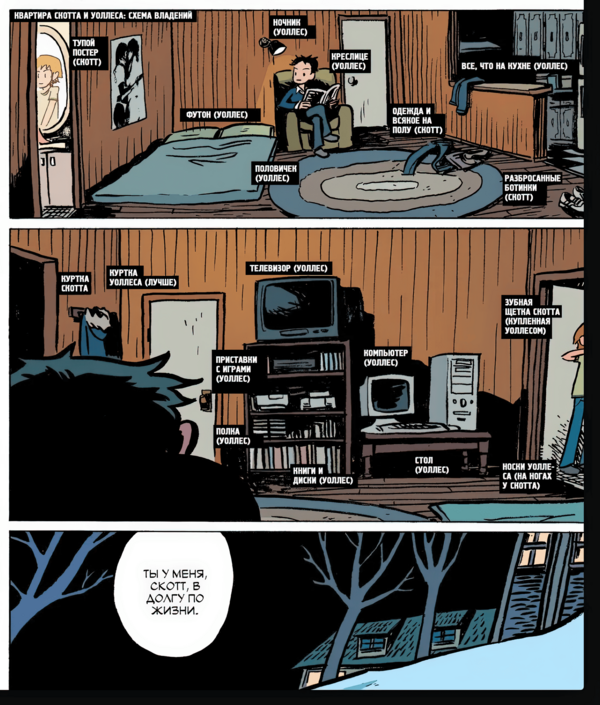
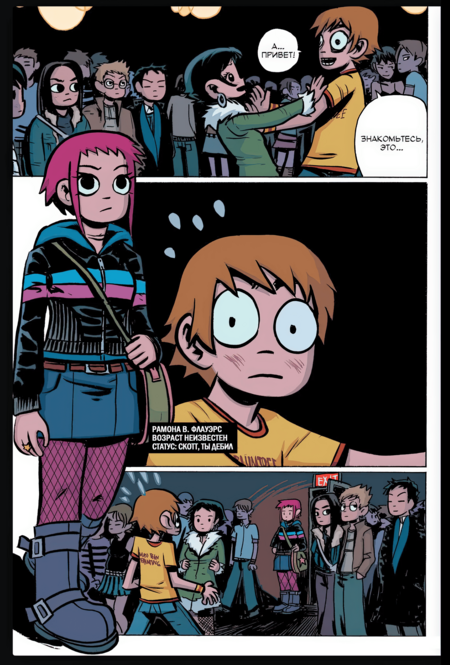
«Scott Pilgrim» by Bryan Lee O’Malley, Oni Press (2004–2010)
He embellishes reality. Scott has grown accustomed to telling stories in a way that makes him look better: he exaggerates his achievements, softens inconvenient facts, and omits details that might cast him in a negative light. He turns a blind eye to his own flaws and missteps. He easily shifts the blame onto circumstances, other people, or Ramona’s «malicious exes.» It is difficult for him to admit that the problem lies within himself.
«Scott Pilgrim» by Bryan Lee O’Malley, Oni Press (2004–2010)
These are precisely the characteristics I will look for in the formal techniques of the comic. I am interested in how the gameplay mechanics and visual language of manga present these elements: what Scott feels and how he perceives others—the idealization, the «cute» and «glossy» imagery, the emotions devoid of reflection, the transformation of a real conflict into a beautiful spectacle. The video game’s language shows what he does and how he justifies his actions: the problem is transformed into an adversary, and the victory over the enemy, along with the reward (points, money, «level»), creates the illusion that the protagonist is changing as he advances to the next level.
PART I. The Language of Video Games