

Today, there is a gap between the vast body of cultural heritage housed in museums and the real creative economy sector (fashion, design, retail). Brands and museums exist in parallel worlds and cannot interact effectively for two main reasons:
>> a. Brands lack unique local codes
The contemporary creative industries market is oversaturated with faceless mass-market products, and it is exhausted by them: modern Russian brands and designers need a foundation in their identity and roots. However, as we see in practice, collections linked to folk culture often look stereotypical and devolve into mere cliché without a real understanding of the local context. Designers do not know where to find genuine and authentic ideas, and popular neural networks like Midjourney only produce a generalized fantasy on the theme of the «Russian style, ” far removed from historical truth.
>> b. Colossal archives of folk art are locked in museum collections
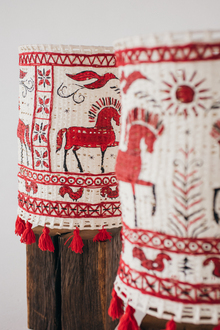
Meanwhile, we observe thousands of masterpieces—such as unique painted spinning wheels and patterns from the Russian North—lying unseen in museum storage. Existing state registries function like closed and inconvenient archival card catalogs: researchers have to spend hundreds of hours manually describing and cataloging exhibits, and the photos themselves are often low quality and entirely unsuitable for designers' work. If a brand wishes to engage with the museum directly, it faces the reality that independent digitization, proper art historical data annotation, and copyright clearance are time-consuming, expensive, and legally risky. As a result, unique heritage gradually falls into obscurity, remains economically inefficient, and businesses lose a powerful visual resource.

Legacy remains overshadowed by funds, and businesses fail to gain authentic visual resources. Our platform builds a bridge between them.

Overcoming the conventional perception of traditional culture as a «static, archival artifact”—that is the central idea of the project. Our ultimate goal is to make this heritage visible, tangible, and reproducible in everyday life.
How did folk painting survive for centuries? The masters didn’t have textbooks: the tradition lived through succession, where a student absorbed the teacher’s experience, developed a visual sensibility and compositional rules, and then created their own work. Our neural network functions in the exact same way. Its goal is not to replace a human being, but to serve as an assistant and successor capable of studying thousands of authentic museum pieces, memorizing the logic and symbolism of Northern painting, thereby preventing this chain from breaking. The integration of generative AI transforms rich ornamental heritage from dusty storage rooms into a living, relevant visual language for modern creative industries.
Startup Concept:
We are developing a universal B2B/B2C digital platform powered by generative artificial intelligence. This platform automatically attributes, verifies, and translates archival cultural heritage into commercial assets—ready-to-use patterns and prints for fashion, design, and multimedia.The platform rests on two main pillars and operates in both directions:
>> Preservation of authentic heritage (assisting museums and archives)
>> Its commercial reproduction (a tool for business)
The project is conceived as a scalable IT startup. It addresses a global problem—economic inefficiency and the gradual erosion of local heritage. Furthermore, the platform’s architecture is designed to be universal: we are creating an engine into which the visual code of any era, region, or country can be uploaded.
As part of the graduation project, three specific outcomes are realized, which prove the viability of the startup from every angle—technical, creative, and commercial.
The prototype is being trained on a pilot sample (300–500 labeled items). Full collection labeling goes beyond the scope of the diploma and is part of future development.
che
The strength of this project lies in the fact that it is supported by established institutions and a strong team of experts, each possessing a distinct area of interest.
> > Open Collection Foundation and Alexey Germanovich
Provides a digitized archive of its unique closed collection, consisting of approximately 3,000 artworks from the Russian North, which serves as the foundational training dataset for our neural network.
> > Russian State Museum
This provides an exemplary archive of its Russian North art collection, as well as the opportunity to submit a joint project for a grant with the direct involvement of Viktor Mikhailovich Sharomazov, an employee of the Department of Folk Art.
> > End-to-End IT Company Self
The product is designed and developed in collaboration with specialists from this accredited IT company, under the guidance of Product Owner and Marketing Director Yulia Malovits. The development team helps to design the web platform prototype, configure the algorithms for verifying museum datasets, and package the technology into a functional B2B/B2C product.