We made this project for «Communication Theory: Bridging Academia and Practice» course based on Elizaveta Volontsevich’s previously created thermal sticker brand «TAG YOURSELF». Her work and analytics can be viewed down below:

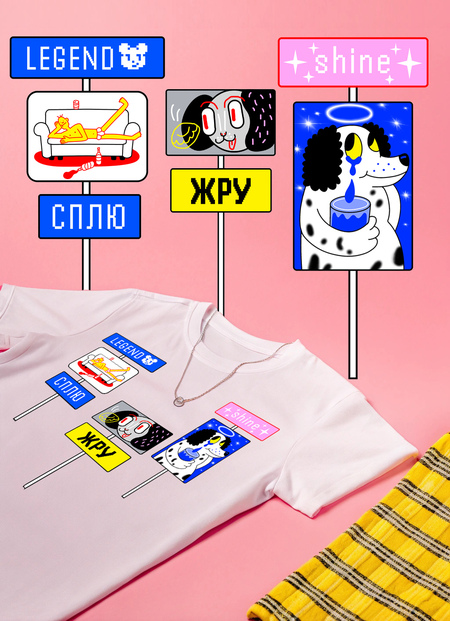
PRESENTING THE BRAND TO A WIDE AUDIENCE
If you’ve ever bought the most popular item of the season and then seen it everywhere, you know how frustrating it is to lose your sense of individuality. Mass-market fashion copies fast — and erases personality just as fast.
What if clothing could speak for you instead of blending you into the crowd?
Meet TAG YOURSELF
A brand of thermal stickers that turns clothing into a personal statement.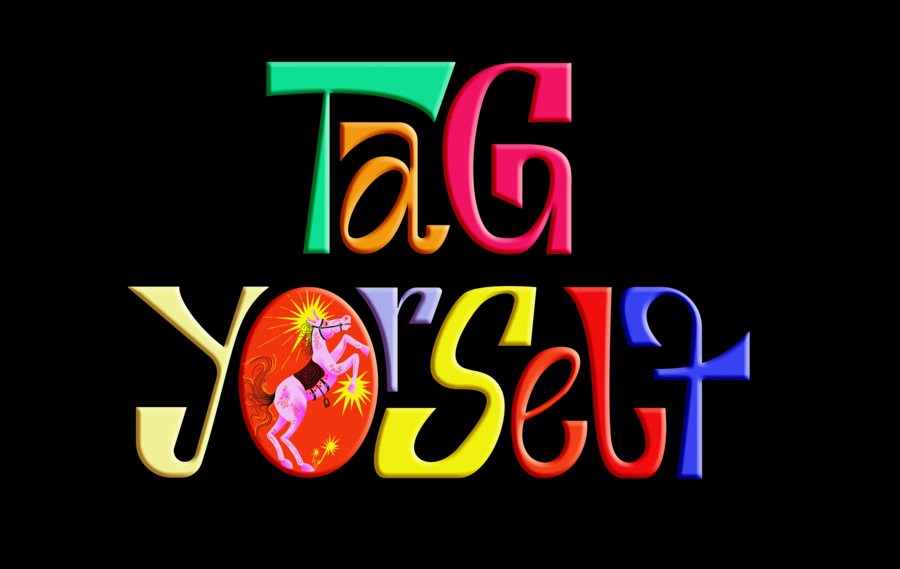
The problem is not only that fashion is repetitive. It’s also that trends dictate how we should look, leaving little room for personal meaning.
People need more than just clothes — they need a way to express who they are.
That’s why we created TAG YOURSELF. It’s not just a sticker brand, it’s a tool for self-identification, a visual language you can use every day.
Slogan: «Your clothes, your rules — tag yourself!»
The product
TAG YOURSELF offers more than 150 sticker designs divided into thematic collections. They can be freely mixed and matched, allowing endless combinations.
Thermal stickers are easy to apply using a regular iron and do not require any special skills. A basic item becomes personal in minutes.
Why it matters
Every sticker works as a sign. Together, they form a message — open to interpretation, shaped by context and personal experience.
TAG YOURSELF doesn’t dictate meaning. It gives you the tools to create it.
In a world of copied styles and repeated images, TAG YOURSELF helps you do one simple thing: mark yourself.




Thoughtful packaging
We care about our customers, so we designed the packaging as part of the experience, not just protection.
TAG YOURSELF packaging has two layers:
Inner layer — a semi-transparent paper envelope stitched with a branded tag. It holds the customer’s selected sticker set and emphasizes personal choice and authorship.
Outer layer — a durable envelope that protects the contents. Each one is hand-decorated with random multicolored stickers, making every package unique.
The opening is sealed with a signature logo sticker, turning unboxing into a small, thoughtful ritual.
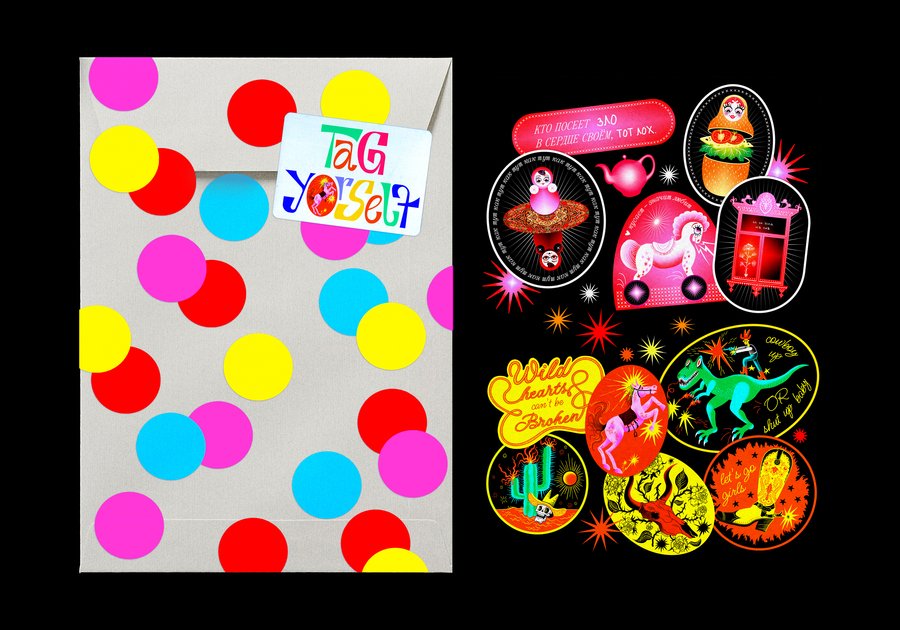
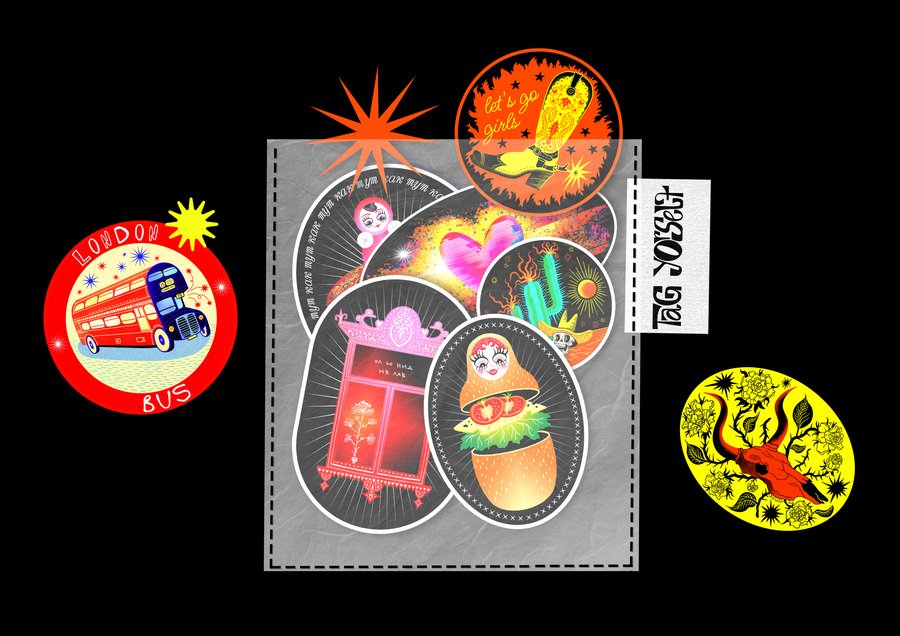
Inner and Outer layers
BRAND PRESENTATION FOR THE PROFESSIONALS: ILLUSTRATORS, DESIGNERS AND FASHION ENTHUSIASTS
The core idea of «Tag Yourself» is self-tagging — a direct reference to digital culture (tags, labels) translated into the physical, wearable world
Each sticker functions as a visual tag: emotional, ironic, playful, bold, or intimate. In semiotic terms, «Tag Yourself» stickers operate as signs rather than decorative elements. The wearer is invited to tag themselves the way one would tag a photo, a feeling, or a moment online. «Tag Yourself» works with thermal stickers treating them as a democratic and flexible design tool. This choice of material for stickers can be applied with a regular household iron and requires no special equipment or technical skills. As for the variety of designs stickers are available in 40 different positions. Users freely choose, mix, and combine all of them.
Illustration language of our brand focuses mainly on character design, playful exaggeration and a mix of tenderness, irony, and absurdity. Illustrations reference multiple visual traditions at once: tattoo flash, sticker culture and naive illustration.
As for the color palette of illustrations «Tag Yourself» uses expressive color contrasts, unexpected color pairings and black backgrounds that add emotional tension to the illustration. Compositions are intentionally bold and graphic — designed to survive scaling, cutting, and recombination. Each sticker is visually autonomous but gains new meaning when placed next to others.
The Tag Yourself logo is playful, flexible, and modular. Typography supports the brand’s tone: it is expressive, friendly, imperfect, and characterful.
The logo does not dominate — it coexists with illustrations as part of the same graphic ecosystem
A key principle of Tag Yourself is shared authorship. The designer creates elements, but the user creates builds a personal visual statement by choosing what stickers to combine with each other and where to place them. the user builds a personal visual statement. Tag Yourself is a brand that transforms thermal stickers into tools of creating visual statements. It merges illustration, fashion, and digital tagging culture into a playful, democratic system of self-expression.
Rather than offering finished images, the brand offers visual vocabulary — inviting users and creative professionals to speak for themselves, one sticker at a time
LET’S TRY THEORETICAL APPROACH
As in any other bussines industry, communication theory plays a important role in design. Nowadays design is not only a visual form, but a bearer of meaning and a way to build relationships between a brand and its audience. Communication answers vary of the fundamental questions, like what exactly does it produce, what types of relationships creates, what social consequences engenders. Communication is understood as a process that constructs reality, creating identities, norms and sense of belonging.
There also is a visible trend to shift from the linear communication model, where a sender conveys a fixed message to a passive recipient. It is being replaced by more of cybernetic logic, in which communication is viewed as a feedback-based system. The author of the message does not fully control the interpretation and is forced to adapt to the audience’s reaction.
Applied to design, this means that an object isn’t a closed statement, but an open structure, constantly reassembled through contexts and interpretations.
Design can be viewed as a semiotic system of visual codes that convey meaning indirectly. This is especially noticeable in commercial visual culture, where different brands operate in completely different ways. They may have different stylizations, approaches to symbols, and styles of «communication» with the audience. It is important to note, that there are no universally «correct» communication strategies: the choice of position depends on the context, values, and the desired type of relationship with the audience.
However, any modern brand takes into account that, with the advancement of technology, communication is taking place predominantly in the digital environment (and even abandoning this platform will become a lever of influence). Social media provides visibility, interactivity, and the archive of proprietary data and history. The digital environment is less rich in nonverbal cues, making interpretations more ambivalent and increasing the polysemy of visual messages, further reducing the author’s control. Public communication itself is built on risk and vulnerability.