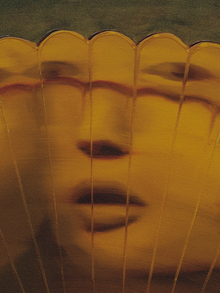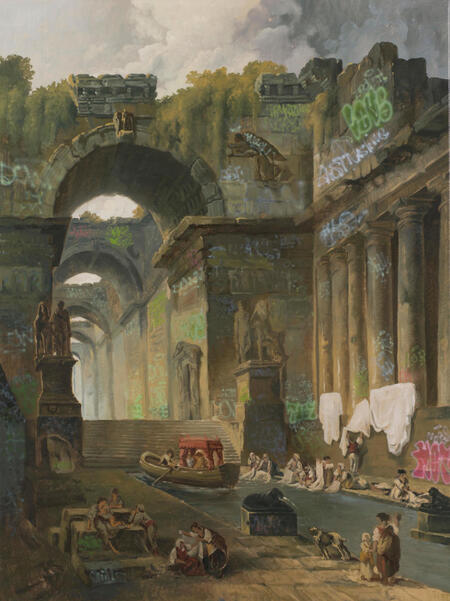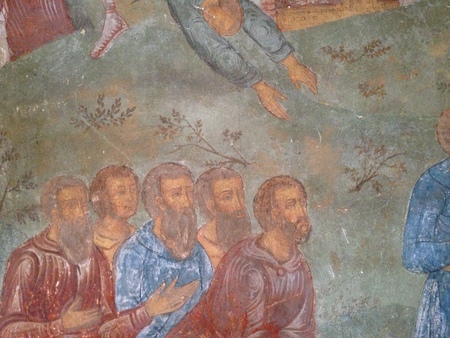
The term mOther (ness), as proposed by artist Maja Smrekar in the Glossary of Common Knowledge (2022), emerges not as a mere typographic play but as a profound conceptual rupture. It signifies a deliberate shift from a fixed biological or social category towards a fluid, politicized, and expanded practice of nurturing. By splitting the word with a parenthesis, the term performs its own meaning: it destabilizes the traditional, often idealized figure of the Mother and empathizes our strive to understand and acknowledge the Other. This grammatical gesture frames mOther (ness) not as an identity one is, but as an ethical relation one practices, a relation that inherently questions who and what constitutes a legitimate recipient of care and empathy.

Madonna Litta, Leonardo da Vinci, 1478–1480
This conceptualization is deeply rooted in a critique of the anthropocentric and patriarchal foundations of Western thought. As outlined in Smrekar’s glossary text, the point of departure is the concept of the holobiont, pioneered by the biologist Lynn Margulis in 1991. The holobiont dismantles the illusion of the autonomous individual, revealing all life, including human life, as a symbiotic collective, a colony of interdependent organisms. This scientific paradigm erodes the boundary between self and other, human and non-human, positing that we are, by our very constitution, permeable and inhomogeneous ecosystems. This theory provides the material groundwork for imagining kinship beyond the human family, a necessity sharply revealed during the COVID-19 pandemic, which vividly demonstrated our global entanglement with non-human viral agents.
Smrekar also addresses the writing of Rosi Braidotti, who talks about the myth of humanity, which has been based on universal values and human exceptionalism, always excluding some that didn’t correspond to the ideal which underlies the apparent universalism. In this light, mOther (ness) becomes a practice of confronting and overcoming these historical exclusions, a way of particularizing care in a world where the line between human and nonhuman has become so blurred.
«There have always been fine gradations within the category of the human, according to gender, race, class, culture, nation, religion, even species; and so on. Therefore, not all of us could say, with any degree of certainty, that we have always been human, or that we are only that» — The Posthuman, Rosi Braidotti
Anna Homler as Breadwoman, 2016
Ultimately, mOther (ness) advocates for a radical expansion of the maternal metaphor. It proposes that the logic of nurturing, protection, and symbiotic co-creation must be extended into interpersonal and interspecies relations on a planetary scale, becoming a foundational principle for co-creating our responsible futures. Of course, this principle is furthermore explored in Maja Smrekar’s artwork, which we will get to later.
the mother and the myth
To understand the radical departure proposed by mOther (ness), we must first examine the ground from which it springs: the feminist art of the 1960s and 70s that systematically dismantled the patriarchal myth of motherhood. In this era, artists confronted the romanticized image of the maternal: an image that had long served to confine women to a private, biological, and apolitical realm. They sought not to celebrate the icon of the Madonna, but to expose motherhood as a complex social institution, laden with unspoken labor, psychological ambivalence, and ideological weight. The personal was declared unequivocally political, and the intimate space of care became a site of critical analysis. In addition to that, feminist artists, such as Judy Chicago, have made several works centering the autonomy of female bodies, highlighting their commodification by the patriarchy.
The Dinner Party, Judy Chicago, 1978
Mary Kelly’s Post-Partum Document (1973-79) stands as the definitive deconstruction of this myth. Over six years, Kelly documented her relationship with her infant son, yet systematically excluded his image. Instead, she presented the archive of motherhood itself: stained diaper liners, feeding charts, phonetic scribbles, and lacquered theoretical fragments. This shift from representing the child to cataloging the process reframed motherhood not as a biological destiny or a static identity, but as a discursive, often messy negotiation. The maternal subject emerged not as a silent icon, but as an archivist and theorist of her own condition.
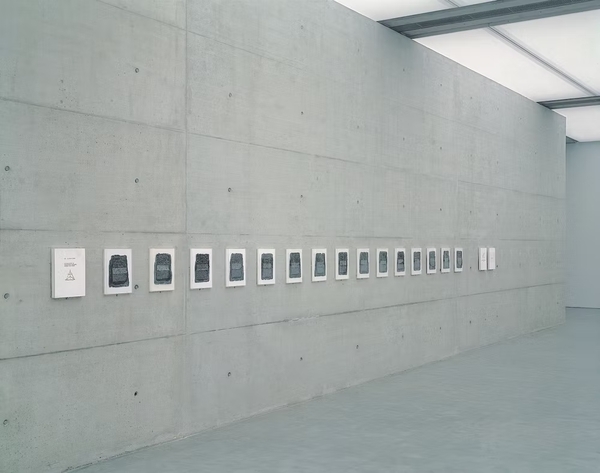
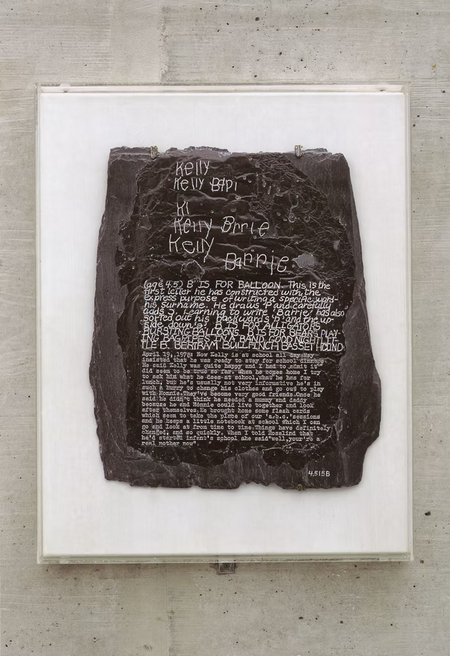
Post-Partum Document: Documentation VI, Mary Kelly, 1978
Kelly’s work performed a critical denaturalization. By aestheticizing the abject and administrative traces of care, she simultaneously exposed and praised motherhood in its beautiful complexity. This deconstruction created the essential precondition for mOther (ness). It cleared the conceptual space, separating the act of nurturing from the biological event of childbirth. Once motherhood was understood as a practice rather than a destiny, that practice could be examined, reimagined, and ultimately directed beyond the human infant. She also focuses on the matter of understanding her son through language and how their relationship perpetually changes. It was quite common to see a mother and her infant as a whole organism, while in Kelly’s «Post-Partum Document» we see her baby as the Other that she passionately tries to understand. This analytical framework made it possible to ask how the caring relation might be redirected, opening the path for the radical inclusion of the Other that defines the contemporary term.
ritual empathy
Following the analytical deconstruction of the maternal myth, I would like to highlight several artworks that transform it from a social role into a vessel for ritual, healing, and primordial connection. Artists like Anna Homler and Joseph Beuys performed what I have termed «ritual empathy», using shamanic and archetypal strategies to enact care as a restorative, cross-species, and ecological force.
Anna Homler as Breadwoman, 1982
Anna Homler, an American vocalist and sound artist, puts the listener into pure hypnosis with her album «Breadwoman & Other Tales». Her alter ego, Breadwoman, sings in a fictional language made up of ancient and modern. Playing with the phonetics and melody of non-words (this method is also known as glossolalia), she comes up with new, most organic and natural ways for her to communicate with the world. You could say that she strived to embody the Mother archetype: the primordial mother as the source of both biological sustenance (bread) and cultural meaning (language). Her ritual is one of offering and creation, an empathetic gesture that precedes verbal logic. This performance aligns with mOther (ness) by decoupling nurturing from biological reproduction and locating it instead in a pre-linguistic, shared corporeality. The empathy here is rather ecological and symbolic; she channels a nurturing force that flows to all, modeling a form of care that is abundant and non-discriminatory, a core tenet of the expanded «mOther» ethic.
«Breadwoman is a storyteller — she’s so very old she’s turned into bread. Breadwoman says: If you don’t try to understand, you will. She is the voice, and the voice is cosmic reality’s musicality» — Anna Homler, own website
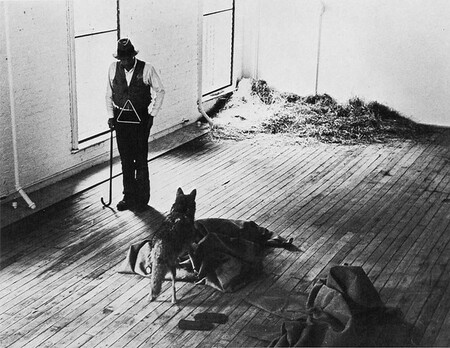
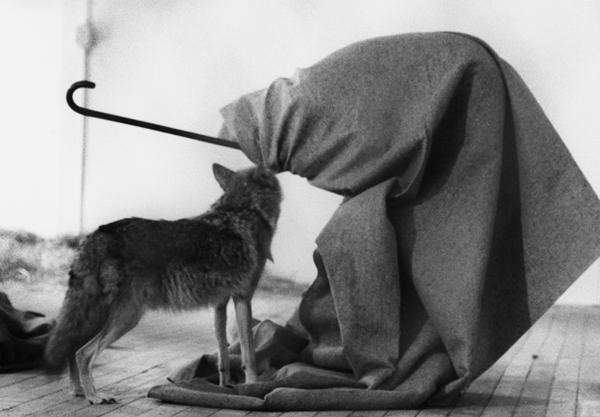
I Like America and America Likes Me, Joseph Boys, 1974
Similarly, Joseph Beuys’s seminal action in «I Like America and America Likes Me» (1974) translates this archetypal nurturing into a specific, charged socio-political healing. For three days, Beuys shared a gallery space with a wild coyote, isolated from the outside world. This was not a domestication but a ritual of encounter. Beuys assumed the role of the shamanic «mOther»: his felt blanket a womb-like insulator, his crook a tool of guidance rather than domination. He performed care as a curative act for the wounded «psyche» of America, embodied by the coyote, an animal simultaneously revered and persecuted in myth and reality. Beuys’s ritual demonstrates that care can be a political methodology, a way to «mother» not a child, but a damaged relationship between culture and nature, the self and the marginalized other.
posthuman practice
The theoretical rupture of the holobiont and the artistic traditions of deconstruction and ritual converge in the final contemporary turn of mOther (ness): its manifestation as a deliberate posthuman practice. This is where the concept moves from analyzing or symbolizing care to materially engineering it within the conditions of a damaged planet.
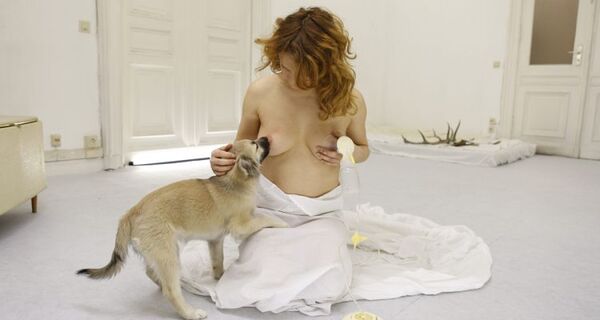
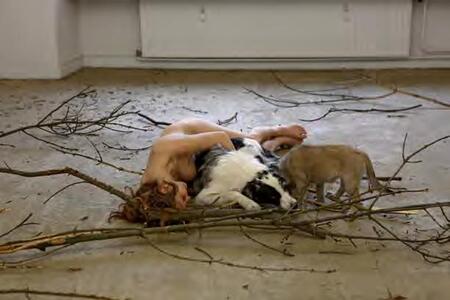
K-9_topology: Hybrid Family, Maja Smerkar, 2016
The pivotal work of this essay is naturally Maja Smrekar’s «K-9_topology: Hybrid Family» (2016). As theorized in her glossary entry, Smrekar’s project is a concrete laboratory experiment in posthuman care. Her 112-day regimen of dietary and hormonal preparation transforms biological processes into a conscious ethical training. By using galactagogues and mechanical pumping to stimulate the release of oxytocin and prolactin she achieves an explicit goal of employing empathy towards the non-human other. Here, the «mOther» is neither a social role (as critiqued by Kelly) nor an archetype (as invoked by Homler and Beuys). It is rather a bio-political, boundary crossing force.
The act of breastfeeding the puppy Ada is the culmination of this molecular diplomacy. It demonstrates that the physiological substrates of care (hormones like oxytocin, associated with bonding) can be deliberately harnessed and redirected across species boundaries. Smrekar’s practice validates the holobiont theory materially, proving that our bodies’ communicative and nurturing systems are not exclusive to human on human relations. This is mOther (ness) in its most radical form: a chosen, orchestrated kinship that bypasses genetic lineage and cultural convention to establish solidarity at the biochemical level.
«I therefore conclude by employing Hybrid Family’s molecular discourse: it has been well recognised that the hormone prolactin ensures not only survival of the species through its reproductive role, but also survival of the individuals of many species in its homeostatic roles. That being the case, I call and welcome (women of) all genders to (continue) breastfeeding!» — Maja Smerkar, Glossarium of Common Knowledge
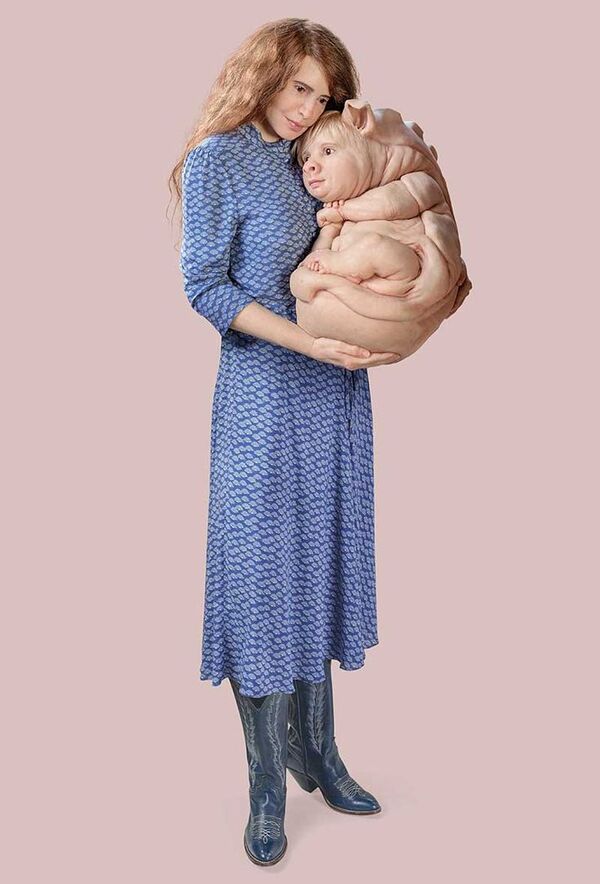
The Young Family, Patricia Piccinini, 2002-03
Patricia Piccinini’s «The Young Family» (2002-03) propels this logic into the domain of speculative ethics. Her hyper-realistic sculpture of a hairless, biotech-creature nursing its young presents a future where the «other-than-human» is not an animal from the natural world, but a new form of life born from laboratory synthesis. The work triggers a visceral cognitive dissonance: a deep-seated revulsion at the creature’s alien morphology clashes with an undeniable empathy evoked by its posture of vulnerable, devoted care. Piccinini forces the viewer into the very dilemma central to mOther (ness): Where does our circle of ethical responsibility end?
.
If Smrekar’s work asks if we can mother the other, Piccinini’s asks if we will mother the futures we create. The Young Family visualizes a world where kinship must be negotiated with beings that challenge the very category of the natural. It extends the mOther (ness) ethic to its limit, demanding that the logic of nurturing, protection, and unconditional positive regard be prepared for the utterly unfamiliar. The creature is not a pet or a wild animal; it is a new subject, a new Other.