Concept
By studying the history of art, one visually observes the gradual development of human culture. The increasing complexity of sculptural forms and the improved level of detail in paintings vividly convey the growth in the skill of creators from one generation to the next. When looking at Renaissance paintings, at first glance, it might seem that Renaissance artists shared nothing in common with the masters of ancient civilizations. However, across many millennia, human impulses have not fundamentally changed. The themes that move the soul repeat year after year, only slightly altering their form depending on external circumstances. Independent of time’s influence, people loved, suffered, fought, celebrated, prayed, and feared. This unites generations and makes the study of the similar aspects of our lives an engaging pursuit. In what precise ways does similarity manifest between Renaissance Italians and, for instance, the ancient Greeks? I intend to answer this question by investigating the representation of sound in paintings from different eras.
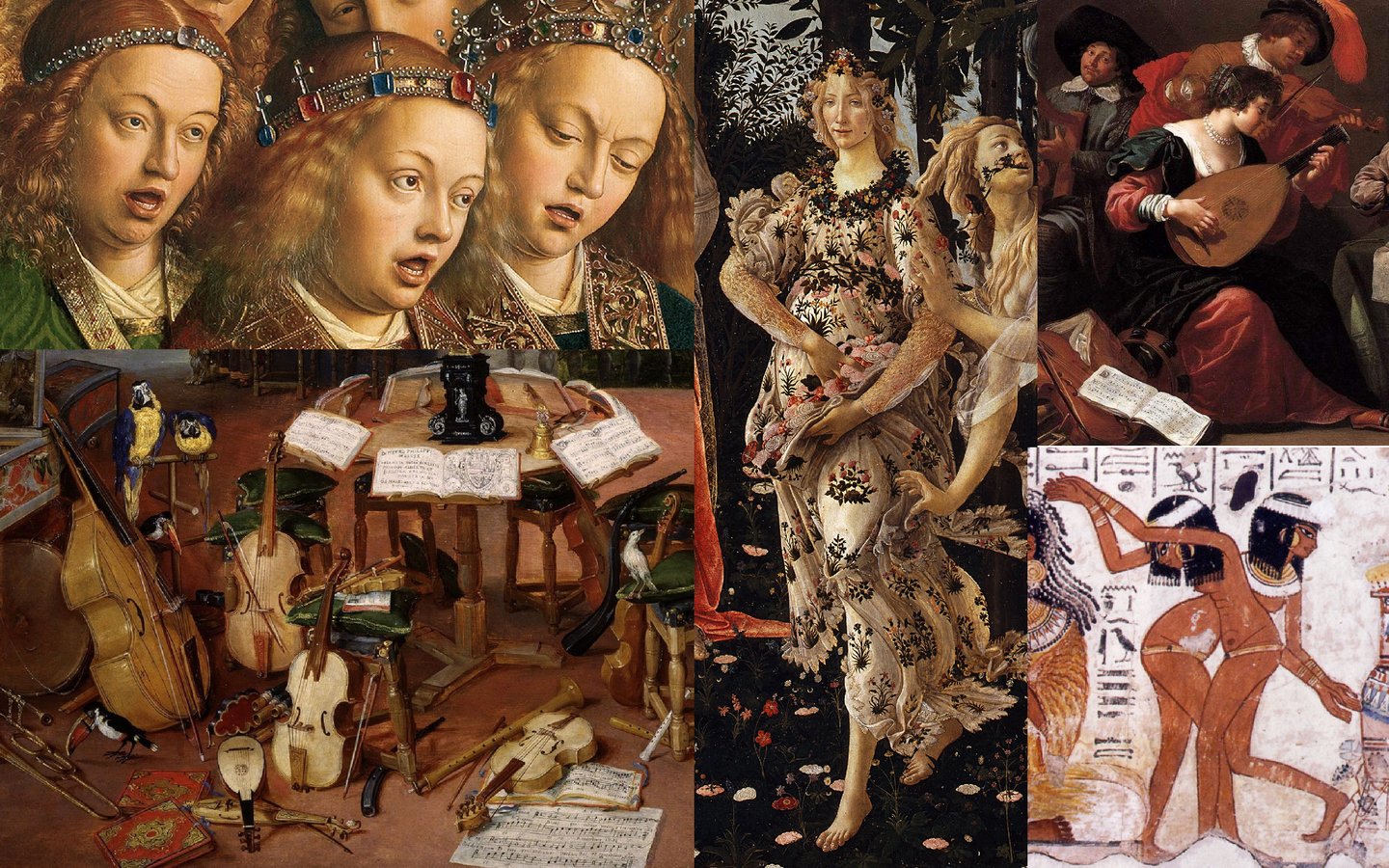
1. Jan van Eyck. Ghent Altarpiece. Singing and playing angels, 1432. 2. Pieter Bruegel the Elder. The Sound, 1617. 3. Sandro Botticelli. Primavera, 1482. 4. Jan Hans van Beyleert. Musical Company, c. 1629. 5. Fresco found in the Tomb of Nebammon, c. 1350 BCE.
Material selection is built upon musical associations. This straightforward approach to the visual component of the study helps accurately capture similarities and detail the differences in how sound is depicted across various techniques and styles from different eras. This method also assists in examining their transformation and deepening the understanding of the relationship between the arts and the cultural context of each period.
The thematic blocks are organized chronologically, tracing the evolution of painting from the Ancient World through the Renaissance.
The first block explores the way of life in the peoples of Mesopotamia, Ancient Egypt, Ancient Greece, and Ancient Rome. Studying the art of the Ancient World offers a deeper understanding of how ancient societies perceived sound and its significance. These are authentic visual artifacts that help us grasp how music and sound shaped the culture and spiritual life of people in those eras.
The second block, «Christian Art, ” covers painting following the rise of Christianity. With the emergence of this new religion, music was primarily associated with church services and spiritual practice. In this section, we will examine new stylistic approaches used to convey the religious spirit.
The final, third block is dedicated to the Renaissance. This period marked a turning point in art, as artists began to explore the connection between external events and human emotions and experiences. Paintings filled with scenes of music and dance became a reflection of social life and culture.
1. Mosaic depicting theatrical masks of tragedy and comedy, 2nd century. 2. Masters of the Upper Rhine. Little Paradise Garden, c. 1410–1420. 3. Michelangelo Merisi da Caravaggio. Musicians, 1595.
Studying the depiction of music in painting allows one to understand the values, way of life, and worldview of people living in different eras. Cultural analysis further helps uncover exactly how the connection between generations manifests.
Ancient World
Relief depicting King Ashurbanipal and his consort seated beneath a pergola woven with grapevines, accompanied by small birds amidst fruitful date palms, circa 645 BCE.
In ancient times, music played a significant role in both religious and secular contexts, regardless of social class.
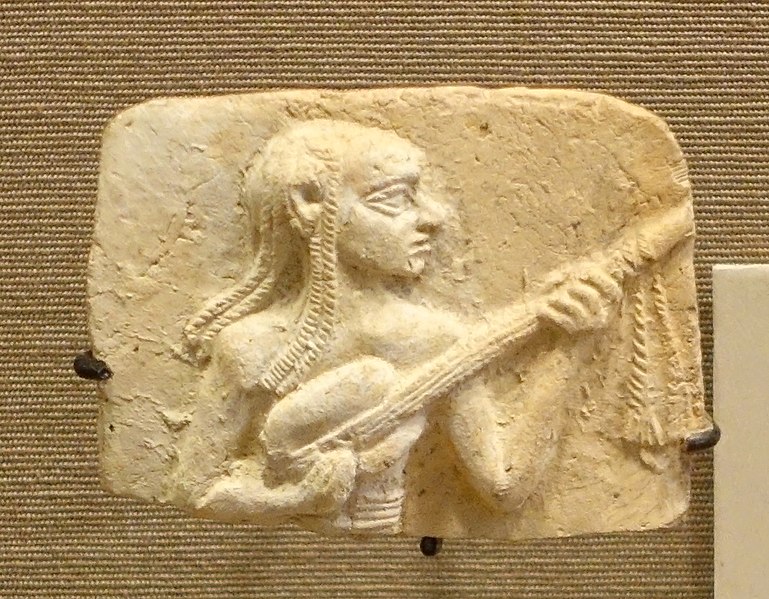
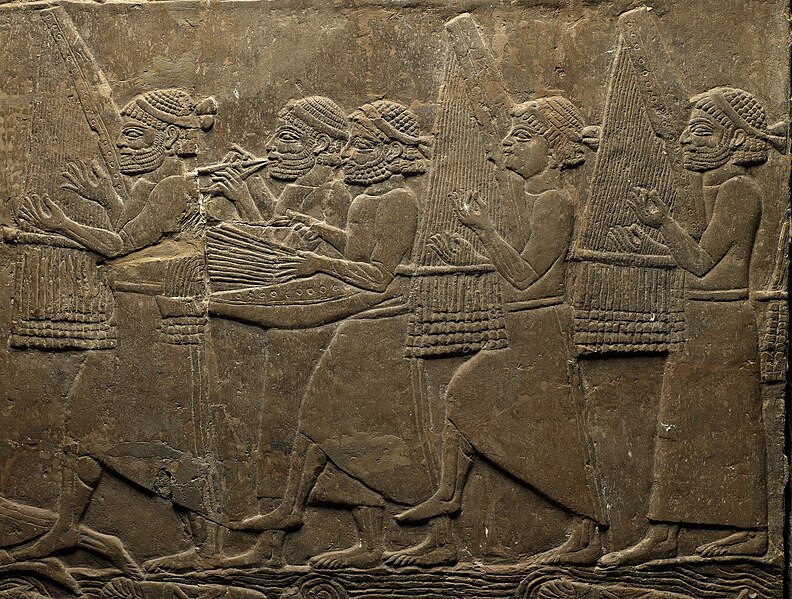
1. Memorial plaque featuring a musician playing a lute, 2000–1600 BCE. 2. Elamite royal orchestra, 660–650 BCE.
Mesopotamian inhabitants primarily played lyres, harps, lutes, drums, and reed flutes. Some of these instruments were considered demigods, leading them to be given proper names. [9]
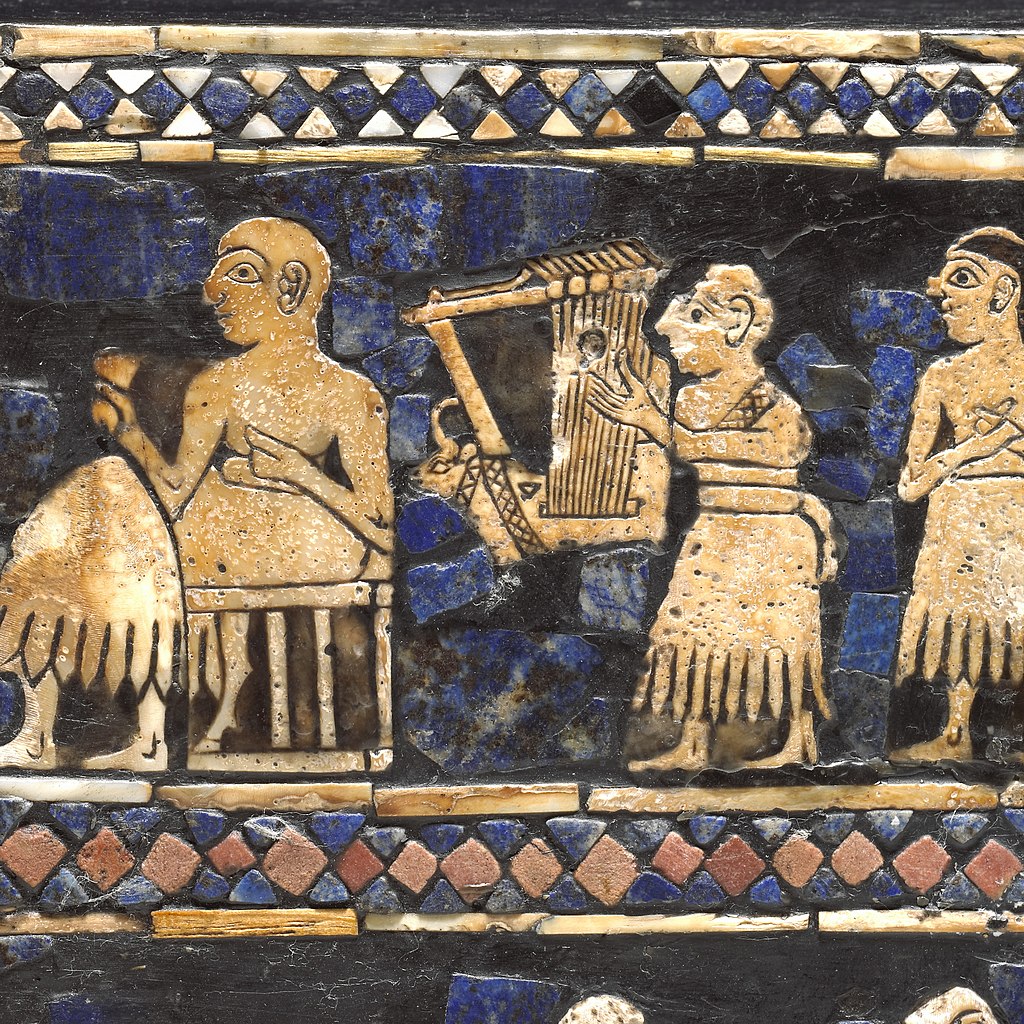
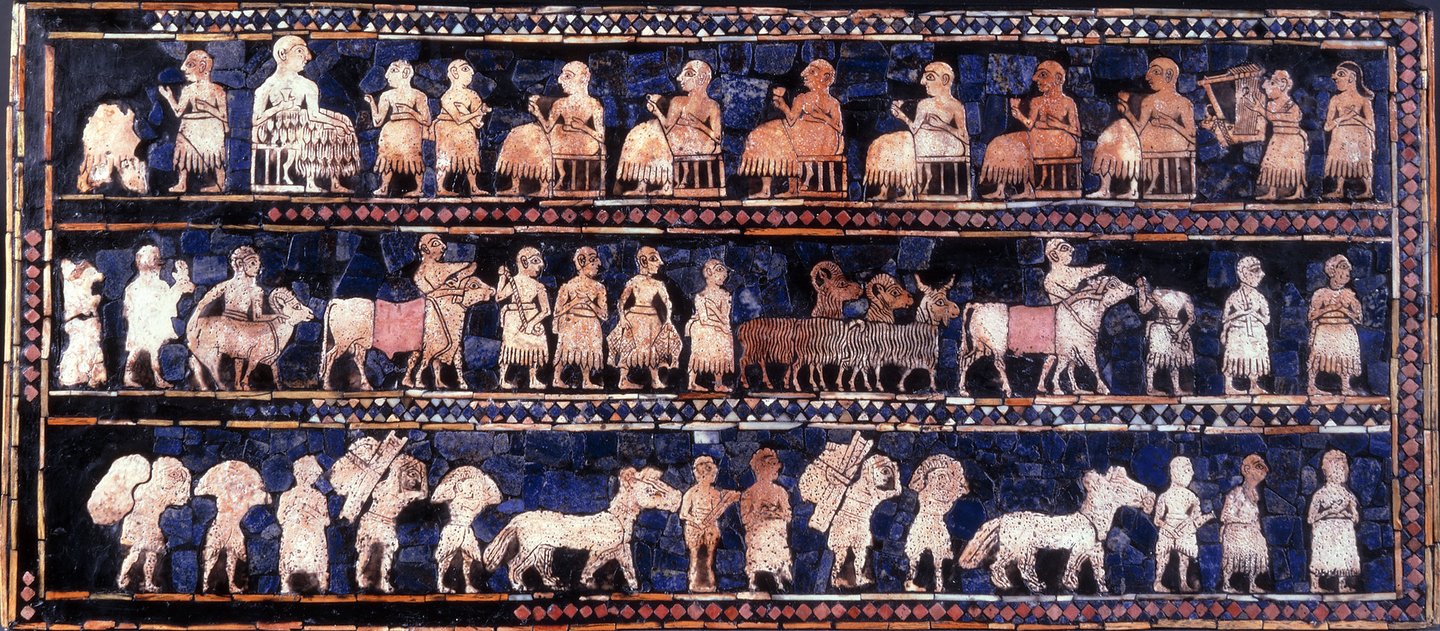
Standard from Uruk. The World. Mosaic, 2600–2400 BCE.
Most of the visual art of that era was dedicated to the ideal of the king’s figure. It can be presumed that by depicting musicians alongside the ruler, people attempted to convey his divine nature. This is related to the fact that some musical instrument names appear in written lists of gods. [9]
Fresco found in the tomb of Nebamun in Thebes, circa 1350 BCE.
In ancient Egypt, the number of depictions featuring female ensembles—singing, dancing, or playing musical instruments—significantly increased. Egyptian women of high social standing served the gods and goddesses at the temples, leading sacred rituals and mastering songs, music, and dance. [7]
Fresco discovered in the tomb of Nebamun in Thebes, circa 1350 BCE.
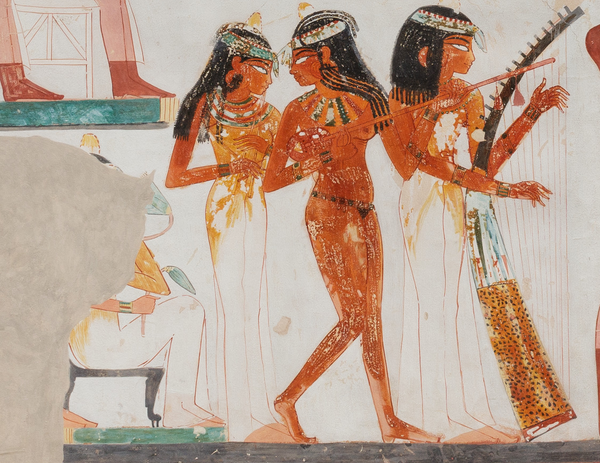
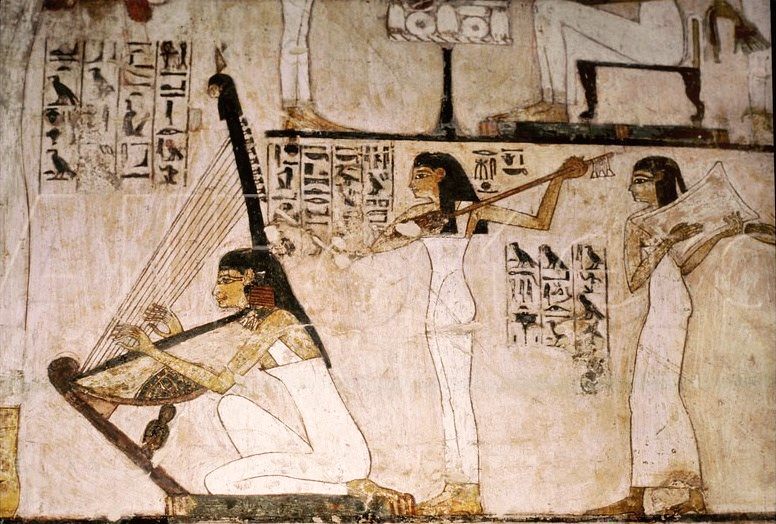
1. Fresco with musicians from Ancient Egypt — a fragment of the painting in the tomb of Nakht in Thebes, 15th century BCE. 2. Fresco from the tomb of the vizier Rekhmire, c. 1832 BCE.
Usually, ensembles are composed of musicians playing different instruments. For performing sacred music, flutes, harps, and tambourines were most often used. To simulate the rustling of papyrus in the wind, sistra and menat were employed.[7]
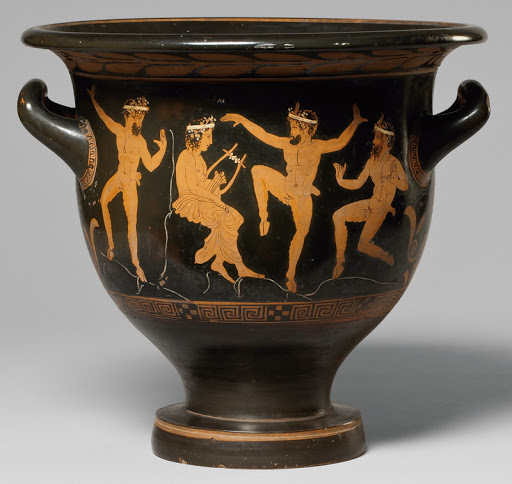
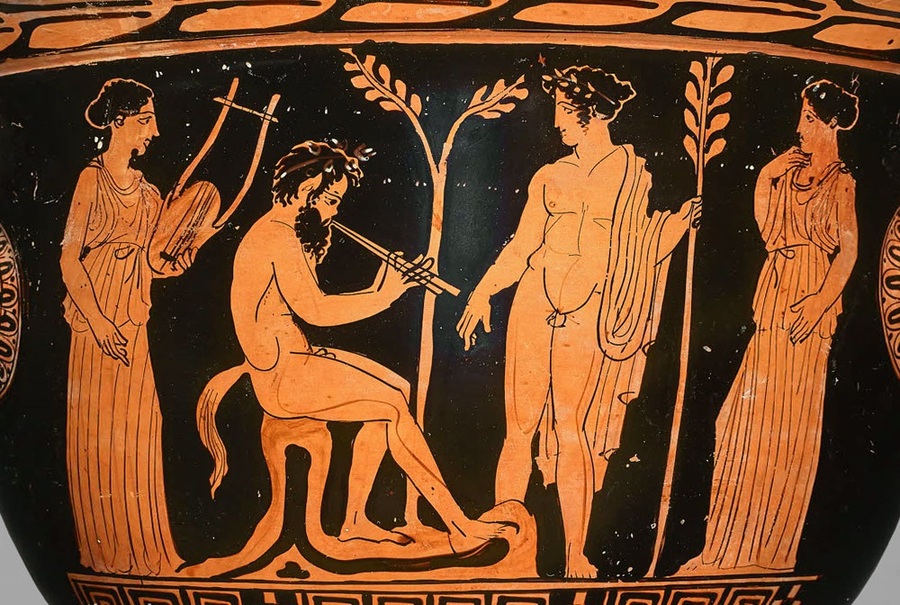
1. Ancient Greek red-figure vase painting. Images of dancers and musicians, c. 530 BCE. 2. Red-figure vase painting of Marsyas, Apollo, and the Muses, 5th century BCE.
The music of Ancient Greece found its reflection in ancient Greek myths, which were inextricably linked to the Greek gods. In surviving imagery, one frequently encounters Mars, Athena, Apollo, as well as satyrs.
Ancient Greek Red-Figure Vase Painting, c. 530 BCE 1. Musician with a lyre 2. Musician playing an aulos 3. Musician with a kithara
Ancient Greek musicians performed melodies on the lyre, aulos, or kithara alone or in small groups.
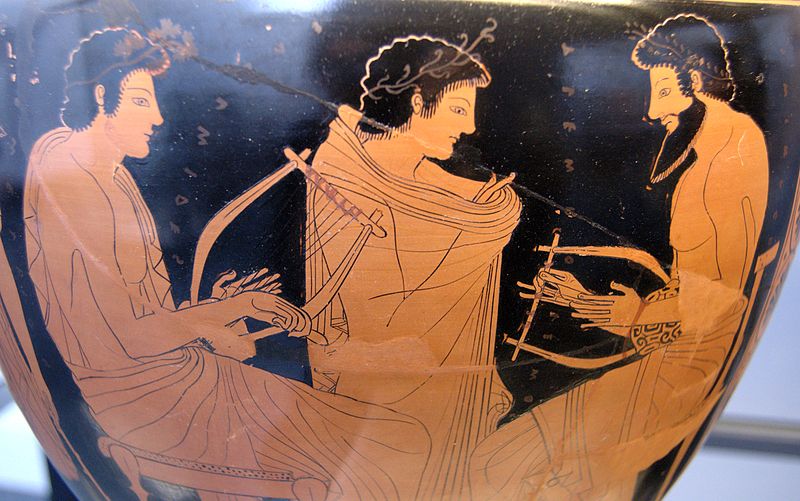
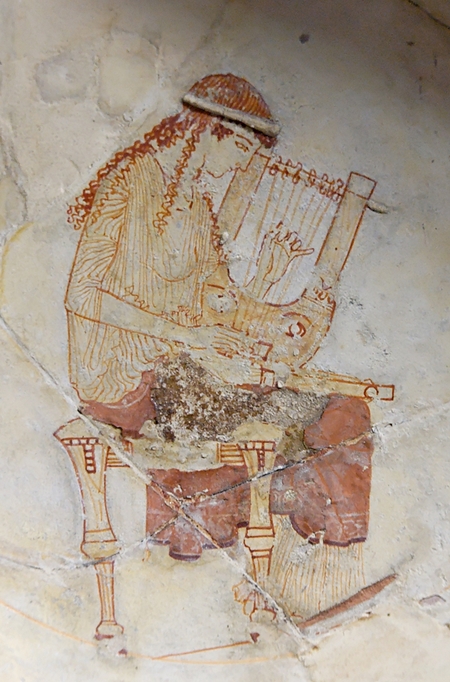
1. Music lesson: a teacher and a student—a boy is telling a story between them. Ancient Greek red-figure vase painting, c. 510 BCE. 2. A Muse tunes two kitharas, c. 470–460 BCE.
Ancient Greek philosophers regarded music as a source of harmony that cultivated moral ideals in humans. [8] As the renowned researcher of ancient culture, A. F. Losev, wrote: «How sensitive the Greeks were to musical mode. They associated each mode with such a specific ethico-aesthetic content that we can still clearly imagine that content today.» [2]
Mosaic depicting tragic and comic theater masks, 2nd century.
It is impossible to imagine ancient Romans without theater, and theater without music. According to art historian E.V. Germsan, music served as a «unifying element» connecting all components of the theatrical performance. [2]
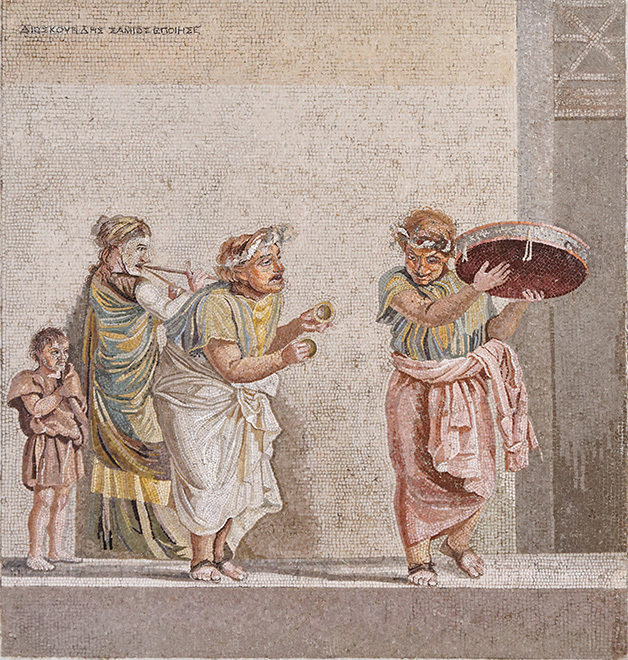
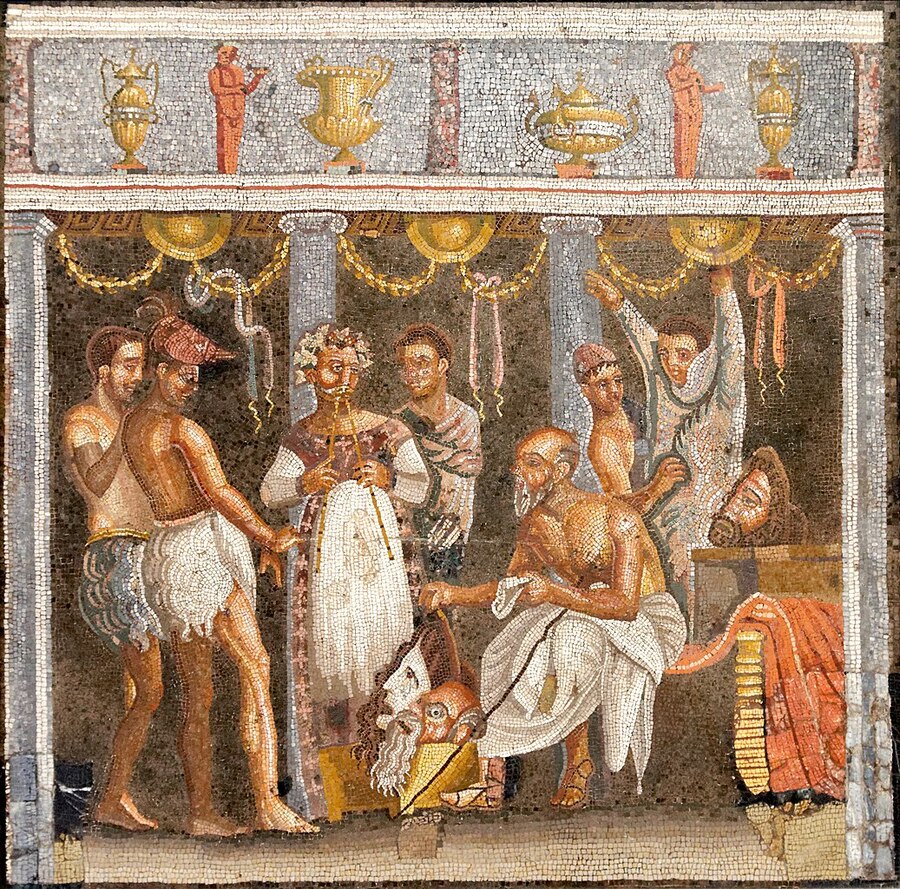
1. The Dioscuri of Samos. Street musicians. The Villa of Cicero in Pompeii, second half of the 2nd century BCE. 2. Roman mosaic depicting actors and aulos players. The House of the Tragic Poet, Pompeii, 69–79 CE.
Ancient Roman mosaics feature actors wearing masks, dancing, and playing musical instruments. The dynamism of the characters conveys the liveliness of theatrical action, while the melody played by the musicians sets the rhythm for the performance.
Christian Art