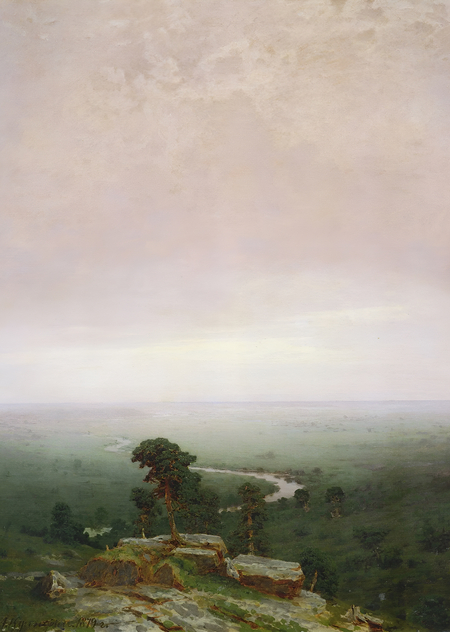
Navigation Menu
- Research Concept
- Image Analysis
- Conclusion
Introduction
Immanuel Kant wrote three Critiques. The Critique of Judgment explains how we evaluate the world through the sensation of pleasure and purposiveness, and it contains both the analytics of the sublime and the analytics of the beautiful, where judgments about the sublime and the beautiful are analyzed.
Kant posited three faculties of judgment: reason, the faculty of judgment, and pure reason. Aesthetics pertains to the second.
Kant divides the sublime into two types: Mathematical and Dynamic: Mathematical is associated with immeasurable magnitude—imagination attempts to grasp the vastness but fails, yet reason contemplates the whole, from which pleasure is born. Dynamic is associated with the power of nature that threatens humanity, yet we remain safe and derive pleasure from witnessing nature. The sublime resides not in the object, but in ourselves.
Kant compares the beautiful with the sublime; the former can be perceived as the complete form of an object, whereas the latter «can be found even in an amorphous object, because it presents infinity, or through it…» The beautiful relates to reason, while the sublime relates to the intellect, which completes infinity as a whole.
Problem
Immanuel Kant writes that the sublime arises from the contemplation of nature, but I feel these same emotions in painting—in human-made art. Can a painting evoke the sublime, and if so, through what mechanism?
Concept
Kant describes the sublime as an experience derived from nature, while Arkhip Kuindzhi paints—that is, art conceived by human intent. Can painting evoke the sublime, and through what means? For the artist, the sublime arises from the artistic techniques I have observed in his paintings: this includes the contrast between light, void, and the absence of large-scale orientation or monumental form. The viewer experiences what Kant described as the imagination encountering the infinite, leading to an ascent of the reason. In Arkhip Kuindzhi’s painting, there is a mathematical sublime, but a dynamic one is hardly observable.
Quindzy evokes a sense of the sublime through picturesque techniques: light contrast, emptiness, and the absence of grand focal points. The viewer experiences what Kant described as the imagination’s confrontation with the infinite and the elevation of reason.
When I first visited the Tretyakov Gallery, I was deeply struck by the paintings of Arkhip Kuindzhi. I couldn’t understand how the artist managed to convey a sense of scale and depth in the canvases, and why I felt as though I was being transported to the landscapes depicted. I wanted to explore this through Kant’s theory—how he conveys the sublime. This reaction became the central question of my research: why does a painting affect my perception so profoundly?
While studying the aesthetics of the sublime in class, I realized that this feeling resembles what Kant described: a bewilderment before something difficult to grasp, followed by an uplift. For this reason, I decided to focus on the paintings of Kyunzhi that evoke this sense.
Iván Kramskoy. «Portrait of Artist Arkhip Ivanovich Kuindzhi» 1872.
Arkhip Ivanovich Kuindzhi was born in Mariupil in 1842. Growing up in a poor family, he developed an early passion for drawing. The artist wished to study under Aivazovsky, but he refused to teach him. Afterward, Arkhip enrolled at the Imperial Academy of Arts in St. Petersburg on his third attempt, where he became acquainted with Repin and Kramskoy and soon joined the group of Peredvizhniki (Wanderers). He gained the greatest fame for his painting, «Moonlit Night on the Dnieper.»
Image Analysis
Arkhip Kuindzhi presented this painting in a dark room and under bright lighting so that the viewer could not see the canvas edges.
Arkhip Ivanovich Kuindzhi. «Moonlit Night on the Dnieper» 1880, 105×144 cm. State Russian Museum, Saint Petersburg
The horizon line on the painting is low, allowing the sky to dominate the large expanse, where a bright moon illuminates the river. In the foreground, there is a settlement by the water. The moon is the light source, and everything glows thanks to the contrast of colors: a cool green light against an almost black canvas.
According to Kant, we perceive the world through sensation, within space and time, and view it as a phenomenon rather than a thing-in-itself. With my eyes, I see spots of light and darkness, but this phenomenon cannot be grasped as a regular object because the river and the sky have no boundaries.
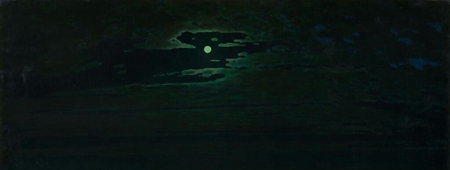
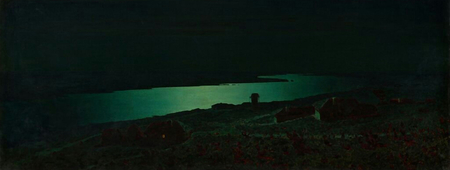
Arkhip Ivanovich Kuindzhi. «Moonlit Night on the Dnieper, ” fragments.
The painting lacks a defined form that can be enclosed wholly; the foreground, middle ground, and background merge into a single space. Imagination attempts to grasp the visible, while the mind demands a whole and perceives it as a unified entity. Before the viewer stands a mathematical sublimity: boundless space, voids, brilliant light—these techniques prevent the viewer from apprehending it by ordinary measure. The bright light on the river has no boundaries, making it impossible to grasp the river with one look, so the mind completes it in its own perception. The painting cannot be fully contained, and it is precisely this that generates the feeling that the narrative continues beyond the canvas.
Arkhip Ivanovich Kuindzhi. «Night» 1900s, 107×169 cm State Russian Museum, Saint Petersburg.
The artist depicted a bright night. The viewer is positioned on a hill’s elevation, where figures of people and grazing horses are shown as a patch of color. In the background, there is a wide river that begins in the lower right corner and stretches toward the horizon, its edges indiscernible. The sky and the river occupy the majority of the canvas, allowing Kuindzhi to create a sense of vast space.
The painting conveys an atmosphere of absolute tranquility, which is transmitted through the endless expanse of the river and the vastness of the sky. The imagination attempts to grasp the entire space, but fails because the boundaries are blurred and the perspective leads into the unknown.
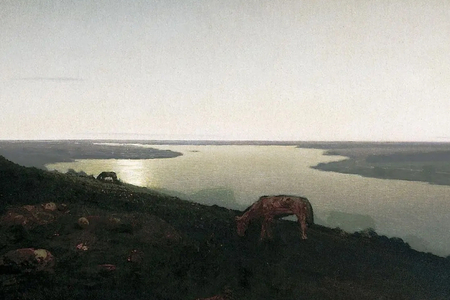
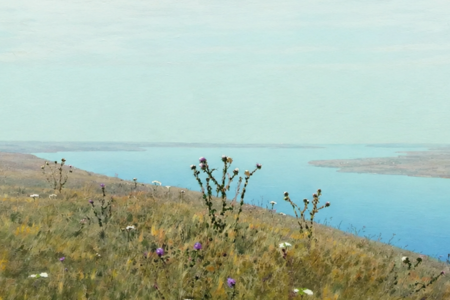
«Night» and «Dnipro,» Arkhip Ivanovich Kuindzhi, fragments.
Archip Cuingji intentionally employs the technique of linear perspective: he leads the river’s course deep into the canvas, such that the viewer cannot see its continuation or end. This creates a sense of infinite space that imagination cannot fully encompass. Kant explains this device through the mathematically sublime: the imagination confronts the impossibility of conceiving space as a complete whole, which prompts the intellect to think boundlessly.
A view from the mountain edge reveals the coastline by the sea. The colors are warm and summery. Most of the painting is rendered in blue, which creates a sense of depth and expanse. The sea dissolves due to aerial perspective, and the light sky and warm hues—contrasting with the vibrant sea—enhance the atmosphere and spaciousness of the painting.
Arkhip Ivanovich Kuindzhi. «Seascape with a Rock» 1900s, 39,3×56.3 cm Vyatka Art Museum named after V. M. and A. M. Vasnetsovykh, Kirov.