This project is a student assignment from the School of Design or a research paper from a School of Design faculty member. This project is not commercial and serves educational purposes.
Concept
Ancient Egyptian art represents a distinct artistic system where depictions of people were created according to specific conventions. Body posture, figure scale, gestures, clothing, and symbolic attributes helped convey not only a person’s appearance but also their social status, occupation, or religious significance.
These features are particularly interesting to examine through the lens of female figures, who held a prominent position in ancient Egyptian painting, sculpture, and reliefs.
Relevance and Research Question
Research Topic: The depiction of women in the art of Ancient Egypt. This topic was chosen because female figures appear in a wide variety of artistic narratives: in domestic and social scenes, festive portrayals, religious compositions, and royal portraits.
However, the nature of the depiction varied depending on the woman’s role. An ordinary Egyptian, a goddess, and a pharaonic woman could all be represented using shared artistic principles, but they differed in posture, attributes, scale, and placement within the composition.
Research Question: How did the image of women evolve in Ancient Egyptian art depending on the status and significance of the depicted character?
Hypothesis and Material Selection
The study is based on the premise that ancient Egyptian artists employed consistent visual conventions to signify different female roles. While spousal intimacy and the harmony of gestures were emphasized in domestic scenes, symbolic attributes took on particular significance in depictions of goddesses. Royal portraits prioritized monumentality, frontality, and insignia of power. In contrast, festive scenes reveal more fluid movements and a greater variety of poses. The works selected for this study are primarily from the New Kingdom period, as this era preserves a large number of tomb paintings, reliefs, and sculptures featuring female figures. Certain pieces from later eras have been included for comparative analysis of stable iconographic types, particularly the representations of goddesses.
Methodology and Objective
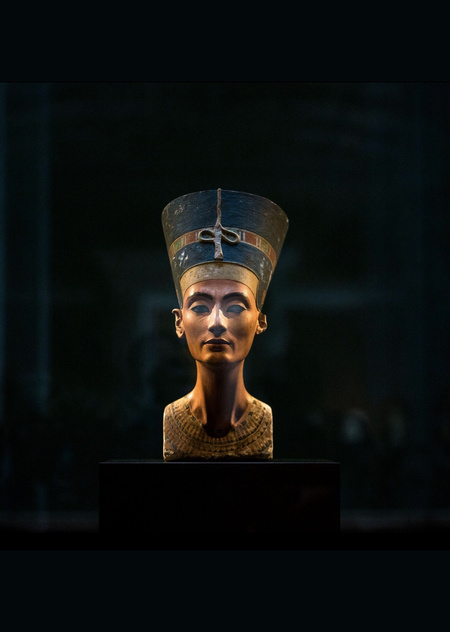
The material is divided into several thematic sections. The first is dedicated to depictions of women in family life and daily existence. The second examines the goddesses Isis, Hathor, and Sekhmet. The third section focuses on musicians and dancers, allowing for the exploration of movement transfer in painting. Following that, the details of the female form are analyzed—hairstyles, clothing, and jewelry. The final section is devoted to images of the female rulers Hatshepsut, Tiye, and Nefertiti.The selection principle for the images is based not only on the historical significance of the works but also on the possibility of visual comparison. The analysis utilizes general views of the pieces alongside magnified fragments, which draw attention to composition, proportions, silhouettes, gestures, facial features, and headdresses.The theoretical framework of this study comprises scholarly publications on ancient Egyptian art, museum catalogs, and works descriptions. The goal of this work is to demonstrate that the image of the woman in ancient Egyptian art was not monolithic: through various artistic solutions, it could convey familial closeness, motherhood, divine power, participation in festivals, or royal authority.
A Woman in Everyday Life
Семья, труд и погребальное искусство
Sennedgem and Yuneferty
Charles Wilkinson. «Sennedgem and Youneferty in the Fields of Yale.» Copy of a 1922 depiction of the Sennegem tomb fresco, 19th dynasty.
The frescoes in the Tomb of Senenjudge depict a married couple in an idealized afterlife. The figures are rendered according to the traditional Egyptian canon: the head and legs are shown in profile, while the shoulders are turned toward the viewer.
The composition is divided into horizontal registers, allowing individual actions to be perceived as parts of a single narrative.
A Married Couple in an Agricultural Scene
Fragment of the Senejem tomb fresco.
The woman is depicted alongside her spouse and is integrated into the overall composition. The positioning of the figures and their shared participation in the action underscore the connection between the characters. In this piece, the female figure is primarily revealed through her role within the family.
Agricultural Scenes
Agricultural Scenes. Detail of the Sennigem Tomb Fresco.
Agricultural scenes hold an important place in the depiction of the afterlife. The artist uses a horizontal arrangement of figures and the repetition of elements to create a sense of order. The surrounding environment becomes part of the idealized space where the couple resides.
Pair Sculpture
A pair of statues: Neferhauer and Rennefer. New Kingdom.
A paired sculpture presents a man and a woman as a unified composition. The figures are positioned closely together, and their poses convey stability and symmetry.
This arrangement emphasizes the familial bond while simultaneously aligning with the traditions of ancient Egyptian sculpture.
Family intimacy
The proximity of the figures and their unification within a single sculptural composition emphasize the familial bond.
Woman in relief
Relief sculpture of a kneeling woman. 18th Dynasty.
In bas-relief images, the positioning of the female figure is often tied to the nature of the action. The pose, the direction of the gaze, and the gestures help us understand her place within the composition. A clear contour makes the figure easily legible, while the limited depth of the relief maintains the image’s two-dimensionality.
Gesture and Pose
The bowed posture conveys an impression of reverence. In ancient Egyptian art, gestures and body positions often communicated the social and religious relationships between characters.