ABOUT THE PROJECT
I did not want to promote my own work using a neural network; this contradicts my views on advertising my pieces and my ethical principles. Furthermore, I did not want to promote old projects that I am dissatisfied with, since I no longer develop them, and my newest piece is not yet finished. I then made the decision: it would be a good option to use a link to a tag on a new portfolio that features work discussing the development of neural networks.
My work is based on the phenomenon of Italian brain-rott animals—primarily because of this phenomenon’s popularity as a meme and its recognition on social media. I also genuinely find them funny, which made the assignment more enjoyable for me.
The article and video, however, direct the viewer/reader to the tag about neural networks on the portfolio via a link.
PROMOTION ANALYTICS
To promote it, I utilized an SEO approach, which yielded partial success: the article on DTF garnered good reach not only in terms of views but also in completion rates, and moreover, it did not receive any negative feedback. However, it is important to clarify that in the final presentation, I supplemented the ChatGPT article with brief personal comments—some rather ironic—which suited the platform.

Statistics on DTF
The situation with the video, however, is far more dismal, even though the title uses the most popular search terms for this type of content: «cute cat AI»

Pinterest statistics (or rather, the lack thereof)
This is largely due to the platform. Pinterest, unfortunately, is not the best platform for promoting video, but among the alternatives, it seemed the most suitable to me.
It is important to understand that this type of video is primarily distributed on platforms that are unavailable in Russia—for example, YouTube or Meta platforms (recognized as terrorist organizations in the Russian Federation), such as Facebook or Instagram. Pinterest was excluded to comply with rules and laws, and to protect my privacy (VK videos are currently very tied to a personal profile).
Conclusion
People definitely preferred the article; at least over 300 people made it to the end. Perhaps the tone of the publication and the human commentary added to its appeal. For the video, it is best to upload it to more suitable platforms (but it is important to check their availability and permissions).
USING AI IN PROMOTION
I opted not to use unpopular neural networks and instead turned to classic tools: I used Chat GPT for writing the article and video script, Leonardo AI to visualize the video content by generating the necessary images, and Hailuo for animation.
It turned out through trial and error that prompts for ChatGPT must be step-by-step: after a standard request to write an article about Italian animal brainrot, it began inventing its own nonexistent, strange characters. This was amusing, but it wasn’t suitable for an experimental article where the neural network writes about another neural network—after all, for the content to be valid, the article needed to be about «real» creatures that had gained popularity online.
Furthermore, ChatGPT was even fabricating names for specific creatures. It became clear then that I needed to incorporate a step-by-step prompt involving web searching and analysis; otherwise, one risks generating chthonic horror descriptions for such monstrous entities. In the case of this topic, the error is obvious, but if I were writing an article about something more real, such fabrication could become a problem.
Weird Characters from ChatGPT (Even Stranger Than the Original)
That is why I created a step-by-step prompt: first, I asked it to analyze the information and write a mini-article, and then, based on that, create an article for DTF.


working prompt introduction
ChatGPT also wrote the script for the mini-video. I asked it to write the script within the same dialogue to preserve the information.
In addition, a video sequence was generated using the AI networks Leonardo AI and Hailuo AI, and the subtitles and voiceover were created by the AI embedded in the CapCut editing program. The developers themselves note this as an AI feature.
VISUALIZATION AND MATERIALS
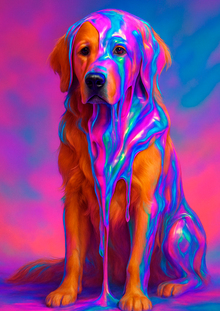
The project cover was also generated in Leonardo AI!