Concept
Traditionally, Gothic stained glass is analyzed through the lens of narrative imagery—figures within medallions that illustrate biblical texts. However, a visual analysis of a 13th-century window reveals a different picture: narratives occupy only a smaller portion of the surface. The primary space of the stained glass is filled with borders, rhombic lattices, ribbon weaving, grisaille patterns, and colored fields. It is the ornamentation, not the narrative, that forms the main visual structure. The selection of this topic stems from the fact that this geometric pattern shares similarities with 20th-century abstract art. The research aims to uncover how the ornamental language of stained glass is structured and what the origins of the phenomenon of «Gothic abstraction» are.The main objective of this research is to study the ornamental language of Gothic stained glass and its role in shaping the visual identity of the church. The paper will trace the evolution of the pattern: from early stages at the Abbey of Saint-Denis (1140s) to the mature monuments of the 13th century (Saint-Chapelle, Chartres, Bourges).
The core concept of the project is that «Gothic abstraction» is not merely decorative ornamentation, but a deliberate construction. The ornament proved to be the sole tool capable of simultaneously solving three critical problems. First, it allowed a sufficient amount of light to pass through the massive openings. Second, it unified hundreds of disparate narrative motifs into a single, legible whole. And third, it transformed color and rhythm into the primary visual effect of the cathedral.
The key research question is: how and why did the ornament, over the course of a single century, evolve from a modest frame around an image to an autonomous structure that holds the entire window together?
Hypothesis: The ornamentation in stained glass was not merely decoration, but the core structure. It simultaneously served three functions: allowing light transmission, unifying the narrative elements into a coherent whole, and creating the principal visual impact of the cathedral.
Origins: Saint-Denis
The history of stained glass, in the form that shaped the appearance of Gothic cathedrals, begins at the Abbey of Saint-Denis near Paris. In the 1140s, Abbot Suger rebuilt the eastern part of the church so that the massive wall almost disappeared, replaced by rows of large windows. Suger described this effect as «divine and continuous light”—the entire architecture there was subservient to light. It is notable that even in this early period, the window is held together not by narrative scenes, but by geometry—borders and medallion grids. It is this structural logic that finds its full development in stained glass.
Interior of the choir of Saint-Denis Basilica, Paris
Material and Technique
The technique for creating stained glass is documented in the treatise of the monk Theophilus (12th century). Glass was made with metal additions: cobalt yielded blue, copper yielded red, and manganese yielded violet. The finished sheets were cut into pieces and joined with lead cames. The key characteristic of this technique is that the line in the stained glass is always dual: it is formed both by black paint (enameling on glass) and by the lead itself. The lead came simultaneously acts as a contour, a seam, and a load-bearing structure. Because of this, the window pattern is not «drawn,» but physically assembled from individual elements.
Leaded stained glass window tracery without glass. France, 13th century.
Stained glass fragment with botanical ornamentation (grisaille technique). Montfort Castle, 1220–1272.
Medallion
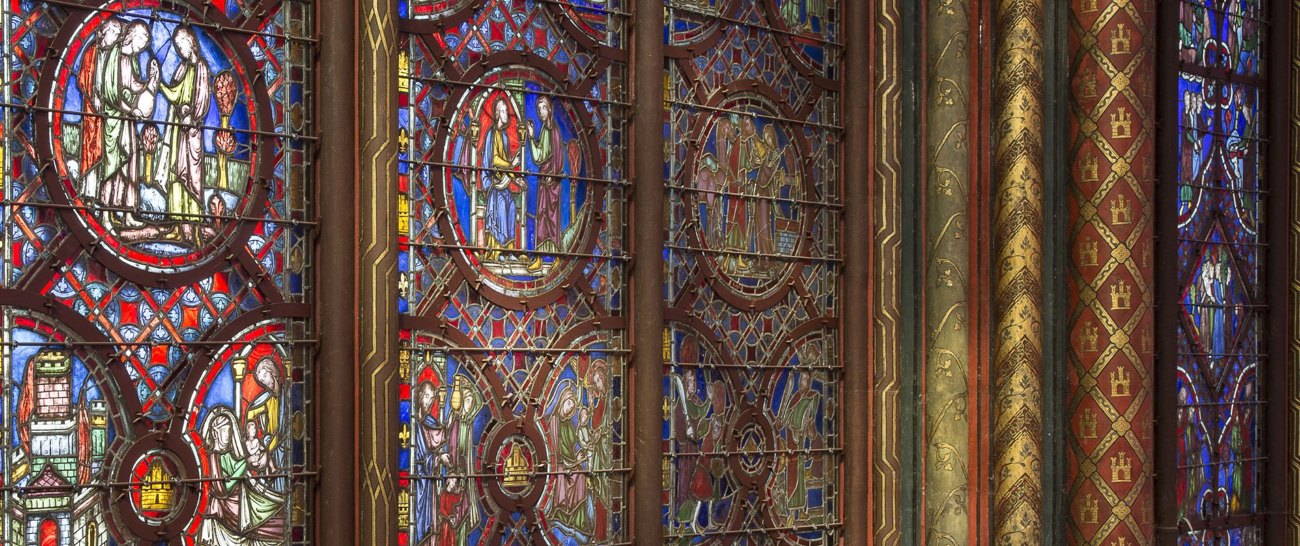
The medallion is the primary structural module of the stained glass. The circular seal is placed within a frame border, adjacent seals form a grid, and the spaces between them are filled with a carpet pattern. In the lower windows of Chartres, the number of such medallions can reach twenty to thirty per window. What is fundamentally important here is that the circle dictates the composition of the scene, not the other way around—the figure must adapt to the predetermined shape.
Ornamental rondel. Glass, vitreous paint
There are both narrative medallions and purely ornamental roundels, in which the border and geometric pattern become an independent work of art.
Rose window with a wedding scene from Saint-Chapelle, Paris, 1243–1248. Victoria and Albert Museum, London.
Image of the stained-glass panel «Scene from the Life of Daniel, ” Paris, 1243–1248
«Saint Stephen Preaches”—a medieval stained-glass medallion, circa 1260–1280, Lower Rhine, Germany
Caiman: a frame that became a pattern
The border acts as the most compact example of stained glass ornamentation. It runs along the top edge of the window, moving downward, and repeats multiple times, functioning like a visual metronome: it sets the rhythm and separates the narrative from the stone masonry.
Stained glass border with leaves and palmettes — Canterbury Cathedral, c. 1200–1220
Fragment of a stained-glass border with foliate ornamentation. Canterbury Cathedral, England, c. 1200–1220.
In England during the early 13th century (Canterbury), a distinct type of border emerged, which can be called carpet-like: a continuous ribbon of palmettes or lilies under small arches, accented with colored «beads» at the junctions. In France, the border is noticeably wider, and the foliage sprigs are denser. Notably, achieving this effect required minimal resources from the artisan: two colors, one motif, and repetition.
Fragment of stained-glass border with leaf ornament. England, Early Gothic, c. 13th century.
Grayscale: a pattern of light
By the mid-13th century, grisaille began to proliferate in stained glass art—a painting technique using black pigment on nearly colorless glass. The windows became lighter and less expensive to produce, and their visual effect acquired a unique, silvery, pearlescent glow.
The most famous example is the Five Sisters window in York, which is composed of approximately one hundred thousand pieces of glass forming an almost seamless geometric grid.
«Five Sisters» Window, York Minster, England, c. 1250. Early Gothic Stained Glass: colored and translucent glass, non-figural subject matter.
Grisaille can be viewed as a triumph of ornament itself: the pattern frames nothing else; it becomes the entire stained glass. The development of this direction shows a clear dynamic: from early English geometric grisaille through French panels of the 1240–1270s to later panels featuring aconite leaves.