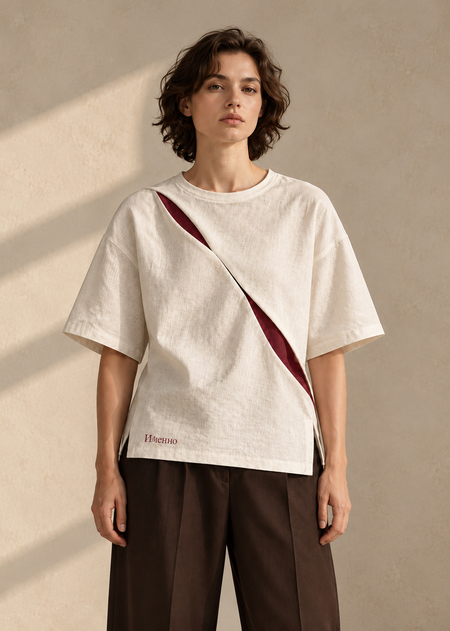
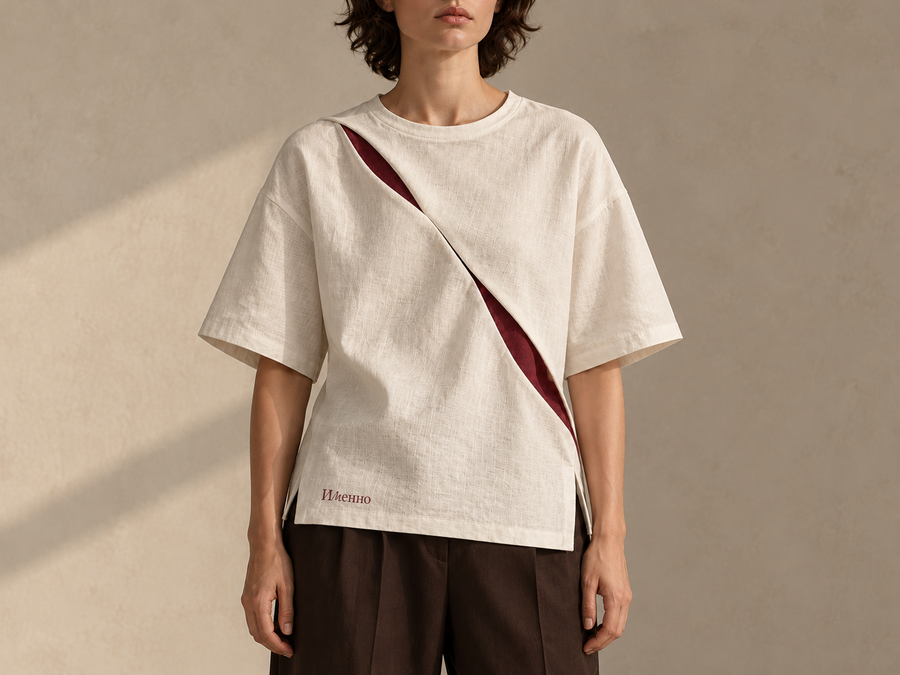
«Imeno» is a personal gift selection service. For its merchandise, I proposed a T-shirt that conveys the brand’s concept not through a large print, but through the construction of the garment itself. A milky overlay runs from the wearer’s right shoulder to the left side, revealing two fragments of a burgundy lining. The strap transforms from a graphic symbol into a dimensional textile detail.
Feed instead of print
The core of «Imeno» is attention to the individual: a gift as a way of saying, «I noticed you.» In the service logo, a gift ribbon is integrated into the letter «m.» On the T-shirt, I translated this motif into the construction: burgundy fabric emerges from beneath a milky overlay, resembling a ribbon unwrapping a package.
The color palette continues the brand’s identity: warm milky white and deep burgundy. A small logo is placed along the bottom edge as a signature, while the diagonal line becomes the main element.
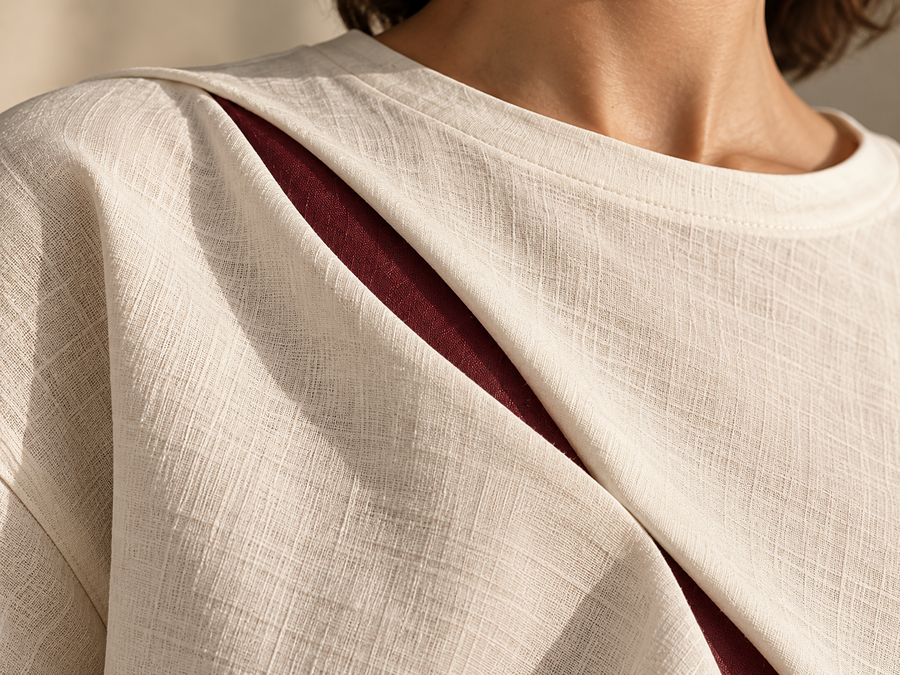
Linen texture and a contrasting underlayer beneath the finished edge of the overlay
Calm silhouette
The loose silhouette, dropped shoulder, and wide short sleeves support an expressive upper body construction. The round neckline and solid back, devoid of extra graphics, maintain the feel of a casual piece. The back is slightly longer than the front, and there are slits along the sides.
Proportion and Material
For the base, a matte 100% linen with a canvas weave and a density of 180–210 g/m² is proposed. For the lining, a burgundy 100% linen of the same or slightly lower density is suggested.
Linen was chosen for its noticeable weave and natural draping. The specific fabric still needs to be tested for shrinkage, opacity, and the transfer of the burgundy dye onto the milk-white base. The volume of the sleeves and the side slits also need to be checked on a physical mock-up while in motion.
Sleeve volume, side seam, and the difference in front and back torso length
Project Parameters
Development Size — M0: a designation for the first sample pattern, not the commercial size M. The measurements indicate the intended dimensions of the finished product after wet-heat treatment and require verification using the sample pattern.
— Chest width laid flat — 60 cm.
— Hem width — 61 cm.
— Front length from the highest point of the shoulder to the neckline — 66 cm.
— Back length — 67.5 cm.
— Shoulder width across the back — 56 cm.
— Sleeve length from the top — 24 cm.
— Side seam — 11 cm on the front and 12.5 cm on the back, with a common top point.
— Maximum finished width of the burgundy backing patch — 8 cm. The 8 cm wide logo is positioned at the bottom right of the front panel, viewed from the wearer’s perspective. The edge of the sign closest to the side seam is 4.5 cm away from it; the bottom edge is 3.5 cm away from the finished front hem.
Preliminary M0 measures. The technical diagram is not a pattern.
How the front end is structured
The piece consists of three elements: a solid milk-colored base, a figured burgundy backing, and a separate milk-colored overlay. The base completely covers the body. The overlay is fastened at the right shoulder seam and the left side seam of the wearer; its free edge is finished with a facings. Two visible burgundy sections are separated by a closed gap. The form, placement, and volume of the pleat will be refined on the mannequin.
Base, contrasting backing, and a milky overlay. Schematic assembly diagram, non-cut components.
How the fabrication is planned
First, you need to select the fabrics and check for shrinkage and colorfastness. Next, you will develop the patterns and assemble a sample mockup to fine-tune the fit, the diagonal layout, and the headhole clearance.
After the fitting is approved, the pieces are cut along the grainline; the side seams are cut on the bias—only the neckline facing. The edges of the facing and appliqué are finished, and the burgundy windows are shaped. Then, the shoulders, neckline, sleeves, and side seams are assembled, and the slits and hems are finalized. If necessary, a hidden fastener is incorporated into the left shoulder seam.
For the logo, a single-color DTG application using the original vector graphic is proposed. This technique must be confirmed through a test print on the selected textured linen.
Current Stage
A concept, six AI mockups, technical drawings, layer diagrams, preliminary measurements, and assembly instructions have been prepared. A physical sample, working patterns, and size grading are not yet available.
The next stage involves agreeing on the tailoring format, selecting specific fabrics, and producing the prototype. The materials list still needs the suppliers, SKUs, purchase links, confirmed usage, and estimated cost per unit. This data has not yet been determined.
Visualization of a daily scenario and garment draping while seated
Materials for Transfer
The complete technical package includes a PDF description, two vector technical sheets with PNG previews, a preliminary specification, and the original logo with a mockup application option. Working patterns and the confirmed materials list will be added after the layout design is developed.