Research Concept. Rationale for Topic Selection
The choice of topic is motivated by an interest in how the same event can be rendered in different artistic ways across various cultural traditions. The scene of the Crucifixion remained one of the most significant subjects in Christian art throughout the Middle Ages. Yet, while addressing the same event, artists conveyed Christ’s suffering in diverse ways. The body’s posture, the angle of the head, facial expressions, the depiction of wounds, the gestures of surrounding characters, color, and composition all influenced the emotional reception of the work. A particular interest lies in comparing Byzantine and Italian painting from the 13th and 14th centuries. During this period, Italian masters continued to draw upon the Byzantine artistic tradition while simultaneously developing new ways to represent the human body and human experience. Therefore, this research focuses not only on the differences between the two traditions but also on how they interacted and influenced one another.
Research Concept. Material Selection
The chronological scope of this research spans the 13th–14th centuries. This period allows for tracing the coexistence of established medieval iconographic schemes and innovative artistic solutions. The primary source material for this study consists of painting: icons, frescoes, and painted crucifixes from Byzantine and Italian traditions. The central theme is the Crucifixion. Works depicting the Lamentation and other episodes of the Passion of Christ are used only as supplementary material if they help illuminate the specific depiction of grief and physical suffering. When selecting pieces, we take into account their dating, attribution, provenance, and the possibility of detailed visual analysis. Not only the renown of the monument but also its artistic characteristics are important—the rendering of Christ’s body, the depiction of wounds, facial expressions, character gestures, and compositional organization. Special attention is given to works that noticeably integrate Byzantine and Western European artistic techniques.
Research Concept. Structure and Sources
The research progresses from the analysis of individual artworks to their comparison. First, Byzantine monuments are examined, followed by Italian ones. Subsequently, a comparative analysis of the artistic techniques of the two traditions is conducted. Each artwork is considered an independent visual source. The analysis begins with the overall compositional solution and then moves to the details: the positioning of Christ’s body, facial expression, depiction of wounds, gestures of the surrounding figures, color, and space. Textual sources are selected based on their reliability and direct relevance to the monuments under study. The foundation consists of museum catalogs, scholarly publications, and research on the history of Byzantine and Italian painting. Priority is given to materials that allow for the verification of authorship or attribution, dating, provenance, and the specific iconographic features of the works. Information from various sources is cross-referenced. Disputed attributions and approximate dates are indicated with caution. Textual commentary supplements the visual analysis, helping to clarify the context and substantiate observations.
The visual sequence includes reproductions of complete works, enlarged fragments, and comparative compositions. Each image is accompanied by a caption specifying the artist or attribution, the title, date, and collection, if such information is established. Image sources are recorded separately.
Research Question
How did Byzantine and Italian artists of the 13th–14th centuries convey Christ’s physical suffering in Crucifixion scenes using artistic means, and how did these means affect the emotional perception of the image?
Hypothesis
It is suggested that in Byzantine painting, the image of the suffering Christ is more often constructed upon established iconographic schemes, symbolic expressiveness, and conventional body interpretation. In Italian painting of the 13th–14th centuries, attention gradually shifts toward the physical weight of the body, anatomy, and the emotional reactions of surrounding characters. Italian artists, however, do not abandon the Byzantine legacy; rather, they reinterpret it by combining traditional solutions with new ways of conveying human experience.
Byzantine Painting
Byzantine painting of the 13th–14th centuries preserves established iconographic principles for depicting the Crucifixion. The composition is subordinate to the religious meaning of the scene, and expressiveness is created through the positioning of figures, gestures, color, body representation, and symbolic details. This section will examine works that allow us to trace how Byzantine masters created the image of the suffering Christ.
«Crucifixion.» Constantinople Workshop
«The Crucifixion.» Constantinople Workshop, 14th century. Byzantine and Christian Museum, Athens. Inventory Number ΒΧΜ 01354.
Two-sided icon: one side depicts the Crucifixion, and the other shows the Mother of God with the infant. The work is interesting as an example of Palaeologan period painting. Its unusual iconography combines elements from earlier artistic models with the specific characteristics of 14th-century Byzantine painting.
Details of the «Crucifixion» Icon
At the center of the composition is Christ, crucified on the cross. The Virgin Mary and John are positioned on either side of him.
When analyzing the work, it is important to pay attention to the posture of Christ’s body, the tilt of his head, and the relationship between the central figure and the surrounding characters.
The figures are characterized by their slender forms and restrained expressiveness. Sorrow is conveyed not only through facial expressions but also through the overall plasticity and positioning of the characters.
The composition maintains a clear hierarchy: the figure of Christ remains the primary semantic and visual focus of the image.
Embodiment and Symbolism
In Byzantine painting, the depiction of the suffering Christ is subservient not only to the task of conveying physical pain but also to revealing the religious meaning of the sacrifice. The posture of the body, the tilt of the head, and the surrounding symbolic elements form a unified image of the Crucifixion. Physical suffering becomes part of a broader narrative of death and redemption.
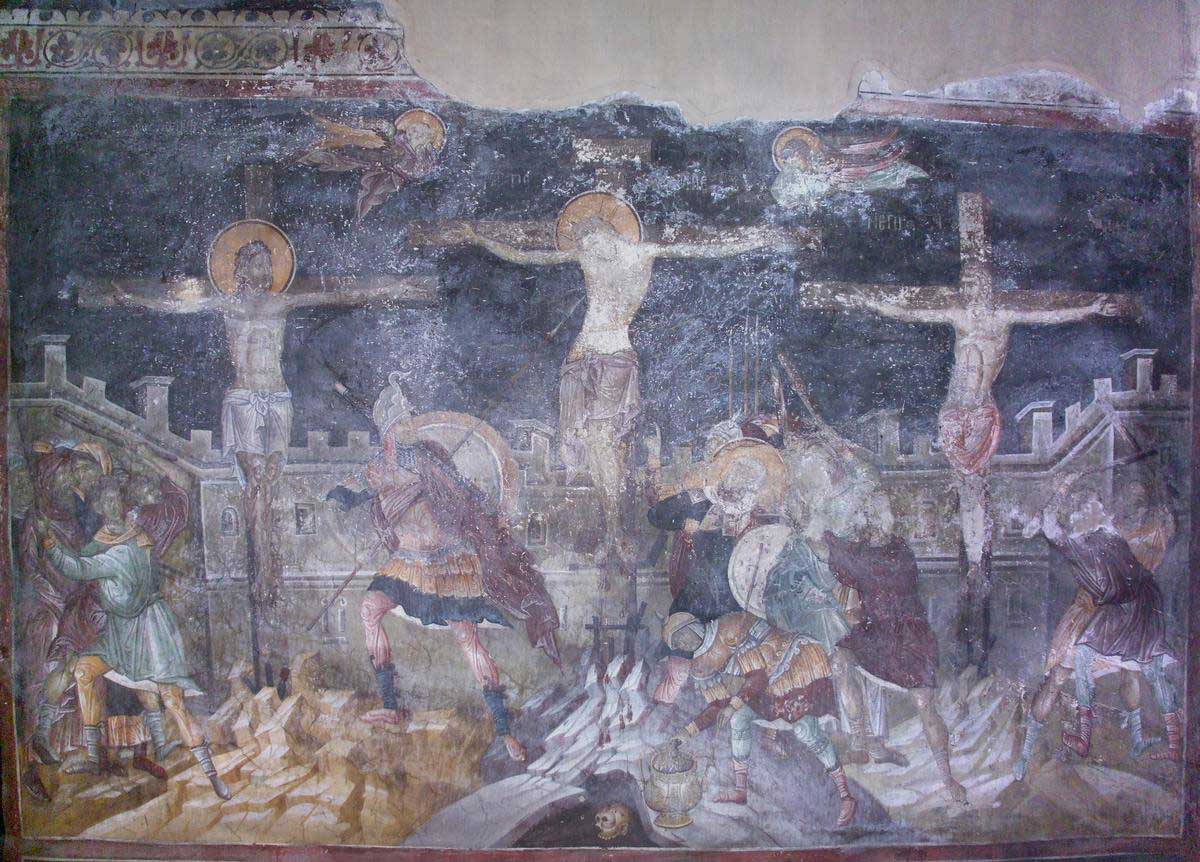
Frescoes of the Vysokie Dechany Monastery
«The Crucifixion.» Fresco painting from the Vysokiye Dechany Monastery, 14th century. Vysokiye Dechany Monastery, Kosovo.
The monumental mural painting of the monastery presents a large cycle of religious imagery. It combines Byzantine and Serbian artistic characteristics. This monument expands the research material and allows for an examination of the Crucifixion within the context of the entire church complex.
Fresco of the Crucifixion in the Grachanitsa Monastery
«The Crucifixion.» Fresco painting at the Grachanica Monastery, circa 1321–1322. Grachanica Monastery, Kosovo.
The fresco cycle of the monastery dates to the early 14th century and represents an important monument of Serbian medieval painting. In the Crucifixion scene, one can analyze how the composition organizes the relationships between the central figure of Christ and the surrounding characters. The inclusion of the scene within the broader fresco ensemble of the church also plays a vital role.
Interim Observation: Byzantine Tradition
The works examined demonstrate that the Byzantine tradition is not limited to a single depiction of the Crucifixion. The icons and frescoes vary in scale, spatial organization, and the character of the painting style, yet they maintain a recognizable iconographic foundation. For further comparison, it is important to consider not only the differences between Byzantium and Italy but also the diversity within each tradition.
Italian Painting