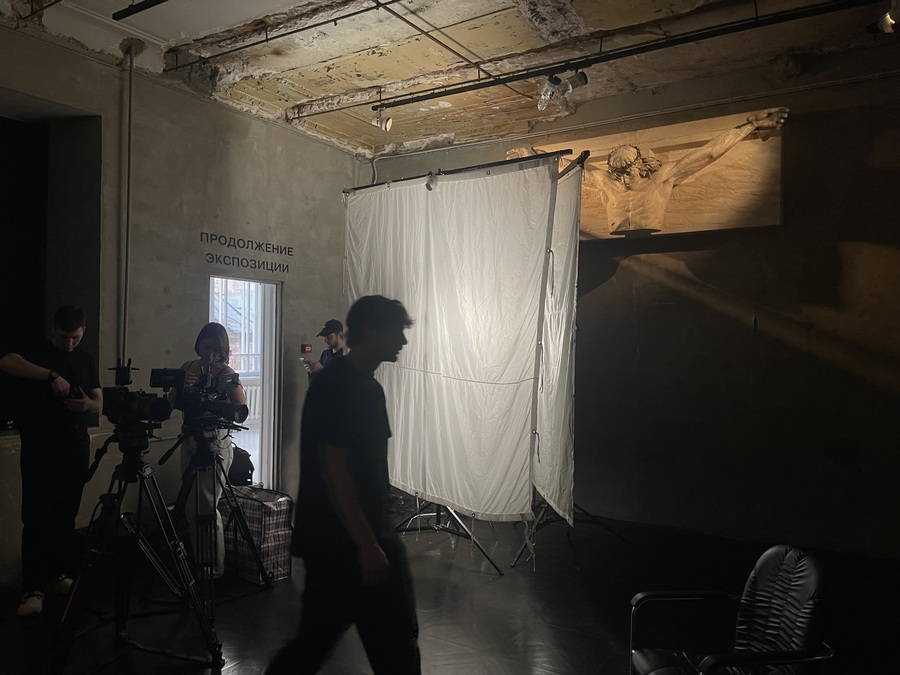
For comparison, I selected the exhibitions «This is Everything» at the Solyanka Gallery and «Sacred and Radical. The Red Thread of Russian Art» at the Atrium Exhibition Hall of the Kolomenskoye Museum-Reserve. Both exhibitions focus on the reinterpretation of Christianity and iconographic art and their connection to more modern trends, but this theme is explored differently in each one.

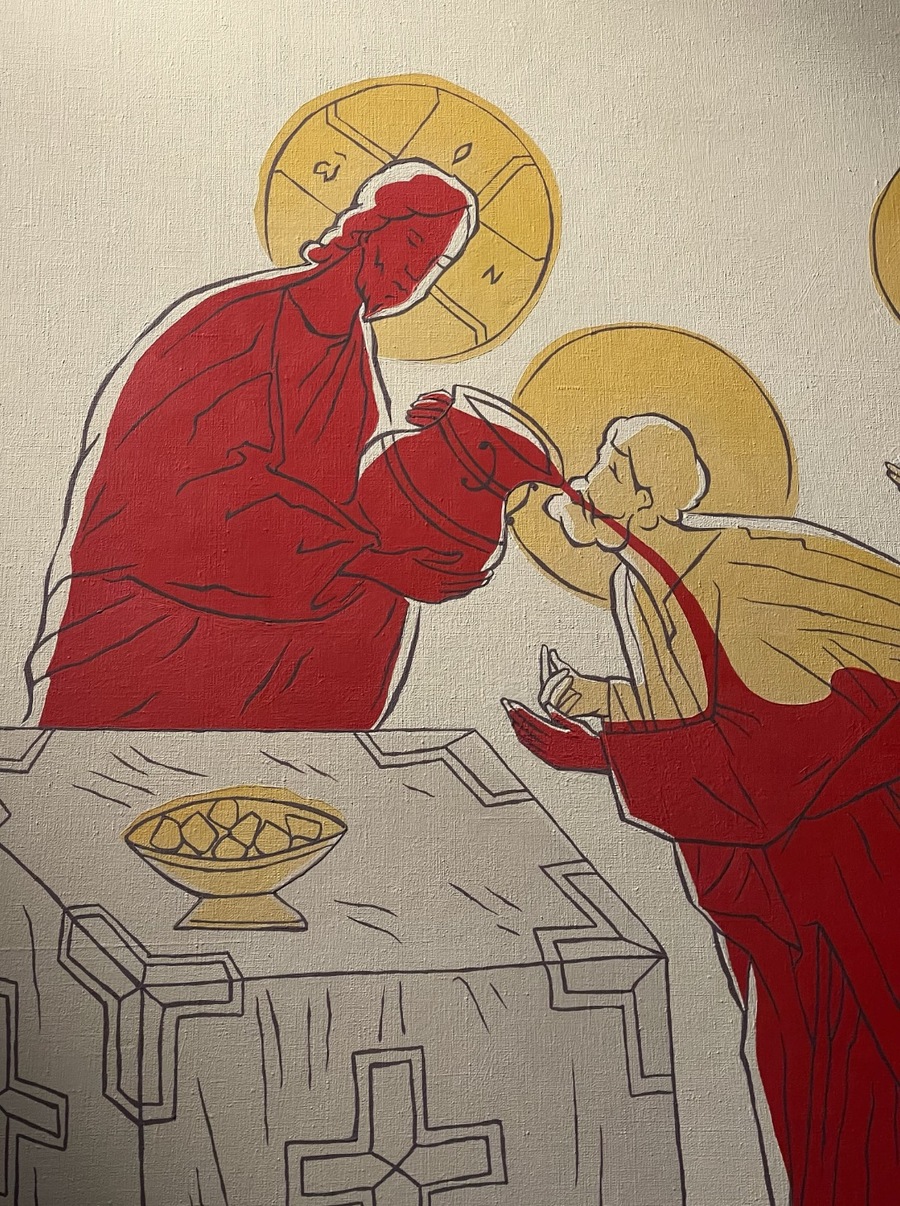
«This is All» (September 18 — October 25) is an exhibition summarizing the «After the Icon» project, curated by Anton Belikov, Emilia Kurilova, Victoria Zabolonkova, and Maria Zhigun. It is dedicated to contemporary Christian art—a phenomenon that emerged alongside the project about ten years ago. One of the key principles guiding the artists who participated in the project is: «Adhering to traditions, we do not create copies.» According to curator Anton Belikov: the project aimed to show that «spiritual quests do not end when God died» and that many people still hold Christian faith. The theme of Orthodoxy here exists not separate from modernity, but within it. The exhibition website emphasizes: «The exposition unites works created in a wide range of techniques and media: painting, graphics, tempera, ceramics, sculpture, embroidery, objects, and installations, print and digital graphics, and video.» The project’s authors point to the deep connection between the artists and their language, drawing parallels with both Rublev, Malevich, and Kandinsky.
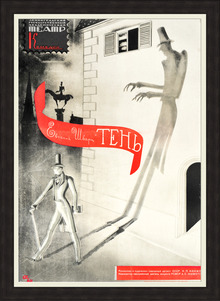
«The Sacred and the Radical: A Red Thread in Russian Art» (May 15 — October 18) explores the comparison between ancient Rus' painting, newly rediscovered in the 20th century, and the works of avant-garde artists such as Larionov, Goncharova, Malevich, Eisenstein, and others. The exhibition was curated by Irina Rodionova and Anastasia Khristenko. The title references a work featured at the beginning of the exhibition: the Mother of God in the icon «The Annunciation, ” who weaves a red thread. This image also holds symbolic significance: the exhibition is structured using a diptych format for clear comparison, and the curators argue that the link between the aesthetics and artistic techniques of icon painting and avant-garde works reflects the „red thread“ running through all Russian art. Furthermore, both ancient Russian art and the avant-garde suffered from neglect and repression during the Soviet period. However, according to an article about the exhibition on the website of The Art Newspaper Russia, the exhibition authors only superficially address the ideological and symbolic aspects of this connection, focusing mainly on the visual link.
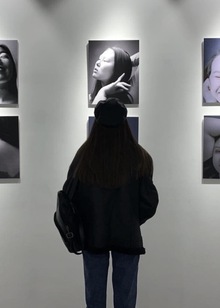
The works featured in the exhibition are displayed throughout the Solyanka gallery space. On the upper floor, paintings and sculptures are exhibited in the halls, while video art is also presented on the ground floor alongside these genres. On the lower floor, music plays in the rooms situated on various sides of the corridor, enhancing the atmosphere. The impact on viewers' auditory as well as visual perception is a deliberate technique that deepens the exhibition experience. The walls were not painted specifically for this exhibition. Nevertheless, the red, black, and white colors, along with the uneven surface framing the works, align with the aesthetic and concept of the show. Furthermore, the artwork is intelligently integrated into the gallery space. The lighting in the halls is predominantly diffused and warm, with some instances of direct light used to draw attention to specific paintings or objects. Some halls maintain a more darkened ambiance. The illumination complements the mood of the exhibition and does not cause discomfort.
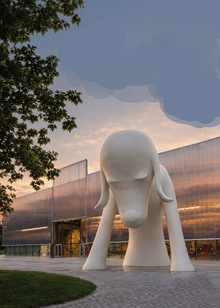
In the «Atrium» exhibition hall of the Kolomenskoye Nature Reserve, temporary installations consisting of purple walls and wooden structures were erected for the exhibition. The artworks are displayed on these walls and installations. The combination of purple and yellow chosen for the exhibition’s design has no symbolic meaning and is not thematically related to the exhibit’s subject matter. The lighting is cold and mostly direct, which creates glare on the glass panels housing some of the pieces. A frame from Eisenstein’s film «Ivan the Terrible» and a projection of the icon «Blessed is the host of the Heavenly King…» are presented in poor quality—the images drift outside the screen boundaries, appearing neither symmetrical nor level.
The curator’s text is presented as an explication at the entrance to the first exhibition zone. It is accessible to viewers and is not overloaded with ecclesiastical or art-historical jargon. It can also be said that the text is metaphorical. According to it, the goal of the «After the Icon» project is not merely to show the contemporary relevance of Christianity, but to create a space for sacredness and preaching as a shared spiritual experience. The work with labels is standard—next to the objects, black labels display the artwork’s title and artist. There is no formal navigation through the exhibition because the curators’ aim was not to guide a narrative, but rather to present the culmination of works by contemporary artists reflecting on the theme of Christianity.